24.2K
Downloads
277
Episodes
Life Talk is a podcast intentionally designed to enrich your life, deepen your marriage, enhance your parenting, maximize your work life, and dramatically embolden this journey that we call life.
Episodes

Aug 21, 2025
Aug 21, 2025
4 min
“The most critical time in any battle is not when I’m fatigued, it’s when I no longer care.”
Too often we don’t care, or that’s what we tell ourselves. We work really hard not to care because we’ve figured out that caring is just too risky, in whatever way it happens to be too risky for us. We get the idea in our head that ‘not’ caring is just easier, because we don’t care. Or it’s safer, because we don’t care. We’re not in a position to get hurt, because we don’t care. If things don’t go our way it doesn’t matter, because we don’t care. If something or someone fails us, there’s no loss to us because we don’t care. And this whole mindset of not caring is not about not caring at all. It’s about protecting ourselves from the pain that we fear we’ll experience if we do care.
But, by assuming this self-protective position, we’re doing something that we may not be thinking about at all. We’re retreating. Basically, we’re retreating from any situations that have caused us pain before, or from situations that we feel will cause us pain if we deal with them.
And in all that retreating, maybe there’s a stance that we should have taken, or some action that we should have engaged in, or some decision that we should have stood in opposition to or in support of. But we don’t. We don’t. Instead, we retreat. And we retreat because we’ve worked real hard to convince ourselves that we don’t care, and we’ve done that so that we won’t get hurt. And therefore, the battle that maybe should have been ours, or the battle that we should have contributed to, or the battle that was critical for us or someone else is fought without us being in it. Or worse yet, maybe it never got fought at all because we didn’t show up to fight it. And the loss that we incur, however we incurred it, is likely to cause a level of pain far, far greater than the pain that we were working to avoid feeling in the first place.
And in the end, there’s a good chance that we’ll end up caring that we didn’t care. And because we end up caring that we didn’t care, we’ll create a battle in the last place that we ever want to fight one…and that’s within ourselves.

Aug 19, 2025
Aug 19, 2025
9 min
Betrayal Is the Manifestation of Someone’s Greed, Not a Commentary of Our Worth
“After saying these things, Jesus was troubled in his spirit, and testified, ‘Truly, truly, I say to you, one of you will betray me.’”
John 13:21
Here’s the Thought for Today:
Betrayal is intentional…ruthlessly so. It is the deliberate choice of someone to hold their interests as so superior to our well-being that the cost of crushing us in order to advance their agendas is deemed as entirely reasonable and indisputably acceptable. In this horrifically devastating scenario, we become fodder in someone’s blind pursuit of objectives that such an action will, in fact, never achieve.
Once the perpetrator comes to understand that both the agenda and the means chosen to achieve it accomplish neither, they will quickly fabricate a distorted narrative crafted to sustain the acceptability of what they’ve done. Such a short-sighted effort will demand repeated editing as the narratives cannot keep step with the ever-emerging realities of the betrayal. And herein the betrayal multiplies as the increasingly frustrated perpetrator fruitlessly attempts to justify choices that are ever more intensely being revealed as flawed, failed, and beyond the scope of every fresh iteration.
Yet, we are not human fodder. Betrayal is not a reflection of who ‘we’ are. It is, in fact, a reflection of who ‘they’ are. And although the person who betrayed us will adamantly deny such a reality, we must remember that this is simply a failed means by which the betrayer will work to justify unjustifiable actions. You are not human fodder. You are not refuse to be discarded at someone else’s whim. Quite the opposite…you are a child of God. You are a manifestation of His amazing ingenuity. You are cherished royalty. You are a one-of-a-kind person with a one-of-a-kind calling. That is who you are.
The Quote for Today is this:
“No betrayal is so big that God’s commitment to us and presence within us is not bigger.”
Today’s Prayer
Dear God:
It is likely that the one who betrayed me is already experiencing the pain of an agenda not achieved and is even now working diligently to avoid that reality. I know that they will work to keep the consequences of their choices at bay, and I know that they will ultimately fail in achieving that goal. And whatever all of this does to them, it is my prayer that they may surrender to those realities and in doing so find their way to You.
As for me, heal the wounds within me, for they are deep. You say that You “heal the brokenhearted and bind up their wounds,” and I believe that You’re doing that right now because You promised to. And in the healing, may I come to understand myself better, may I grow as I press in and through this time in my life, and may I find myself turning to You with an ever-increasing intensity and ever-growing commitment. I know that my heart will be peppered with hate and I will tend toward revenge as that is part of my humanity. But as this happens, build within me an ability to see the other person as a wounded human being who has only served to increase their own woundedness. And may that soften me sufficiently to begin to forgive them, knowing that such an action will not come easily, but it will come.

Aug 15, 2025
Aug 15, 2025
8 min
What I Would Say to the World
I often think about what I would say to the world. In the pain, confusion, fear, and rampant disorientation…what would I say? With the deceit, the manipulation, the less than admirable agendas being floated on all fronts…what would I say? With marriages fracturing under the weight of a culture gone rogue, with teenagers taking their lives before they ever have a chance to even understand what life is, with eyes cast to a hopeless future that seems to become dimmer by the day…what would I say? What would I say? And as I speak to an audience of patients that day-after-day sit crumpled and bent, as I speak to those who tolerate my penmanship and read the words that I stitch together, as I come across the innumerable people wounded and bleeding in whatever way they are wounded and bleeding, what would I say? And maybe, just maybe I would share these thoughts with them. This, I think, is what I would say:
This is what I would say…You’ve spent the whole of your life filling your plate with the scraps that life has thrown your way. And even so, you feel horribly undeserving of these. But please understand that there is a glorious table generously spread with everything that you will ever need. And you might think about the fact that God sits at that very table staring at an empty chair that has your name on it. So, maybe you should step up and RSVP the God who is desperate to see you in that chair.
This is what I would say…You can possess every single bit of every single thing that you see, and yet you will still be insufferably empty. For you cannot be filled by the things created by the world. You can only be filled by the God who created the world. So my hope is that once you’ve gorged yourself to emptiness on the stuff of the world, you would reach out to the God who stands ready to fill you with the stuff of Himself.
This is what I would say…If you don’t believe that you are worthy of being loved, you won’t accept love. And it’s my conviction that the most unbelievable breakthroughs come when we step past our unbelief and act on the very thing that we don’t believe in. So my prayer for you is that you step and accept.
This is what I would say…You are worthy of every single thing that God patiently stands waiting to give you. And if He is waiting for you to allow Him to lavish every bit of who He is upon every bit of who you are, you would be wise to throw away every bit of everything else.
This is what I would say…Don’t think for a moment that God wouldn’t step up and save you from that which is consuming the very essence of your existence, for to save you is the very essence of His existence.
This is what I would say…I am praying failure into your life. And I am not doing that to harm you. Rather, I am doing that to so disgust you with the failed promises of the world that you can do nothing other than turn to the God who has never failed on any promise.
This is what I would say…God says that you are enough. You might look in the mirror with a million voices screaming something very different into the person that you see looking back at you. But voices and mirrors lie when God never does.
This is what I would say…You are not a mistake. Rather, you are a mass of living, breathing potential desperately begging to be unleashed. The only mistake is that you failed to recognize that this God of ours took the time to build into you something so phenomenal that you mistook the inability to see it for its absence.
And that is what I would say. To you. To fracturing marriages. To hurting teens. To those who have lost hope. To desperate patients. To those who graciously read what I write. To the wounded and the bleeding. To a culture dazed and living daily in fear. And even to those who have themselves created that fear. This is what I would say. And it is my hope that in saying these things, I have touched your life in whatever way God might chose to inject these words into your life and your situation. This, yes, this is what I would say.
Aug 14, 2025
Aug 14, 2025
14 min
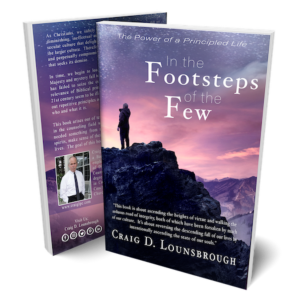
"In the Footsteps of the Few - The Power of a Principled Life"
To Believe In Something Better - The Rise Against What Is
Our humanity is ingeniously fashioned in a manner that it can handily break the realities that would seek to break it. Our existence need never be held hostage nor pressed into servitude to the sordid realities of all that is happening around us. Rather, we are able to stand in spirited opposition to those realities, and in the face of them we are capable of crafting brilliant and utterly resilient solutions that crush those realities by transforming them. We are dreamers and the authors of visions. We have the ability to conceptualize marvelous things and actually begin the act of crafting them even at those times when the presence of them or the hope for them is entirely non-existent. We are a powerful bunch vested with immense potential that exceeds even that which we understand.
Yet, we bring these abilities to bear against a world that would wish to press us flat in its skepticism. The world becomes embroiled in the selfish pursuits that it crafts as it chases things born of greed, gluttony and selfishness. The world would bend us to its darker ways rather than be bent to a better way. The world would prefer to kill both us and itself rather than give up what it has selfishly given itself over to. Indeed, the world has sold its soul to something that it is convinced will liberate the soul that it sold. Therefore, in the insanity of a world gone rogue, the world will viciously fight for the things that are certain to destroy it.
The weight of living in a world such as this, as well as the incessant press of darkness that such living spawns can at times leave us wondering if our influence might be too insufficient to wrestle the world out of a darkness that has become so terribly dark. We stand as single entities, bringing what light we can. Most times, that light seems swallowed in the vast darkness that seems to advance without restraint. We are left in the squalor of a battle that seems lost, only holding the line so that we can delay the full descent of evil and grant ourselves a few precious moments before life is over.
To Believe In Something Better
But we forget. We are extraordinarily quick to lose touch with a greater reality that infinitely surpasses the darkness which surrounds us. Our perspective becomes one of gradual defeat and continual hopelessness. Our understanding of who we are and Who we serve is lost in the grief of a battle seemingly hopeless and ground perpetually surrendered. We fall prey to the lies of the darkness whose own darkness is completely dependent upon our fear of it. Therefore, the darkness must appear dark beyond what it is in order to create the fear necessary to insure its own survival. It is not an undefeatable foe. It is, in fact, a foe that fears lest we discover the power that we possess and the vulnerability that it has.
Therefore, to remind us of who we are in times such as these and to fan the flames of our passion, I have compiled a number of quotes that I have had the privilege of authoring. It is my desire to call us back to lofty dreams and rigorous passion. To remind us that the darkness is the absence of light and therefore is totally dependent on the light remaining absent. As such, the darkness is terribly vulnerable as it possesses no means by which to stop the light other than creating fear in us. These quotes are written to set us free and send us out in the marvel of our humanity to change a world that is too ill-equipped to change itself. To say that we stand for something better, and that we will be that ‘something better’ in the standing. It is my hope that these quotes will move you to move your world, for I believe that you can, and I believe that you will:
The Rise Against ‘What Is’
“If it didn’t go all that well today, tomorrow is the opportunity that I have to do what I did today without doing it the way that I did it today.”
“Pull every dream that you’ve ever had from all of the places that you’ve abandoned them, brush them off, set them in front of yourself, run the fingers of your heart over each of them, fight the lie that you’re not enough to achieve them, and realize that the dream was not too big. Rather, the belief in yourself is too small.”
“Let us not fall prey to the leaching negativity and rank pessimism that runs unleashed all around us. Rather, with the utmost determination we must bring ourselves to understand that these lies have been given legitimacy by people who thought themselves as powerless in the face of them, rather than recognizing that we have the power to rip the face off of them.”
“You, yes you are the impossible waiting to happen. And the only reason that that sounds impossible to you is that you haven’t been daring enough to push the possible out to the point where it becomes what you once mistook for the impossible.”
“I am begging you to let nothing shackle you that God has sent you to unshackle.”
“I’ve sat with tens of thousands of people and I’ve stared into as many empty eyes. And I must say that the inexplicable contradiction for me is that despite the gaping emptiness engulfing every one of these eyes, there yet lies within each one a wonderfully formidable gifting, an irrepressible energy, a depth yet undiscovered, riches unfathomed, and the resources to amply transform this ever-darkening world. And I’ve seen enough eyes to know that if yours are also empty, like everyone else’s they are also full.”
“God doesn’t ask if something can be done. Nor does He ask if we have the resources to do it. For God is bound by neither question. And when we stand with God, neither are we.”
“You are fully and magnificently equipped to stand up and change the world around you. And to simply sit down and tolerate the world around you is to squander who you are in the process of never being who you are.”
“Do not be ashamed of who you are, for in doing so you are not taking into account the majesty of all that you are. And without any shred of doubt, I know that you are a person of majesty, for in my innumerable years of working with people I have yet to find even one person who is not.”
“Stand up and be the light that God created you to be. Stand with me and the millions of others like both of us who have bowed before this inexplicably marvelous God of ours and in the bowing have begged that He not let us die until the darkness in the world around us has died first.”
“Look in the mirror. Go ahead and look yet again. And look not at the reflection, for while this body of yours is marvelously complex in ways that continue to elude the reach of modern science, it is but a simple shell that holds the image of God within you. And if the shell is that grand, how much more what God has placed inside of it.”
“If I let that which I hold to be true fall victim to a world that says it is not, I have in that action surrendered to the voices of those who know nothing of the truth other than to destroy it because it terrifies them. And if there’s one thing I should be terrified of, it’s not the surrender itself, but the fact that in the surrender I have given the world permission to avoid the very thing that it should fear.”
“It’s not the gifts or the abilities or the talents that equip us to accomplish great things. Rather, it’s the persistent and adamantly stubborn conviction that we will in no way leave the world the way that we found it. And I would rather join hands with a single person of this kind than sit with a million gifted people who are not of this kind.”
And finally…
“I will spend my life believing in you so that you will someday commit to doing the same.”
To Believe
We must press ourselves into a sort of reckoning. We must realign our minds with the truth of who we are, who God created us to be, and the fantastic mission that He gifted us with. In a battle this pervasive and insidious, we must ground ourselves in a truth so brilliant and pristinely clean that it will handily stand against the wiles of the devil and the depth of the darkness he has spun. We must align ourselves with a reality so brilliant, robust and muscular that we find ourselves unintimidated by the darkness that now stands quaking in front of us.
We have a God who has called us to great things. Great things. He has not called us to defeat or even some slightly marginal victory. He has called us to complete and unquestioned victory. And such a call would never have been extended had not this God of ours provided ample resources to achieve that victory.
Before moving to the next chapter, I would encourage you to reread the quotes shared in this chapter. I would likewise encourage you to pick one that speaks to you, to write it down, and recite it daily. Let its truth seep deep into your soul and ignite your heart. Let it breath confidence into your spirit and energy into your convictions. Indeed, it is time to rise against ‘what is.’ So, let’s rise.
Aug 13, 2025
Aug 13, 2025
15 min
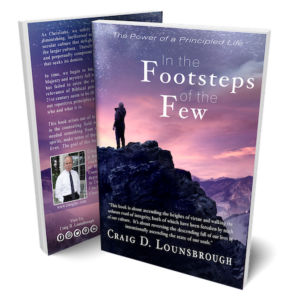
"In the Footsteps of the Few - The Power of a Principled Life"
Not Where We Were - Finding Ourselves Somewhere Else
It seems that we have some vague and rather ethereal sense of where we’re going in this thing called life. For the more contemplative soul, that sense might be quite refined. For the casual traveler, it might be a bit more nebulous and scattered. For many, where they’re going is defined by the tasks of the day, rather than enlarged by a vision for tomorrow.
In many cases where we’re going is far more rigorously defined by all the places where we don’t want to go, rather than the places where we do want to go. At other times its definition is rather handily shaped by the opinions of others, or it’s carved directly from the bedrock of the value systems that have been built into our lives throughout the whole of our lives. For others, it’s based on the need to avoid the pain of our past or somehow prove our worth in the face of a self-image that lays battered and bloodied. Vague or refined, we all have some sense of where we’re going. And too often, we find ourselves ending up someplace else.
Some of us are not necessarily in conscious pursuit of wherever this place is. We have this instinctually primal sense that it’s there and we intuitively assume that our path will take a natural course to wherever that place is. Then, there are others of us who are myopically focused on where we’re going to the degree that everything that we do is wholly defined by that singularly beguiling destination. Some of the more adventurous souls among us nimbly pursue that destination, spiritedly pulling in as much of everything that we can along the way to accentuate both the journey as well as the destination. In whatever way we do it, we all have some sense of where we’re going. And too often, we find ourselves ending up someplace else.
The Detours We Create
Yet, life is not so predictable as to always wind its way to the places that we presumed it to be going. There are those times when where we were going was bafflingly mistaken as some sort of final destination when in reality it was only a step to a final destination. At other times the place where we’re going is really a destination that we had fabricated because the place to which life had originally called us appeared too big, or too far, or too steep, or simply impossible in whatever way our limited vision happened to interpret it. At such times we craft some other less intimidating and thoroughly unfulfilling destination. Sometimes our destination is to set a course away from our destination so that we can dispense with whatever responsibility or obligation our original destination might have demanded of us.
And then in the magic of life, there are those times where we have actually pursued some authentic destination with such rigorous tenacity that the trajectory of our efforts has catapulted us past our destination to places that are everything of our furthest and fondest imagination. However, it might play out, we’re all headed somewhere.
The Detours Life Creates
But then there are those other times when life takes a sharp turn that seems little of our actions, nothing of our destination, but everything of circumstances designed to kill our journey and crush our destination long before we get within arm’s length of it. There’s a sense that something intrinsically unjust, stealthy and evil is always about and on the prowl, and whatever it is, it’s bound to show up if it hasn’t already. When it does, it undoes everything that we thought was secure and certain, wreaking havoc on whatever our journey had been to that point. And to whatever degree it wrecks the road underneath our feet, we’re left in a blurring trauma that renders our journey disjointed, our destination uncertain, and our lives dispirited.
The Explanation of Detours Missed
How It Happens
Yet, more often than not it’s the not the obvious shifts in our journey that are the core problem. Sure, life shows up and we get shoved down. There’s no question that the natural ebb and flow of life, whether it be titanic or miniscule, will happen to us. Despite our frequently ego-centric inclinations to the contrary, we are not so shrewd or ingenious as to be able to traverse life in a manner that deftly side-steps everything that comes at us. We don’t dance as well as we think we do. Our ingenuity falls prey to our arrogance, and the winds that we assumed to be reliable often shift and drive our genius toward some rocky shoal. And so, life will fall upon us, or ram against us, or pull the ground out from under us, or wreck us.
Casual and Careless
Yet, more often than not, the explanation doesn’t rest in life having shown up. The much more poignant issue is that too often we are passive, flabby and lax in rigorously living out our lives. We’re far too casual and careless. Somehow, somewhere the exquisite sanctity of life and the priceless privilege of living it out was supplanted with some sense that it’s too much work or that it’s not going to work, so why try? The gift is lost in the grind and we lose a sustaining sense of gratitude.
We get caught in the shallows, forgetting that the deepest waters hold the greatest treasures. But we would rather forage for trinkets because treasures are too stubborn to just hand themselves to us and we will not succumb to such preposterous demands. The shallows become our calling when they are nothing more than our coffin. Therefore, we drift without knowing that we’re drifting because we’re no longer paying attention. We come to believe that we are living a life of great things because it is too overwhelming to embrace the truth that we have forfeited great things. The outcome of such passive living is that we end up finding ourselves somewhere else without ever seeing it coming.
Preoccupied with Pabulum
Too often we’re too preoccupied with pabulum. We’re tediously engaged with tiny things and we’re caught in the tedium of minutia because we can gather these things around us and control them when the bigger things are out of our control. Too frequently we’re goaded by the fear of big dreams and massive possibilities, so we dumb down our lives to anesthetize those fears.
There’s plenty of pablum to go around. Therefore, we assume that if we collect sufficient quantities of it, it will add up to something bigger than pablum. Yet, dreams are never constructed of pablum and our fears are never put at bay by any collection of it, regardless of how massive. It is an escape, but it is never an answer. It’s a detour, but it is never a destination. It is an imitation of what we are attempting to avoid. Subsequently, pablum gives us a sense that we can circumvent everything that we fear and still achieve everything that we dream. We’re caught in small things, and the outcome is that we end up finding ourselves somewhere else without ever seeing it coming.
Along for the Ride
Frequently we presume that we’re some docile passenger along for a ride that’s going wherever it’s going, so we just let it go to wherever that place is. We freely surrender to passivity which is an invitation to meaninglessness. And meaninglessness is the death of the soul itself. Life is a river, we say. And the best course of action is to navigate it because entertaining the far-fetched notion of swimming against it is utterly preposterous.
Assuming that we are along for the ride releases us from any accountability for the ride and where it might end up. We are innocent. Or we’re victims of circumstance. Or our families put us here because they didn’t know any other place to put us. Or we’re simply being obedient to whatever we’ve subjected ourselves to. Assuming we’re on a ride that we can’t direct, the outcome is that we end up finding ourselves somewhere else without ever seeing it coming.
The Walls of Denial
At other times, we live in the constructed confines erected from the raw material of denial, causing us to live out a life that is in denial of life itself. We become squatters living in a squatter’s camp constructed by the flimsy materials of justification, rationalization, blame-placing and projecting. We pull in the walls due to the reality that materials of this sort are always pulling inward because they will die if we dare to press them outward. Hemmed in by walls of this sort, the world around us is shut out and moves on without our awareness of it.
We live in walls that we pretend are horizons, or vast doorways that open to massive expanses and marvelous places. In time, we come to believe that they are not walls at all as we’ve visualized them as something that they will never be. We then live out our lives in these confining hovels, convinced that we are forging great mountains and running in wild places. The outcome is that we end up finding ourselves somewhere else without ever seeing it coming.
Ending Up Where We Wish to Be
We will end up somewhere. The fact that we have a destination is irrefutable as life is a journey that presents us with no option other than the journey. We may decide that the nature and course of the journey is irrelevant, and we may take a backseat to passivity. If we do, we have no right to complain when we end up in some place other than what we may have thought or preferred.
Yet, we can recognize that we are not automatons subject to the flux of the world within which we have found ourselves. It would seem advisable to recognize that we have an obligation to the course that our life is taking, and that along with that obligation we have been granted a profound degree of power to bring to the course. If we imprudently succumb to carelessness, or become engrossed by pabulum, or if we just let the ride go wherever circumstances take it, or if we pull close the walls of denial this thing that we call life will wind itself to wherever it’s going with no one at the helm. And that kind of destination cannot be good.
We would be wise to inventory our lives and determine if we are in some way large or small participating in any of these behaviors. If so, we need to root them out and expunge them from our lives. Reclaiming a sense of vision, and then seizing our lives with discipline and intentionality will set us on a path that will land us in places that we’ve dreamt to land. If we don’t, the place we land may not be on any land that we even remotely recognize.
Aug 12, 2025
Aug 12, 2025
14 min
"In the Footsteps of the Few - The Power of a Principled Life"
What I Want - The Frightening Call of Great Things
I want to be happy, but I don’t think I want to be satisfied; for satisfaction lures me into believing that happiness is found in reaching some point rather than realizing happiness is born of striving for those points. I want to experience a resilient and wonderfully endearing sense of contentment that neatly threads itself through every part of my soul, but I don’t want that contentment to morph into the baser mentality of complacency. I want to keep a weathered eye on every horizon, but I want to do more than just watch those horizons from some sorry distance. Rather, I want to walk their ridges. I don’t want to contemplate the taking of a journey. Rather, I want to be contemplating a journey as I’m taking it.
I want to robustly celebrate the achievements and vigorously revel in the milestones in a manner completely worthy of them, but I never want to fall to the bane of mediocrity that would prompt me to see them as a terminus. I want to develop a sturdy confidence born of the advances made, and I want to have that confidence perpetually reinforced by the successes achieved. Yet, I pray that my failures will always serve to temper that confidence so that it never turns to rot in the form of arrogance. And in further managing this tempered confidence, I never want it to be so strong that I errantly assume any challenge as too small to be worthy of my time. I want to be happy, but I don’t think I want to be satisfied.
For whatever reason I might do it and in whatever way I might do it, I never want to hand myself excuses to round the next summit instead of scaling it. I never want to slothfully presume the ability to achieve a goal without holding myself accountable to actually getting on the track and running the race. And I suppose worst of all, I never want to scan my assorted array of trophies, whether they be numerous or few, and in the scanning embrace some languid sense born of complacency that somehow it is done and that I can hang up my hat, when in reality life is never done and no hat is really ever hung.
Why Do I ‘Never Want’ to Do These Things?
Laziness is humanity domesticated to its own destruction. Mediocrity is life pent up in the very iron-clad cages that we create out of the misguided notion that an ‘adventure’ is a product of those misty-eyed idealists who expend their lives chasing dreams too elusive to catch. Therefore, we create dreams that we can cage so that they simply can’t elude us, and in their captivity we can manage them so that, God forbid, they never manage us. And what we forget is that a dream caged is nothing more than an anemic, pasty-white wish that is always in the process of dying in whatever cage it happens to find itself.
We Are Made for More
We are made for more than all of that. Our humanity yearns for the next adventure. We desire lofty summits and distant finish lines that tax the whole of our energies in order to get us to them. There is inherent within us this incessant sense that where ‘we are’ is not where ‘we’re going,’ and that to park it wherever we’re at is to start dying in that very place. There is some fixed notion in our psyche and some insistent voice in our souls that will not be silenced and cannot be appeased by lesser agendas. These call out despite the many ways we work to silence them, and in the calling out they call us out.
Sadly, in light of the calling, we too often surrender to fear and we sell-out to apathy. We foolishly peddle our resources and pawn off our talents to lesser things so that we can hold up some small, pithy achievement to offset the gnawing guilt we experience over bypassing the greater achievements that were our calling before we were called away. We can’t show up empty-handed, for that would work against our efforts to squelch the already suppressed voice of passion. Yet, unless we set our sights on higher things we will always be empty-hearted, for blind obedience to fear and the steady ingestion of apathy leaves everything it touches empty. And I would propose that emptiness of this sort is the bedfellow of death itself.
Therefore, we achieve something because we must. And at times we dress up those ‘somethings’ so that they don’t look half bad. But too often our achievements are an insidious effort to sedate our sense of passion and render it appeased. They’re the anemic manifestation of our fears, a groveling by-product of our lackluster vision, and a response to the snide voice of mediocrity that herald’s ‘passion’ as the fool’s errand.
Passion is not fooled, even though we are fooled by the belief that we somehow fooled it. To numb passion is not to diminish its power. Rather, it is to diminish our sense of its power. In doing so we stepped down instead of stepping up. We swapped mountains for back alleys, and dramatic vistas for fading fences. And these realities create a grinding angst within us that will not be soothed by anything but heeding the call from which we’ve run.
What to Do?
Decide to Do Something
As obvious as it may sound, the first thing to do is decide to do something. Without the decision to do something, anything and everything is only an idea. An idea, regardless of how ingenious or bold changes nothing until it is birthed as a reality. The greatest ideas will only tickle our imagination, but they won’t fire it until they’re released. They will nudge us, but they won’t force us to jump. They will call, but they won’t beg.
To do something is to decide to be disciplined. It’s a decision to take a step rather than toy with ideas. It is a choice to move from the non-committal ease of playing out various scenarios in our head, to grabbing one of them by the throat and acting on it. It is not based on cost in stepping out, for the greatest cost of all is in not stepping out. And it is the sad reality that most of our ideas die without ever having been birthed as realities because we choose to do everything but step.
Decide If You’re Going to be Brave
An idea as only an ‘idea’ and nothing more than an idea is safe. As ideas and ideas only, they’re manageable. They’re domesticated. They’re leashed. We hold them within the safe confines of our minds and our imaginations, toying with them as time permits and returning them to those confines when it does not. But cut the reigns and turn an idea loose and it may not be as manageable and domesticated as we might like it to be. So, are we brave enough for the ride that is certain to ensue?
An idea that is given legs is one of the most dangerous things imaginable, but it is also one of the most exciting things possible. An idea running at full stride is wildly frightening in a manner that unleashes something that was never supposed to be leashed. It is not about throwing caution to the wind as some might think. Rather, it’s about stepping into the wind and being swept up by it while wisely holding caution as we do. It’s about understanding that wisdom is not held hostage to safety. Rather, wisdom is based on figuring out how we navigate dangerous things in a way that no longer renders them dangerous. And as such, are we going to choose to be brave?
Decide How Important Comfort and Familiarity Are
Unleash your ideas and things will never be the same; guaranteed. Things will change when great ideas are unleashed because they can’t help but change. What ‘is’ will become the stuff of a history that will lay beyond our ability to ever reclaim again. Our ideas are the stuff of the future. They are never home in the present for the present is only the thing that launches them, not the thing that cultivates them. If our lives have been expended in the acquisition of comfort and the cultivation of familiarity, our future is our ‘now’ and no idea can sufficiently grow in that.
While the degree of success rests on the magnitude of the idea being released, the greater degree to which it will be successful is the degree to which we unleash it. And if we prefer familiarity and the comfort that it engenders, we might never truly let an idea loose, or we may well attempt to cram it back into the confines we released it from after we’ve unleashed it. At best, the ideas are hamstrung. At worst, they perish.
Get the Resources
If you’ve decided that you want to do something, if you’re sufficiently brave to do it, and if you’re willing to forgo familiarity and comfort in the pursuit of it, then get the resources that you need to make it happen. Real resources. This is not about thin and pasty resources, nor is it about material that’s been worn thin. It’s not about sugary-sweet notions or trite sayings that are fun and fanciful but are shallow and porous.
Rather, this is about finding bold, honest, timely, daring, frank, deep and brisk material that will thrust you out beyond the confines you saw as the terminus of your dreams. Find resources that are unforgiving in helping you grow, reliable in content, proven in substance, and thick with wisdom. Learn from trusted people who have been there-and-back who have likewise taken other people there-and-back. Grab these resources, let them grab you, and then rigorously apply them without delay or excuse. When you do, you will start the process of placing yourself in a position to begin heeding the call of great things.
Aug 11, 2025
Aug 11, 2025
26 min
The front porch was the door to the world “out there.” As a kid, it was the stepping off point to the world that never forced us to step off. It was the place through which the outside world would come into mine; monitored and managed in a way that didn’t make the world safe, but that pared and neutered it sufficiently to make it safe whenever it was granted entrance. As a kid, other than it being huge, I didn’t know everything that was out beyond the oak planks and cement steps. What I knew however was that the front porch would unflinchingly manage its entrance into my life.
It was a rarely used place because I found the solace of home much better than the turmoil of a world I didn’t understand. The front porch was that first step out into that world; the threshold to whatever was out there. I suppose it was something akin to witnessing terribly frightening realities from a vantage point of absolute safety; vulnerability rendered neutral either by safety or the sturdy knowledge that safety breeched would not be unsafe at all on the porch.
That’s what made it the safest place of all. It was the stepping off point to a big world that I knew little of. It seemed like the portal from the safety and embracing warmth of my world to whatever lay out there; fixed and firm but never naïve. In the child of my mind, the front porch edged right up to the world, but it held me perfectly safe and completely secure all the while. It provided me a front row seat as the happiness and horror of life paraded by, holding me, it seemed, entirely in perfect peace. I loved the front porch.
George Moore astutely pointed out that "a man travels the world over in search of what he needs and returns home to find it." Somehow I knew that I would someday step off the front porch and go out there into whatever the world was, and that the journey would eventually return me to this place. But for now, it was a magical and certain haven on the sidelines of life.
Fall always graced the front porch with vibrantly colored leaves from the massive maples that lined the street as mammoth sentries. Hardwood behemoths, they would rain color; drops of searing reds falling in torrents when the wind blew firm. Blown onto the front porch the spun in royal red eddies; dancing with abandon as the wind courted them with a mix of tease and intention.
The turn of the season always invited me to the front porch to watch fall hand itself off to winter. You could watch it all safely from the front porch, as you could watch anything. It was, it seemed, somehow the best of all worlds.
With three or four bulbous pumpkins, several stalks of dried corn cinched tight with flax cords, a ragged bale of hay and a handful of incandescent leaves as trimming, we would dress the front porch for fall. It became a stage of sorts from which we would celebrate the departure of fall; pulling onto the front porch all the assorted things that symbolized the season. It was all staged right there on the oak tongue and groove flooring. We said goodbye from the safety of that place, acknowledging a passing from the kind distance that the front porch afforded us.
Adulthood and Distance Gone
They were other dying eyes the weekend my Mom died; one pair so much younger and entirely unexpected. I met them on the front porch. It’s not a long front porch, other than being long with the kind of miles that memories pave; lined generously with so much of my childhood. If memories were to define its breadth, it would stretch beyond any home to contain it. The tongue and groove flooring is yet firm, having welcomed and ushered feet both wandering and intentional to a sturdy oak door for nearly one hundred years. Friends, visitors and strangers have all crossed its planking in order to engage the family within; that defining portal to the world out there.
How do you grasp a place framed by towering pines and muscular maples whose width and breath hem you in above and around? Beyond the reach of their canopies, a sweeping lawn paints a tender, green expanse mottled with the glory of fall scattered about in leaves of gold, explosive red and scintillating orange. Out past the fringes of its grassy mantel stand more forest behemoths that seem to challenge the enormity of the sky itself. The old porch is surrounded by a mantel of nature’s best.
How do you engage a place that sits back just far enough from a sleepy street to muse as the world goes by while finding ample space between you and it? What do you do with hedges, thickets and sweeping canopies thick with the chatter and chorus of birds singing out of the sheer rapture of living? What do you do with squirrels that skirt precariously on thin limbs as if taking no notice of the peril they place themselves at, leaping vast expanses of air from one forest behemoth to another? What do you do when life affords you just such a place?
But what do you do with it when you’ve engaged the sordid world out there in ways entirely unimagined by the childlike mind that staged fall on its expanse? What do you do when it seems no longer a portal because you’ve stepped out so far beyond it that you can never again step back to the other side of it; even when in your most dire moments you desperately wish that you could do so? What do you do with something that provided the most gracious and sacrificial protection imaginable but whose role seems to have been long terminated by time, circumstance and this mysterious thing we call adulthood? What do you do?
If something this grand and yet this quiet is afforded you, then I would presume that you needed it. If you don’t think that you needed it, there’s a good chance that you’re oblivious to your own needs or you’re oblivious to the provision God affords us in our times of need. David sings, “The Lord is my rock, my fortress and my deliverer, my rock, in whom I take refuge” (Psalm 18:2, New International Version). Weave the metaphors and realities of our rock, fortress and deliverer together and we have an impenetrable place of deep and certain refuge. We all need such a place for such times as those that were about to befall me. We need a front porch.
Permanent Provision for Grief
Is there always a front porch of some sort or other? Can there be a consistent place of unexplainable solitude that provides us a place of refuge? Can God carve out this kind of oasis in the midst of the most searing grief, an oasis that does not remove us from our grief but gives us complete sanctuary in it; that lets life move and circle all around us but provides us tranquility in it? More than that, do we need a place of such solitude and security that allows us to invite grief right into the middle of it, knowing that this place is so secure that nothing can shake it even when it is invited into the heart of it? Is that possible?
“I am with you always . . . “ (Matthew 28:20, American Standard Version). “God is our refuge and strength, a very present help in trouble” (Psalm 46:1, American Standard Version). We may find great relief and inexplicable solace in purposefully looking beyond grief in the midst of our grief in order to determine the provision made within it. Grief is consuming, wrestling away the sum total of our attention and energies in order to deal with it and attempt to flee from it. If grief becomes our focus, the hand of God is something other than our focus.
We don’t think to look for any provision as grief assumes none. Grief assumes a process by which grief is navigated and resolved; a process which rarely assumes a place from which to do it. Grief renders us vulnerable which leaves us with the assumption that the struggle is ours alone. Grief calls us out. It strips us naked. It renders us helpless in our helplessness. It assumes little else and it does little else. Yet, what kind of front porch has God given us in the midst of our grief?
Loss Strikes Twice
Into it all, Paul walked onto my front porch and into my life again. He had walked into my life some thirty-five years earlier as a dear childhood friend, settling into my developmental years; navigating the tumultuous journey of adolescence alongside me until I left home for whatever it is that calls young men outward and sometimes upward. However, the demands of living and the scurrying about that seems so much wasted energy had long ago drawn us apart. He had changed over the gaping hole of the twenty-six years since we last said goodbye. The Paul that I knew was gone but there all at the same time. After over two and a half decades of unforgivable separation, Paul came by to visit.
Sitting there on that same front porch, we shared the passing of time and events, of life unfolding for each of us mostly in ways unexpected; the unanticipated and circular journey that led us from that front porch and back again decades later.
Trials and successes, painful failures and lost relationships, dreams realized and other dreams that we surrendered to the cold hands of reality. We talked about life through the eyes of middle age when the ever-increasing distance from the past rolls dim off some subconscious horizon of our minds, while the shortening days of the end of it all draws ever sharper. It was all amazingly rich. In a few moments, the years seemed erased.
With the friendship rejoined, Paul gazed into my eyes with a thick pause wrapped in an unexplainable intensity. With a frankness that belied the length of his own struggle, he cast a longing glance at the hearty trees that surrounded the front porch, ran his finger around the ring of his coffee cup, drew a breath of sweet fall air and muttered that he was dying. It was not some sort of speculation that there might be a cure or that the treatment might yet stop the advance of cancer that relentlessly pushed forward on multiple fronts throughout his body. It was the surrender of a valiant warrior who felt that the battle might not be fighting cancer, but closing out a middle aged life in front of an audience of friends and family as a man of integrity, faith and bravery. It was not about survival anymore, but about legacy.
His condition was terminal. Terminal is such a final word. It’s the ultimate period that’s put at the end of last sentence on the final page of the book. Nothing follows it other than nothingness. Its finality is so unfathomable that you have no alternative except to hope that it really might have been mistaken for a comma; that it’s some other sort of punctuation about the person’s life that might legitimately suggest a pause before moving on again. But terminal . . . how I wished it was something other than the chilling finality of a period.
My mind instantly teetered, tipped in the emotional imbalance and then plummeted. Whirling in wild gyrations, Paul's face immediately blurred and spun. A thousand memories, variant clips and fragmented mementos of our shared childhood raced across the forefront of my mind at speeds that were emotionally deafening. My heart dropped so far that I had no sense of it any longer. An emotional paralysis humanly halted it all.
And then Paul's voice, soft and firm, grounded me. He said, "you don't need to say anything. Just thanks for listening and thanks for the years we had." The words, so needed, were wrapped in a silken veneer of complete peace that gently wrapped itself around me.
My mother was hours from death, Paul was two months or so away from the same thing. I bore both on that front porch. Stunned and pummeled twice. Blackness had fallen once, and then once again. Sometimes you are convinced that life has struck you sufficiently for it seems that its task in irrefutably crushing hope and driving you into some sort of trackless abyss has been so thorough that there is nothing left to destroy or maim. But sometimes life strikes twice, insanely attempting to kill that which has already been killed; finding some savage and sadistic pleasure in touting its victory and superiority by striking one more needless blow on its way back to wherever it came from. If life doesn’t make sense, it’s at times like these.
Being Truly Lost
Struck with a deafening blow by the pending passing of my mother and sent reeling again by Paul’s disclosure; I was dead-center in that place; ground zero in grief. In those places there is no sense of bearing, of true north to at least know where you’re at. Most of the time when we talk about being lost, we have some general sense of direction that provides us a place to start heading off to. We at least have some vague and diffuse sense of where to go.
But being truly lost is nothing of the sort. It’s having absolutely no idea of where you’re at because where you’re at is a place you’ve never been before and could never have believed existed except for the fact that you're now there. It’s having no idea where you should go because all that was once familiar is now terrifyingly unfamiliar and entirely uncertain, rendering the place that you need to go to as unknown.
All of this takes on the horror of a rapidly escalating panic as we suddenly realize that we are utterly and irrevocably alone in it all. Life at its worst isolates us because the more devastating it is, the more unique our experience in it. We become abjectly alone. That’s lost. It is a rare, horrible and deathly place that engulfed me on the front porch that day.
A Path Out of Being Lost
It was all too much had I not bore the immensity of this while sitting on that front porch, that place of deep solace wrapped in majestic trees and God’s thick arms. The front porch offered me a place of solace to watch two people that I loved embrace the reality of a world that is turning and turning dramatically. Oddly and unexpectedly, it was in the watching that I began to find my way out of the lostness.
Both were dying with great grace and valor. There was nothing of surrender in it at all. Surrender implies a weakness that renders us inadequate in conquering that which stands before us. Rather, death with honor and a chaste spirit was hardly weakness. It was bravery of the greatest sort. And on that front porch, surrounded by this place of refuge that God had granted me, I could see it all with great clarity and conviction.
It was not about searching for some path out of the lostness. It was all about watching. The keys and the compass were handed to me in the very things that had thrust me out and down into the abyss that I had plummeted into. Pain frequently results in panic. Panic seeks an immediate resolution and remedy by whatever means that resolution and remedy can be achieved. Panic frequently leads to a flailing and an impulsivity that only deepens and constricts the darkness that wraps itself around us with long, constricting and chilling fingers.
I watched Mom and Paul courageously course their way through the onset of death; deciding to face it head-on with defiance and daring. They had each embraced a posture of bravery and faith; seizing the inevitable, turning death on itself by celebrating and cheering past victories and savoring the innumerable gifts life had lavished on them. It became a recitation of glories, gains and gifts, and deeply flowing gratitude. It was the most genuine celebration of life that I had ever witnessed. I could not grasp it and felt that if I were the one facing death that I would be absolutely nothing of what they were. It was joyous and marvelous, mixed into some sort of wild and terribly rare concoction that I had no right to sip, but was handed by the glassful nonetheless.
Virgil stated, “They can conquer who believe they can.” Conquering for Mom and Paul was about seizing the apparent untimely arrival of death and choosing a posture of celebration and savoring. I confess my inability to grasp it all other than I know it to be real because I watched them grasp it. They seized it in a manner that not only ministered to them, but ministered to others as well. They believed that they could conquer . . . and conquer they did.
It was in this that I instantly found my bearings; both where I was and where I desperately wanted to go. Lostness dissipated by simply watching. The birds seemed to hold their songs for a moment and the trees leaned ever so slightly as if to hear a heart grasp a profound reality. The porch provided me the place. The examples provided me both keys and compass.
In the end, those keys and that compass allowed me to find myself so thoroughly and center myself so precisely that my sense of myself was honed sharper than it had ever been. It was nothing short of stunning and astounding.
God as My Front Porch
“My God -- the high crag where I run for dear life, hiding behind the boulders, safe in the granite hideout; My mountaintop refuge . . . ” (2 Samuel 22:3, The Message). Carefully listen to the metaphors of safety and security that are richly interwoven in this verse. God is place of perfect security. It’s not that life can’t reach us there. God is not a god of seclusion, sweeping us away from all harm and setting us far out of the reach of a world of pain and inexplicable circumstances. He is our refuge right in the middle of this kind of world. He is the place that grants us the place to be found and to find. He is our front porch.
God is that place of perfect security in perfect insecurity. He is that place surrounded by enduring beauty, filled with his marvels so that we might not forget all that is good in all that is wrong. He places us just far enough from the world to muse at it while being separate from it; to find a place from which to learn the lessons that we need to fearlessly engage it. In Him there is a quietness that doesn’t deny the cries of a hurting world, but a quietness that keeps it all at just enough of a distance to grow in it, but not be consumed by it.
“Before you know it, a sense of God's wholeness, everything coming together for good, will come and settle you down. It's wonderful what happens when Christ displaces worry at the center of your life” (Philippians 4:7, The Message). That can only happen in just such a place. In our grief, God affords us a place like that . . . a front porch. And this place is strong enough to weather all the grief that life can throw at us. It is entirely sufficient.
It's a place quiet enough, safe enough and sufficiently spacious for the keys and compass that we need to be handed to us in manner that we fully see them, fully embrace them, and allow them to fully impact our lives. The front porch is then a place of safety, but a place that creates enough space for the miraculous to have plenty of elbow room.
It is an odd, indescribable, nearly inscrutable thing to be able to feel the searing intensity of a life unraveling, and to feel it all in the midst of perfect security that affords me both a path out of my own lostness and opportunity for amazing growth. That is what God affords us in our grief. It is a most marvelous thing indeed.
Paul took it all in stride. He smiled, laughed with a contentment at the life he had been able to live, glanced at the trees and vast expanse of lawn covered in fall’s flaming bounty and said, “it’s been a good life . . . it really has.” Dying fully at ease, that’s what he was doing. He exemplified God’s security in a way most marvelous. God in our grief, that’s what I saw in him. I know it works because I saw it in Paul. Mom exemplified it all of her life. The front porch created a place safe enough and expansive enough to see it.
Because I saw it, I was released to release that which was being lost to me. I was unexplainably released to come alongside my losses and tearfully, yet boldly escort those very losses to the next place.
Additional Resources
Discover an array of additional resources on our website at www.craiglpc.com. Find all of Craig's thoughtful, timely, and inspirational books at Amazon. com, Barnes and Noble, or wherever books are sold. Also, take a moment to explore Craig's Public Speaking Resources for information regarding the resources available to your business, ministry, or organization.
Aug 10, 2025
Aug 10, 2025
27 min
They leave sporadically. Some of them go at the first hint of fall’s advance. Others hang around until the first snows herd them southward as a rancher with heavy-footed cattle lumbering across pasturelands; gorged on the last of summer’s grasses. The air is sullen and stilled by their absence; the void of song leaving a hole wide and gray. Trees stand as tenements emptied, their residents having taken wing for warmer skies.
But it was the geese really. Their movement was monumental; indescribably massive in scope as if a whole nation of waterfowl moved in unison. Other birds would cluster in sordid bands and bounce southward; a grouping here and a grouping there. But geese . . . they would advance as an innumerable army seizing the very skies themselves.
As a kid, they would surge down the Atlantic flyway as if it were a conduit that compressed untold millions of geese into an invisible highway in the sky. The main body would come in droves of thousands; an endless string of black pearl strands being pulled southward; waving like the tail of a grand kite in the wind. It was too vast to embrace; being one of those things in life that defies the parameters of our imaginations and spills far outside the reach of our senses. Because it does, we’re never quite done with it because we never quite absorb it all. It slips by experienced as something grand, but we inherently know that the grandeur that we were able to embrace was but a minuscule part of the whole. As I kid, I knew that.
The Atlantic flyway cuts a mystical swath through the heart of the southern Lake Erie region. All but an hour's drive or so away from home, we would tumble into the car and head out to sit on the sidelines of the miraculous. From miles away, you could see thin layers of black string formations low-slung across the sky; birds ascending and descending in numbers too vast to count. The water, the adjacent fields, the roads themselves were thick with them, each seeming to be an exact replica of the other; each energized with a corporate sense that something grand was afoot that was as individual as it was collective.
Even as a kid I knew that what I was observing was but a moment in time. Some things are too grand to last for long because you can only absorb so much wonder and majesty before you’ll explode. But therein lays the rub. You want it to last, even if the sheer pleasure of it all kills you. At least death would be happy. You’d die with a smile.
To appreciate most things you have to let them go. Some things become even more precious by their absence. When you lose something you grieve the loss and the exercise of grief can be brutally hard. At the same time, appreciation for that thing is dramatically enhanced in kind of a give and take exchange. It’s the push and pull of life that as a kid watching a million geese I didn’t get. All I wanted to do was to stand in the middle of this ocean of airborne life and somehow try to be a part of it; to find my place in it and believe that I could join it if only in the celebration of a season turning and a migration transpiring.
In feathered constellations of hundreds and sometimes thousands they would launch themselves from all around me in a deafening burst of pounding wings and haunting voices; assailing the sky and rising to warmer horizons. And in it I was left behind, simultaneously feeling a sense of abandonment, an equally thick sense of loss, but a deeper instinctual sense that this was right and proper and good. I had to let go. I had to let it be. I had to close out this moment, let it pass into my history, go home and resume my life. As a kid, that was tough.
Yet there was something temporal is the grandness of it all. Jacques Deval said, "God loved the birds and invented trees. Man loved the birds and invented cages." Some things cannot be bound over or held, despite our desire to do so. It's in the context of unabated freedom that we experience the highest exhilaration and seize the fullest manifestation of that which we are enjoying. Caging it kills it because it robs life of the freedom to be its fullest self. Geese need to fly unfettered, otherwise the majesty is gone. Life is much the same.
Somehow making something temporal makes it precious. Standing amidst thousands of migratory geese, I knew that part of the magic lay in the fact this incredible phenomena was only momentary; a brief moment at that. Holding it would make it ordinary. I couldn't fathom it all as being anything but wildly extraordinary and so I stood in the midst of the sheer magic of the temporal and relished it until it passed. Then I would walk away with a living piece of the magic embedded in the heart of my soul. I had to allow it closure or the magic would be stripped.
Closure – Fighting Against Ourselves in Adulthood
Fall was passing, hugging the calendar on the cusp of an arriving winter that was set to push fall off the page. Sometimes life moves too fast. At times we want it that way. At other times we wish that the calendar would seize up and come to a complete halt, taking away the reality of a pending end and suspending change that we don’t want. Why is it that we can’t stop the clock even when it feels completely legitimate to do so? Why is time so ruthless and insensitive as not to grant us even the slightest pause; to hold the sweeping second hand of life for even a single moment when such a reprieve would allow us to briefly hold a little longer that which life itself is stealing away? To let kids stand amidst wild geese a bit longer?
But time moves on, creating an endless space within which change unfolds and flourishes. The passing of time means that all is in transition all the time. It means that we gain and lose along the way as part of the transition, but it also means that life always has the opportunity to be new, to be fresh and to be tried again. It means that life is left wide enough and unfettered enough to unfold with all the boldness and mystical expansiveness that makes life, life. But with the freedom comes the reality of change and the fact that it renders everything temporary and existent only for a season. An end will come.
However, we can know that change and any end is grounded in “Jesus Christ (who) is the same yesterday and to-day, yea and for ever” (Hebrews 13:8, American Standard Version). With that undergirding, we can find peace in change, knowing that change is ultimately grounded in Him who is unchangeable. Therefore, change need not be feared, grieved or hated as something that steals or depletes or cheats, but rather as something that is ordered by Him who ordered the entirely of creation from eternity past and beyond. We can let change be the creative molder of life, hating it at times but believing in a final outcome as purposeful.
Passing and Change
Ice had begun to take a toe-hold around the edges of the pond. From the edges, it sent slight crystal fingers out onto the surface of water chilled and sullen. Songbirds had taken flight southward. Geese were massing in thread-like V-formations that drew silky black threads of pounding wings across graying skies, their call drifting in the deep woods as they passed. That year I had not stood among them. I had not for years.
Frost had laid a wafer thin layer of ice crystals on the beams of the wooden bridge. It was yet tentative, instantly melting to the touch and pooling in tiny droplets under my fingertips. Everything was changing and I found myself angry and resistant about it all. I didn't care about what might be diminished in stealing freedom. I wanted life caged and held.
The Illusion of Holding What We Can’t
I’m sometimes not ready for things to pass; for geese to ascend and cross horizons out of my line of sight. Life is precious. That which is precious we strive to hold. There is something about its value that drives us to possess it, to retain it; somehow feeling that possession is the only means by which that which is precious can be truly enjoyed. Without possession it is fleeting, easily escaping our grasp and robbing us of the pleasure that it brings. And so we seek out that which is precious. We hoard it if possible. We lock it up, insure it, put it in wills so that it remains under our control even in death, and do our level best to preserve it against anything that would steal it away. And because we hold it, it is no longer precious for we have robbed it of what is most precious . . . the possession of inherent traits too precious to ever be held.
Yet, I think we hold the precious out of fear. Fear that life will be flat, that we will have lived empty lives filled with the damp grayness of a sullen existence; the kind of dampness that goes right through you and the kind of grayness that suffocates you. We fear that endings won’t begat beginnings and that geese won’t return. We have to accumulate that which is precious and keep it in order to stave off the dampness and lighten the grayness. But how do you possibly accumulate and hold a million geese heading south or a mother dying?
Life then becomes the summation of the possessions that we think we hold, which in reality is finitely very little, temporal at best and killed by the fact that we're holding it. Our purpose becomes the continued holding of these things. Our identity, whatever it is that they are. Our passion becomes their maintenance so as to preserve them. Our hope becomes entangled in the continued accumulation of them to stave off potential loss. Our future becomes a cycle of maintenance and continued accumulation. And we can’t let go because if we do, we’ll have nothing left. We then lose the sense of awe when life sweeps our way, and we forfeit the humbling sense of appreciation when its time in our lives is concluded.
The Obedient Letting Go
“If you grasp and cling to life on your terms, you'll lose it, but if you let that life go, you'll get life on God's terms” (Luke 17:33, The Message). Fall was obediently letting go, not demanding some other terms. Summer had let go a long time ago, releasing all of the energy, vitality and splendor of life despite the fact that the life it was releasing surged with a stamina and passion that simply seizes you with wonderment. Yet, summer let it go. Fall was letting go a spectacular inferno of color that raced through endless treetops and splashed the forest canopy to the sky’s edge. It launched millions of geese and hurled them southward over forests thick with falls fire. It was all precious and blindingly glorious, but life found a way to let it go, to release it, to allow it to be free. It seemed to celebrate and revel in the releasing as much as it did when the season first came.
Mom was dying, and I didn’t want it to happen. I railed against letting go. I had no interest in closure because I didn’t want the loss in the first place. She was precious beyond description, a woman unique in a way that makes uniqueness priceless. Time would not stop for her. The sweeping second hand moved with terrible precision, marking off precious seconds that I could neither hold nor halt. It seemed at that moment that I could hold nothing, precious or otherwise. Everything was slipping through my fingers and drifting off on the winds of time much like vapor caught in the swell of a firm breeze; much like geese rising and heading south without me.
We walked across the broad timbers of the arching bridge, into the hospice and down the hall to her room. She was in the throes of death, able to hear but not able to respond. Pasty and a million miles drawn away from me, she laid there; each breath laborious and slow. Her eyes fell into a sinkhole of graying cavities, the blue sparkle having lost its luster as the light of her eyes faded and then found itself doused. Her vision had shifted, catching fantastic glimpses of something majestically eternal which only the eyes of her soul could see. It was all spectacular, rendering entirely unnecessary any need she might have for closure as the magnitude of her destination obliterated all loss. Those deep blue eyes were needed no more.
Obedience and denial found their place in me at the same time, each vying for a place that they could not simultaneously possess. I wanted to let her go, but denied that I needed to. I was appalled by the course freedom had chosen that was allowing her to die. I wished to hold her captive as I might hold endless hoards of migratory geese; not understanding the futility and absolute absurdity of such a thought.
For the next six hours every thought, each memory, the vast storehouse of emotions, the swill and swell of all that makes me human; all were plumbed to depths I could not have imagined. The more she faded, the deeper I went. Up from their subterraneous caverns all of these things surged in an engulfing flood, allowing me to touch my own humanity in a way that made my humanity entirely unfamiliar to me. I shared it with her as she drew further to some distant horizon that I could not go to, reciting those kinds of memories that sweep you away with warm and thick emotion regardless of the number of times you tell them or play them off the folds of your mind and heart. I surrendered to the inevitable course of life and watched her take wing as I had done as a kid engulfed in a million geese all gloriously free.
The Freshness of Obedience
And here I let go. I let go because life is not based on the holding of anything. Life is based on freeing yourself from holding so that you can embrace the wildness of the journey. Holding onto something renders you captive to wherever that thing is at, holding you hostage to whatever that place is. Life that is held is life stagnant. Life that is stagnant is not life.
Life rolls on because it must, because it was designed that way. It’s ever fresh, building upon the past in the present in order to enrich the future. Holding life kills it, much like holding a flower eventually wilts it. That which is precious can’t be held or possessed because it’s fragile and elusive. It’s those qualities that make something precious. If it’s not fragile and elusive, it’s not precious.
So I let Mom go in a sheer act of will that seemed to entail more energy than a million geese aloft, with an exhilaration of equal proportions. I released her to a deepened belief that God’s plan is a process, a series of events that flow much like a river; pooling here and there at times, and cascading in a bubbling froth at others, but always moving. If we attempt to throw a dam across this river, it will pool, stagnate and go no further than the parameters of the dam we have constructed around it. It will eventually mass itself and burst any dam that we can construct because life is irreparably bound to the achieve the complete manifestation of its design and intent. Freedom is entirely and indisputably indispensible to that objective.
Regardless, we attempt to manage it anyway. And in doing so, we will have managed it to death and controlled the vitality right out of it; much in the same way that forbidding the migration of geese would rob us of the wonder of it all; as if we could forbid it at all anyway.
Likewise, if I hold the past I cannot simultaneously seize the future. My grasp will be directed in one place or the other; my energies vested in holding onto misty mementos locked in an unalterable past. Or I can take a firm hold of a future that is unwritten and therefore entirely unencumbered. Letting go lets me grieve. Letting go allows me to run in the natural currents of life, therefore resting in the fact that whatever the outcome, it will be good and right.
Grieving Through Accepting
At that moment, I began to grieve. Something broke open that permitted the first feelings of grieving to flow. You have to release to grieve. Releasing is accepting the course of things out of the belief that there exists a sure and certain order to this course. Geese fly south with an uncompromised certainty. Releasing releases us from our battle to alter the course that our life is taking, and to rest in both the gains and losses of where it’s going; geese moving on, seasons turning and Mom’s dying. We are free to celebrate wildly when it’s called for. And we are likewise freed to grieve deeply when it's appropriate. We can embrace both sides of life rather than attempting to control it in a manner that we experience neither.
A fall sun was preparing for an early slumber. A myriad array of geese and ducks had settled on the periphery of the pond, drawing up against the deepening twilight. I was once again able to walk among them, to join them a bit before I would lose them to the instinct of migration.
Mom would not live to see the next day. She would be gone by the time this array of waterfowl would take to the sky on pounding wings at the first blush of tepid dawn, heeding a call to skies far south. The sun would edge over the eastern horizon without her smile to illumine or her eyes to take in the glistening promise of a new day. For the first time in my life, the sun would rise without her. Life had moved on, leaving yesterday forever in a myriad collection of seemingly endless yesterdays. For the first time, she had moved into yesterday as well.
Acceptance – The Key to Freedom
Acceptance is our willingness to admit that we can’t control life or direct outcomes. It embraces the fact that robbing life of the freedom it needs in order to be everything it was designed and ordained to be is deadly, audacious, and in the end entirely impossible anyway. Acceptance either comes as we teeter on the precipice of sheer exhaustion; our own spent nature leaving us no alternative. Or we readily embrace acceptance because it puts us seamlessly in step with God rather than grating against Him by vying for control with Him.
Acceptance is errantly viewed as surrender when it’s really an acknowledgement that we don’t have the control that we pretend to have and that we’re not as powerful as we might like to think. Geese will fly and people will die. Acceptance is embracing our insecurities. It‘s recognizing that control is our attempt to establish a sense of security and safety in a frequently tumultuous world. Acceptance then is embraced by relinquishing our need to control and choosing instead to rest fully in God’s constant care and provision.
That sense of acceptance that is heavy with peace and rich with empowerment is a sense that when walking with God, life rolls on as it should, even when the gravity of situations or their course would seem to suggest otherwise. It’s about discerning the ebb and flow of life for the clues that God has placed there, rather than merely having our vision halted by questions about whether life is good or bad, fair or unfair, just or unjust. “Those who hope in me will not be disappointed” (Isaiah 49:23, New International Version) says the God of geese and the overseer of death.
It's looking past the nature of events to the lessons and flecks of gold that God has scattered liberally within them. Acceptance is letting freedom give life ample space to do its work without our mindless intrusions and savoring its subsequent bounty.
We can accept whatever comes our way if we know that in the event, regardless of the nature of the event, God has placed something there for us that’s of more value than the situation within which God has allowed it come. Acceptance creates infinite room for an infinite God to work out the infinite in the finiteness of our worlds. It geometrically expands our worlds out beyond the most unimaginable horizons. It breathes possibilities into everything that looms impossible. We throw open the windows of our existence; pulling back drapes of despair and we let our souls air out in a vastness that takes our breath away. In the releasing that acceptance demands, we lose everything that we thought was something, and we gain everything that that is truly everything.
A kiss on a dying forehead that was even now becoming cool; my hands stroked her face and brushed back hair so gray and still that it seemed to have already fallen into an eternal slumber ahead of my mother; a final goodbye. We stepped out into a parking lot somehow sterile and lifeless; people coming and going as if moving through some sort of mechanized script. The angst of holding on and letting go plied hearts and hands as they stood somber over awaiting cars; numbed and lost, fumbling for keys and answers.
And then they burst across the treetops. Hundreds of geese in a collection of V-formations surged over us, skimming the underside of a fall sky and brushing the last pastels of twilight. Fall accepted its own departure, seeing itself as part of some grand drama that played out in the simplicity in geese aloft or as vast as a turning cosmos. Everything seemed thrilled to be a privileged part of it all. In embracing such a feeling, I found the beginnings of closure and a door to the future.
I waved goodbye to the airborne minions and I said goodbye to Mom. Somehow in the letting go I experienced a transition to a place where I was allowed to settle; a place warm and familiar. And in this place of solace, I was likewise prepared for yet another unexpected goodbye.
Additional Resources
Discover an array of additional resources on our website at www.craiglpc.com. Find all of Craig's thoughtful, timely, and inspirational books at Amazon. com, Barnes and Noble, or wherever books are sold. Also, take a moment to explore Craig's Public Speaking Resources for information regarding the resources available to your business, ministry, or organization.
Aug 9, 2025
Aug 9, 2025
32 min
Did you ever run with leaves: a wild race born of wind and liberated foliage? It’s a race, but more than that it’s really an invitation to partnership and farewell. Racing with the leaves was not about finishing first; rather it was about a romp enjoyed in the midst of a transition being celebrated. It was playing with a friend before that friend was called away home.
It happened in fall’s own autumn when the leaves turned dry. They had long lost their color, becoming curled and brittle; gnarled sometimes like hands beset with arthritis. Winter’s impending snows skirted the horizon and teased the forecast. It was something like the last hurrah before fall slipped away. As a kid, it was an invitation to play one more time; to playfully challenge the remnant of leaves that had yet to sleep.
It most often began in the street as a brisk winter wind dove and spun from graying skies; slipping just centimeters over the asphalt. The myriad leaves strewn about seemed to grab hold for one final thrill, hitching a ride for one more bit of hilarity and fun. They raced, spun and tumbled down the road, at points catching themselves in winter’s eddies and spinning in perfect circles as if caught in a delirious waltz. Pooled in some sort of scripted conglomeration, they would suddenly burst forward amass to continue their pell-mell race down the road.
For a kid, it was all too inviting. It was play and farewell all in one. You had to race; to run in some sort of camaraderie or you felt that you were somehow betraying fall and being brutish about its departure.
And so we raced. It was playful enough until winter blew a briskly firm wind that sent jovial leaves bounding past us at a pace we could not match. Left behind in a deluge of wildness, we would pull up and stop; breathlessly watching the leaves hurl themselves down the street and into the bosom of winter. It was more than just leaves. Rather it was bidding a season farewell; watching it roil and dance down the street, turning back and waving goodbye as they went. Fall was drawing out of reach, leaving us behind to wait for the next season.
Breathless and aching, it was a bittersweet moment; those times when you don’t want to lose what you have while you’re simultaneously looking forward to what’s coming. It was about wanting to hold all things at all times, not in the sense of seasons for seasons don’t hold; rather they give and then take. We want all the accumulated good of life to be constantly present, rather than a good thing having to leave in order to make room for another good.
Kids don’t understand goodbyes. I saw it all as kind of circular; that whatever I was losing would come back. Fall would come again. We’d race again. The hello and goodbye of this season would happen again and again. It did not embrace loss as permanent so it was easier to let go knowing it was eventually coming back. Kids don’t understand that sometimes things leave forever; that finality has a non-negotiable terminus where an end is indisputably an end often without apology or explanation. But,I didn’t know that. Fall was drawing out of reach only to return on the backside of next year’s calendar. And so we waved goodbye to fall and ran wildly into winter.
Drawing Out of Reach in Adulthood
It wound in stilled wonderment past the sturdy walls of the hospice and around the pond, mystically inviting grieving passerby’s to a soulful stroll. Brushing the edge of a dense forest caught in the early stages of releasing falls blaze, the brick path offered those on its gentle concourse the opportunity to brush the edge of their own existence as well. Death does that, and a hospice is a place for death.
The path was an artistic fusion of decorative bricks laid out in relentless mosaics. It was ever changing and always beautiful. Gracefully worn at the edges and framed in slight strings of emerald moss, the path was a brick menagerie aged and gentle. It wound around the entire pond, encircling the waters with a gentle but slightly distance embrace.
It had known the footsteps of many whose strides were made heavy with pending loss. Tears had mottled its surface. Sobs had run in rivulets deep into its crevices. The lamenting of lives lost and opportunities squandered had drawn the brickwork tight. Grief and celebration held simultaneously had prompted wonderment; the path often attempting to understand the contradiction. It had aged indeed, but with the sturdy mantel of wisdom and the tender softness of a rare empathy. It didn’t dominant but invited the passerby with muted whispers to a curious walk along the edge of life and death.
That Thin Line
The first of falls leaves had begun to litter the path by the time my brother and I walked it. They wanted to race, but their invitation was more than we could heed. The invitation to frolic and farewell was the same, but I had no heart for it. Fall would be back. My mother would not. Fall drew out of reach every year only to return. As a kid, I didn’t understand that sometimes things leave forever; that finality has a non-negotiable terminus where an end is indisputably an end often without apology or explanation. Mom’s departure would be permanent, without apology or adequate explanation.
The path seemed to weep as only true sympathy can beget weeping, brushing aside fallen leaves as so many tears; itself declining one more romp. Something about this path seemed thick and generous with empathy, somehow knowing our pain because of the pain of so many others whose steps and pain still lingered in the crevices and cracks of its brickwork. It beckoned, inviting us to a contemplative stroll that took the mind beyond the simple hedgerows of the heart and deep into the wilderness of the soul.
Death invites us out there, beyond the comfort of life’s edge. It seems that the thin line where life and death meet is a tempestuous and fearful place. One does not cross over only to return on the backside of some calendar. Goodbyes are not followed by hellos; at least none that happen on this side of that line. There was a foreboding permanence that this line was not circular; rather it was linear, moving on to something else someplace else.
A Glimpse of Both Worlds
This precarious line calls into question so many things we prefer not to call into question. Latent feelings lying deep within some sort of emotional substrata are awakened and rise despite our desire to keep them submerged. Edging up against our own humanity is always a frightening thing. Living in the denial or ignorance that finality is final allows us to live with a sense of the eternal in a world terribly temporal.
There is that inherited bit of eternity that lies deep within us that rails against the confines of the temporal, awakening a deep sense that we were originally designed for life without limits. When limits are laid out as lines across the landscape of our lives, much like that path, we find ourselves facing something that was not meant to be, but something that is anyway.
Yet, this line is filled with a sublime richness, handing out pearls of wisdom and priceless insights that give away, in some nearly magical way some of life’s most closely guarded secrets. It is here that the dichotomy of life and death, of the finite and the infinite, of the eternal and temporal edge up to each other and eventually intersect in one place. The two sides of life merge in a rare and uncanny way, giving us vast glimpses of the whole of existence.
Somehow winding down its broad path it afforded the grieving the privilege of winding down a path not often traveled in both heart and spirit. Here the deep wood drew up shoulder to shoulder with the brick path, much as death and life draw shoulder to shoulder in such moments.
It was not a clash, but one aspect of life being fully present with the other likewise fully present; life standing side by side with death in a partnership of sorts. It was indeed the consummation of the entirety of existence, an extremely rare convergence where each inhabited a single place at a single moment. It was really not about anything waving goodbye only to say hello in the turn of some season. It was about the complete appropriateness of this finality as being the crowning touch to life. It was the need for a final exit that set the stage for a final entrance in a place where hello was in reality “welcome home,” and “goodbye” would be eternally unknown and therefore entirely absent. Something surged within me as two aspects of the same thing came together on a simple brick path that wound tight against fall’s wood.
Our Fear of the Line
I lived on the life side of that line, as far away from the line itself as possible so as to be as far from death as possible. My mother was drawing ever closer to that line, moving to cross from this side to the other. Her illness had thrust me to the edge of that demarcation, either as a means of keeping Mom from crossing over or attempting to see that the place she was heading was both prepared and fitting. I don’t know. An illness had pushed her near the line when I was in kindergarten at a tender five years of age. Thankfully, she did not cross then, although she had brushed frighteningly close.
This time the crossing was imminent. There would be no return, no coming back on the backside of the calendar. Leaves blew down the tight brick path into a pending winter. I felt no urge to bid them farewell, nor did I feel brutish and insensitive by not doing so. The farewell that I was facing supplanted any desire for any farewell ever. Yet I attempted to grasp the appropriateness of a final farewell in exchange for a forever hello.
Other loved ones had crossed over this path . . . aunt and uncles and grandparents, descending into some sort of abyss that permitted no spectators, leaving me distanced by the fear of that place. From this side, I couldn’t see what was there. Like the forest running deep and dense, death quickly drew those I loved out of sight behind veils of shadow into some place that I couldn’t see. If there was life out there, I couldn’t make it out. And if there was, could it ever possibly be as colorful as life on this side of that line? What was Mom crossing over to? Seizing the hem of a winter wind, the leaves bounded into the deep wood and cavorted out of sight.
The Known Unknown
“For I go to prepare a place for you” (John 14:2, American Standard Bible). Somewhere out there a place was prepared for Mom. Across that line that she was approaching lay a provision unknown to me. It was said to be spectacular; the stuff of mansions. But I wanted to see it to affirm it as being so in order to lend me some comfort. She was drawing out of reach. When you draw out of the reach of one place, you draw into the reach of another. However, I couldn’t see that other place.
I held to belief that whatever that place was, it was magnificent. Magnificence begets mystery, somehow becoming so grand that it’s too grand to be randomly disclosed. It is the stuff of privilege, holding secret its bounty until those destined for it see it for the first time. Grandeur disclosed in a sudden massive display is thrilling. I hoped that heaven was such a place. Despite the fact that I couldn’t see it past the deep wood and shadows of life, I prayed that it was out there waiting for Mom in indescribable splendor; a welcome growing in wild anticipation of her arrival from which any departure would be eternally unnecessary.
Despite the wonder of all of that, my first and most fierce intent was to stop this crossing over, oddly railing against a journey I could not stop. Sometimes life appears to carry out its plan without seeming to cast an eye towards those affected by that plan. I felt alone and invisible, lost on a gentle brick path teased by parting leaves that wound around a quiet hospice.
Drawing Away and Fading
A number of the bricks embedded along the way contained inscriptions of names and dates etched deeply into their reddish clay surfaces. Some had filled with dirt and scattered speckles of moss; the footprints of time revealed. Others were entirely fresh and sharp, being new to this gentle path. Each name represented a history likely embellished with both wonder and tragedy; a story now completed and slipping with ever increasing vagueness into a misty past. They were inscriptions . . . a handful of letters shouting out names in brick and mortar relief, leaving the world one remaining voice that would forever speak the names of those who had died in this place.
The names cascaded through my mind as torrents of people whose faces I attempted to visualize and whose lives I found myself fabricating. They were entirely unknown to me. Yet, it seemed all too appropriate to resurrect them in my mind at least, to not allow death to draw them out of reach entirely. It seemed some primitive effort to minimize the power of this line by pulling a foggy fragment of these people back across to this side.
The brick path was a curious path, made for the living by those now dead; made so that the drawing away might not result in being entirely drawn from existence itself. It was an inevitable path, one that we all walk, skirting the immortal at one time or another. Some are in front of us along this path, others are behind, and yet others refuse to walk it even though not walking it is not an option. Life on one side and death on the other.
The record of those passing across that line were etched as whispers on fired clay beneath our feet so that names and lives would not be forgotten as they drew out into the deep wood. All of these names had drawn out of reach, leaving the single footprint sketched out in a handful of letters. These bricks held their ground while falls leaves bounded over them and raced off to winter. Mom would cross this line. Her name and her life were already being etched across my heart.
The soles of our shoes scuffed the path’s surface that day. We paid little attention to the support that it laid under us and the guidance it provided us. We were adrift in a mother drawing out of reach in this place of death. It is likely that the path served the most anonymous role conceivable, being a path upon which the grief of those walking it made the path entirely obscure. Mom was becoming obscure as was the entire scope of life itself. Yet this path gave us a footing that we didn't even recognize, much as God gives us a sure footing when what is precious and sacred is being drawn out of reach.
The Onset of Grief as the Inability to Stop Loss
Grief often begins before the loss impales us. Grief finds its origins in the anticipation of loss and it deepens as we become increasingly convinced of the ruthless inevitability of the loss. At his most dire moment, Jesus uttered the plea “if it be possible, let this cup pass from me . . . “ (Matthew 26:39, American Standard Version). His grief was related to what had not yet transpired. It was ground not in the loss itself, but in anticipating the loss.
It may be that anticipation of loss is something of guesswork and speculation, being our attempts to manage or deal with a pending loss. Sometimes it seems that we attempt to visualize loss as some sort of proactive strategy so that the fury or fire or ferocity of loss itself is contained before it befalls us. Such endeavors call for great speculation, thought and a host of presumptions that frequently render the process itself in excess of the actual loss.
Likewise, it seems that grief arises from our inability to stop the loss. Our grief also appears grounded in the realization of our weakness as held against the enormity of what looms before us and our inability to coerce life into avoiding those things. It’s that we can’t stop loss. We’re powerless before this thing called life. It will forcefully move through our days, our hours and our most guarded core with no consideration for what costs its movement may incur. Often life pulls across this line and out of our reach the very things which we so desperately wish to hold onto. And mom was drawing out of our reach.
Obedience and Understanding
Are we willing to be obedient to that which we may not understand? “As the heavens are higher than the earth, so are my ways higher than your ways and my thoughts higher than your thoughts” (Isaiah 55:9, New International Version) declares God.
It's not about understanding the movements of God and creation. It’s about finding some meaningful abandonment and embracing an entirely confident surrender to that which we can’t grasp and therefore don’t understand. We intentionally set ourselves squarely outside of ourselves, allowing ourselves to live in places we have no hope of comprehending, choosing to believe that there is no other place so grand to be. We realize that the vast majority of this thing we call life and all that makes life grand and massive and terribly exciting is out there; in a place that only God understands. And there, we are left without any understanding except that we are perfectly placed and at home more completely than anything this side of eternity.
It's impossible to find this place, much less reside there unless we trust that in God’s hands all is purposeful with a purpose whose value is far, even infinitely beyond whatever loss might be sustained. Is it a matter of fighting the pull of life or attempting to redirect the great torrents that come against us; to halt the army of departing leaves that race down the road and into winter? Or is it assuming control by the relinquishment of control? Is it seizing with a brash intentionality the belief that in the pulls, torrents and torments God has a grand purpose if we only dare to look, ask or step aside so that we can run to this place of faith, safety and utter abandonment?
Paul wrote that “faith is being sure of what we hope for and certain of what we do not see” (Hebrews 11:1, New International Version). Faith is not about dissection or deductive thinking or rationalization or endeavors designed to rein the infinite into an intellectual corral where it can run itself in predictable circles. Faith is about deciding not to know. It’s not about ignorance or the lack of commitment to gain and garner knowledge. Rather, it’s about acknowledging that all knowledge will quickly collide with a grand wall which human intellect cannot scale, dismantle or burrow under. It’s acknowledging its presence and embracing, even seeking its arrival. It’s about knowing that the vast majority of life is surrender to what we can’t know and a God who we can. If we can do this, then when death comes and it moves into the shadows of the deep woods beyond our vision, we can accept it, embrace it, and in time even cheer it on.
But here lies the great defeating rub. The lynchpin upon which our thinking is either prone to lavish graciousness or unbridled hate is understanding, or lack thereof. We demand to know. Tell me about this crossing over. In light of its unfathomable permanence, explain its rationale and process to me! Show me how it fits and how it’s the better option.
“It is not for you to know the times or the seasons, which the Father hath put in his own power” (Acts 1:7, American Standard Version). We hate that, particularly in crisis. It’s not enough. It explains nothing. It asks me to believe without hard data or fast facts that would give me a reason and platform to believe. Our lack of faith demands the infusion of information. Information shapes an explanation. And we hope that the explanation is sufficient.
It’s God’s odd, seemingly incongruent dichotomy that we grow the best when we know the least. Lack of understanding provokes faith and forces it. If we don’t understand we either seethe with rebellion, or take a radical posture of resting in a grander plan whose scope and breadth we simply cannot see or adequately apprehend. Mom was drawing out of reach and I was forced to the precipice of this decision to demand to know or let it go. I found it easy in theory but enormously taxing in reality. I wrestled with it imperfectly.
Beating Grief Equals Surrender
Is beating grief the wrestling with surrender and surrendering to surrender? Would grief not only be reduced, but possibly abolished? Surrender is largely synonymous with abandonment in the sense of abandoning our right to fear and embracing our greater right to peace. “And the peace of God, which passes all understanding” (Philippians 4:7, American Standard Version) . . . is ours if we rest in surrender rather than the terrible angst of information that is always insufficient in loss.
Surrender is a choice. As a choice, it is a privilege. We have the privilege of surrendering to God. Surrender in a relationship with God is not about defeat as we presume it to be. It is a supremely tactical move vested in wisdom and faith.
In dealing with grief, it is handing over our lives and our pain with the full acknowledgement that surrender to God means the defeat of grief. “Not my will, but thine, be done” (Luke 22:42, American Standard Version). It’s not acknowledging our inadequacy, rather it is acknowledging God’s adequacy. We move away from the need to know and move toward the need to believe. Knowing is never sufficient . . . genuinely believing always is.
Surrender is letting go to something infinitely bigger than I who sees a plan much bigger than the one I see. It’s resting in the conviction that the path unfolding before me is rich even though its escarpment and ascent seems only the stuff of pain and its glories largely obtuse. It frees me to set a course along that line between this life and the next, drawing into the lungs of my soul both halves of life as living and dying.
More profoundly, it’s embracing the fact that Jesus crossed over this line into death and then of His own accord and power came back across this same line into life again. “He . . . is risen” (Luke 24:6, American Standard Bible): three simple words that are said of no one else in all of human history. Sometimes the grandest of all events are best described in the poverty of a few simple words. In a handful of syllables it was declared that Jesus crossed back over. He did both sides of it, and He controls both sides of it. He returned on the backside of the calendar. If indeed He controls both sides of this seemingly precarious line, then the line is really of no accord.
The sun set a rapid course for a horizon tinged in the color of autumn and chilled by that October fall. The path drifted into the chilled shadows of fall; the leaves having ceased their romp. The day’s advance marked far more than the closing of a simple day. For the first time, and the last time in my life it marked the closing of my mother’s life as well. She seemed tied to this day, passing as it would pass. She was moving out of reach as was the sun and the day it defined.
Oddly, I had no alternative but to surrender. I fought the only option presented to me for an option that I did not have. A few of autumn’s leaves swirled at my feet, dancing it seemed on this line between life and death, inviting me to race. They pirouetted as some grand waltz between life and death as if this place marked celebration, seemingly understanding the permanence of Mom’s transition. The words “nevertheless not as I will, but as thou wilt” (Matthew 26:39, American Standard Version) seemed so easy for Jesus to say. The seasons seemed to grasp them. However, they were not easy, but Jesus said them anyway. I struggled to do so, for in doing so I released that which I did not hold. I stepped back. In the stepping I let go of that which I didn’t hold and I let my mother draw across that path and out of reach.
Tears once again mottled the surface of a gentle path that brushed the edge of a dense forest. The leaves raced off the edge of fall, I found myself unexplainably able to release them to the next season. Although it was fight, in the slow release I sensed a pending space to begin grieving. I cried in the fight against myself and the first thin wave of grief that the fight permitted.
Additional Resources
Discover an array of additional resources on our website at www.craiglpc.com. Find all of Craig's thoughtful, timely, and inspirational books at Amazon. com, Barnes and Noble, or wherever books are sold. Also, take a moment to explore Craig's Public Speaking Resources for information regarding the resources available to your business, ministry, or organization.
Aug 7, 2025
Aug 7, 2025
31 min
It’s eight feet at best, if even that. When you’re a kid you run with the natural assumption that life will fall in your favor. It grants exceptions and kind of looks out for you. You think of life as some sort of doting grandparent and adventurous friend all in one; inviting you out to wild frolicking play while hovering close enough to catch you if you fall. It’s the best of both worlds; of all worlds really. It makes life terribly wild and inordinately safe all at the same time. So, it’s only eight feet. The next limb up was probably another four feet at least. That was a stretch. But eight feet; that was just about perfect.
We had spent days raking those leaves; several days. Pungent remnants of a summer nudged off fall’s calendar. When we had raked them when they were still electric; royal gold’s, velvety reds and sizzling oranges. Pigments liberally scattered from an artist’s pallet, the ground had been magically transformed to a patchwork potpourri of splendor on a canvas of faded summer grasses. We hated to rake it up really; to desecrate the canvas. But the passion for fun prevailed and so they were raked into massive piles, clearing summer’s faded canvas to wait for a distant spring.
It was only eight feet. But with both the wild child and protective grandparent of life begging us to jump, we could do no other. Eight feet is only eight feet. But when you’re a child entirely wrapped warm in the embrace of the wild and protection of life you leap, you plummet in a manner that feels much more like flying through a tract-less sky fully abandoned to the gracious mercy of life . . . and then you land.
It seemed that you fell forever, but it was all terribly immediate at the same time. Both the vast endlessness and terrific brevity of it wove a puzzling dichotomy, giving the eight foot plummet two sides; providing me two entirely unique experiences at the very same time. It seemed part of life’s mystical ability to be inexplicably different and wildly divergent about a single experience; God being relentlessly fresh every time He touches us.
In the landing, at that very moment the exhilaration of the entire adventure distills itself down into some sort of crazy tonic that instantly saturates your brain, electrifying every neuron with emotion. And there, gazing up eight feet to the branch above and another fifty feet to the massive canopy that bequeathed these leaves, life surges with tsunami force within you. You can’t move but all you want to do is move. It’s incredible, and it is good.
Off in the distance, the last of autumns leaves pirouette from trees now heavy with fall’s slumber. The breeze has turned a bit brisk, slightly seasoned by the chilled hand of an approaching winter. Birds gathered in mass as throbbing clouds of aviary sojourners bouncing south under heavy skies.
It was only eight feet, but the descent and the landing dramatically sharpened the senses to allow every ounce of fall's vitality to surge in all at once. Life becomes so electrifying that you have to shut it off or you feel that you’ll explode from the inside out. And so, it’s back up the tree for another eight feet of wonder.
And Then Adulthood
Columns of stately maples, elms and oaks stood at attention; woodland sentries stoutly ringing a small, broad pond. Its glassy expanse thinned in the middle, drawing its banks close enough to permit a small bridge to cast a slight arch across its tepid waters. A slight chill permeated the air. Tentative but timely, the thin crispness was just strong enough to hint at the turn of the season on that mid October’s day. Yet it was sufficiently subtle to cull a rich aromatic delight from the first of freshly fallen leaves. Fall was back . . . early.
Fall had come quietly that year, unobtrusively as if heeding something reverent and austere. The leaves held a bit that October. Slightly pausing, they turned from summer’s tired green to the exuberant blaze of fall. They seemed to hold their canopies close, refusing as of yet to fully surrender to a season turning on the axis of the year. Life, it seems, is so very profuse that even the pending death ever engulfing me was muted and restrained in the swell. It’s breath-taking and life-taking all at once. Mom was dying. Fall had turned another side to me that I had never known or wished to know. The plunge was infinitely more than the eight feet of childhood. This time the descent was endless as the emotional freefall of her dying felt bottomless. The wonder of that season remained, but it has become tightly woven and inseparable with the loss in the turning.
The doting grandparent and adventurous friend seem to have backed away, if not disappeared altogether. “To grow up is to accept vulnerability... To be alive is to be vulnerable” (Madeleine L’Egle). Yet vulnerability is exacting and devastating, especially when the colors turn early.
Mallards slid from low slung fall skies, cutting smooth lines in the glassy surface of the pond; sending glistening ripples in the same V-formations that these waterfowl had drawn across a graying firmament. With the momentum of migration propelling them, they skimmed under the wooden bridge’s span and briefly settled on fall’s waters, preening translucent feathers before fall called them back to her skies.
The ornate bridge's sturdy wooden beams and gently curved rails invited the grieving to pause over reflective waters. Death invites lingering and pondering. It provokes it as death raises innumerable and terribly tangled questions about life. Death is a reality that calls the rest of life and all of our assorted strivings into sharp relief, begging dark and foreboding questions. It forces the questions that we are able to deftly deny . . . until death comes. And death had come unexpectedly that fall, ramming the fist of adulthood squarely against the sweet memories of wild laughter and eight foot plunges. The disparity was stunning and wholly paralyzing.
Several figures lingered on the bridge’s broad oak and maple spine. They too wrestled with death, giving us a shared experience that mystically forged comrades from complete strangers. A hospice wrapped in fading gardens invited such pondering and the melding that results from a mutual experience.
Strolling the bridge's oak span, they paused over glassy waters in a momentous struggle to understand how something as final as death figures into the exuberance of life. Behind them leaves pirouetted and avian voyagers charted paths southward as always, but there was a sharp relief of what the child side of me wished to grasp in the momentum of fall and what the adult side of me was mercilessly forced to deal with.
I stood a short distance away at the edge of a sandy bank generously hemmed with dried reeds and brittle cattails that tiptoed through glistening shallows. Even from there, I felt the thoughts of those on the bridge as sharp and leaden as if they were my own. How does it all work, this life and death thing? How does it hold itself against all the wonder of life to which it seems so contradictory? The suddenness and incongruity of it all pressed upon me with a blackened vigor; I found myself standing in a slumped stupor weighed by forces and crushed by realities that descended without notice or warning. How does it all work; the beauty and tragedy of life? A hospice created a place where such questions were gently entertained in lives where those questions were now being forced.
Tinges of fall color in the surrounding forest reflected in the mirrored surface, dancing on the slight wakes of arriving geese and shimmering when a passive breeze gently rippled the calm waters. Hedges of blueberries and tangles of wild grape filled in the forest floor, hemming in this place of wonder and solace. Inside the hospice, a few feet from that pond and the surrounding woods my mother was dying . . . quickly, unexpectedly and without remedy. Nature itself was turning in what was always her favorite season of the year. That fall, she would depart with it. Even though I was desperate to do so, I could no more hold on to her than stop the roll of the season turning in front of me.
Grand and Grievous All at Once
How can life be so terribly grand and so utterly grievous at the same time? I sat but a handful of feet away from a dying mother and attempted to reconcile this most glorious season with a suffocating loss that pressed my heart with such weight that it labored to pound out each precarious beat. Yet I was at the same time drawn back to an eight foot jump in the arms of a wild grandparent who always bid me gracious favors and loving protection. I saw nature in spectacular display all around me with forested vistas rolling off to vividly painted horizons. Yet, in front of me there walked those whose faces were veiled ashen in the pending death of a loved one.
How do you reconcile it all? I wanted to believe that life was either good or bad. In resting in one or the other I freed myself of the gargantuan task of having to believe in both. In doing that, I removed the hideous disappointment that befell me when the bad prevailed, and I kept myself safe from unsustainable joy and hope when the good abounds. Either way, I know that one or the other will seize the landscape of my life and just as quickly leave it to the other. I would simply prefer to rest in one rather than have to alternate between both. I was falling much farther than a mere eight feet and the exhilaration of it all had turned terribly black.
My mother was dying. The juxtaposition between an eight foot fall and a mother’s death was entirely unfathomable. I sat at the ponds edge groping to seize and hold close the wonder of life on one side in order to believe that life makes sense and that good is sustained even in great and terrible pain . . . or more so, in great evil. On the other side, with great trepidation I tried to reach out and touch the pain ringing both cold and hollow; knowing that I could not deny it nor could I ignore it.
An eight foot drop and a dying mother seemed as from horizon to horizon in distance from one another, yet I knew that I had to embrace them both. Sitting by that pond, a handful of feet away from a dying mother, I could not span the gapingly impossible expanse.
It was here, in these places that we realize the vast dichotomy of life. At one end of the created framework there is set intoxicating joys that exhilarate and enthuse us to the end of our emotions and beyond. At the other end there looms the specter of devastating pain and chillingly dark moments. Life embodies both of these dramatic extremes. And at times we are helplessly tossed between both of them.
Managing the vastness of life is about managing our response to it. When the colors turn early and the riotous leaps of eight feet turn bottomless, we can choose our disposition and thereby navigate these extremes. Martha Washington wrote, “I am still determined to be cheerful and happy, in whatever situation I may be; for I have also learned from experience that the greater part of our happiness or misery depends upon our dispositions, and not upon our circumstances (italics mine).”
More than simply navigating these extremes simply to survive, we can put ourselves in a position to effectively savor the vast dichotomy of life. We live in a world of immense and incomprehensible variety. Incredibly, we are shaped and created with the capacity to fully embrace, experience and incorporate the full depth and breadth of that marvelous diversity. In the embracing, we can experience the vastness of life as both dark and light, subsequently growing in ways unimaginable while managing the venture by choosing our disposition. I prefer eight foot leaps, but I likewise see the opportunity in bottomless falls.
Turns that Leave the Precious Behind
Peering over the pond and out to the deep woods beyond, the seasons were changing. Life was rolling on leaving behind something immensely precious. Nearly, it seems, discarding something it should not. At times life seems insensitive, casting aside that which yet has some remnant of life remaining. Something seems incomplete, a resource not yet exhausted; something seized and stolen before its time.
Sometimes life seems unfinished, the edges not yet sanded smooth, the final touch not yet having been rendered on a canvas bathed in colors of near perfection; a finish line not yet crossed swelling with applause and exhilaration. It simply should not be over. So it seems. There should be more eight foot leaps to make, but eventually there will be the final jump. And it had come.
Sometimes completion is not what we think it to be. We hold some idea of what something will look like when it's complete or has fulfilled its purpose. We apply a standard that in most cases is terribly inferior to the perfect destiny for which this person or this time or this thing had been created. We see the loss of the moment and are blinded to the larger purpose. Life tips on finely orchestrated events that vastly supersede our comprehension. Jesus uttered “it is finished,” (John 19:30, New International Version) to an event that his followers could not believe should have finished in that manner. In their minds something was not completed, yet it was completed perfectly.
Grieving acknowledges completion. Whether we can see it or not, it’s resting in the belief that there's a completion that gives sense, meaning and a rationale to our loss. Completion means that anything more is unnecessary. That loss is not about a future now stolen. It takes unfairness away and replaces it with an appropriate closure.
Twice Stolen
In the taking, it’s all relegated to the whimsy of memory. Memory is what’s left after something’s over. It seems wholly incapable of fully holding on to the thing that it's attempting to recall. It’s but a lean shadow, a thinning recollection of something marvelous and grand. Memory can only hold a piece of that which we lose. In the holding, it often takes artistic license and amends the memory so that it’s either less painful or visually richer. In either case, it’s easier to hold. So when we lose something wonderful, in great part we lose a great part of it forever.
Goldfinches and orioles skirted the woods edge and lighted on bustling feeders hanging sturdy at the bridge’s edge. Having been left far behind the hem of a summer long thrown off the edge of the hemisphere, they reminded me of a season past . . . harbingers of what was. Summer itself walked with us through lush green days caressing us with warm kisses of new life. It granted us sultry nights be-speckled with galaxy upon galaxy of stars packed into its rotund, velvety canopy. It begged us to smell dandelions, to run sandy beaches, to roll in mounds of wildflowers, to ascend the muscular limbs of maple and aspen, to climb lofty peaks and to wonder in a way that makes reveling sublime.
It was all fading now, relegated to the back alleys of my mind, conjured up in anemic images void of the flurry and flourish, of scent and the sacred. But its time was over even though we presumed there to be more life to be had. Summer had more to give it seems. But sometimes the colors change early.
Inside this hospice, a few steps from fall itself my mother was passing just like summer was passing. From the inside of her room, her window framed the glorious scene of transition unfolding in front of me. But from the outside looking in, this same window only served to frame her in death. She had yet to draw her final breath, although it was terribly close. Already the images of her were fading. Already she was passing into the far corridors of my mind cloaked in ever deepening shadow before I felt she should. Already the tone of her voice, soft around the edges was becoming muffled. Already her gestures, her mannerisms and smile, her tone and touch, the dancing crystalline blue eyes so full of life were slipping as turning wisps of smoke through my fingers. I couldn’t remember the eight foot fall anymore although I was desperate to do so.
“Now we see but a poor reflection as in a mirror” (I Corinthians 13:12, New International Version) says Paul as he squints, cants his head a bit and gazes into the next life. I saw but a poor reflection gazing at this life as it unfolded inside a window where the colors turning early. Already I was grieving not being able to hold her or the memories so poignant and sweet. The colors were indeed turning earlier than I presume they should. But colors were turning anyway.
Turns of Life Turning Forward
“I go to prepare a place for you” (John 14:2, American Standard Bible) says Jesus. “Whoever puts his hand to the plow and looks back is not fit for the kingdom of God” (Luke 9:62, American Standard Bible). “I have come from the Father and must return to the Father” (John 16:28, American Standard Bible).
Jesus actions in the present were all about the future . . . that time which stands a nanosecond in front of us and beyond the larger season that we call today. Out there is something called eternity; that thing which seasons cannot define or contain. Eternity is the future infinitely multiplied against itself. It’s the ultimate destination that always held Jesus gaze, yet it didn’t hold mine as much as I wish it did.
Was this season over? Was eternity rushing upon my mother? Or was that all simply a marginalized perspective drawn tight by blinders of fear or absence of vision or thinness of faith?
In actuality, it’s a step into something that will never be over. Eternity is the end of the end. There are no more endings there. The end of this life is the beginning of an endless eternity of ceaseless beginnings. And so, is the end really an end, or the beginning of that which will never end? Is eternity the extermination of even the notion of an end? Then we are obligated, if not forced to ask, “what is more in death . . . loss or gain? Are we losing something, or is what we’re gaining so vast and terribly grand that it essentially wipes out any loss whatsoever?” Does it eclipse eight foot jumps?
Does it matter . . . really? Was it suggestive of a past now being lost before its time, or was it a past being set aside upon which an endless future was to be built? Was it about the limits that the past imposes upon us because its story is unchangeable history written in incomplete relief, or was it about limitlessness of a future as a story yet to be crafted, formed and told that will not be held hostage to whatever the past was or was not? Was life about a checklist of accomplishments completed and thoroughly marked off with some prescribed tedium? Or was it about joining a much vaster adventure that is not defined by our expectations, but by the hand of a God who perfectly brings every life to closure at the perfect time in order to seize that exact adventure and set us out on horizon-less hills? Will it make eight foot jumps in the throes of childhood appear terribly minor by comparison? I think so.
How it All Fits
My mother was dying. For the first time in my life I found myself caught between a past on the verge of passing that seemed premature, and a future that I was not ready for. It was fall. October was slipping away and my mother with it. In it I felt both my dread of loss and my lack of faith in the future. If my Mom didn’t somehow figure into my future, any vision that I would cast instantly disintegrated into a bitter talcum that blew an acidic residue all around me. I couldn’t let go because the past was fading fast, the future was inconceivable and eternity was simply too incomprehensible.
Panic stricken, facing uncertainties behind and before, I held on to that which I couldn’t hold on to without seeing both the promises for her and I. I sensed something infinitely grander, but at that raw place of unexpected loss I couldn’t grasp it. I could see it all around me in the flush of a season celebrating death so that it could celebrate life. But the bridge that this created for me, much like the stout maple and oak arch that spanned the waters before me was simply too difficult to cross. I edged up to its footing and I knew the passage that it called me to. I needed to cross. I wanted to cross. But I could go no further.
The Colors are Turning
The leaves rustled in the wind, its fingers culling nature forward in both death and dance. It was an odd combination indeed . . . celebration and cessation all at once. A non-negotiable bargain struck for us by the sin of the first man; a counter offer on a cross without which life would stall, stagnate and eventually cease to be life. Seasons must turn. Season is built upon season in an escalating dance. Oddly, the cross itself was accomplished so that we can pass from the season of this life to the season of the next. On the cross, Jesus built the ultimate bridge. He jumped, but infinitely further than eight feet.
Geese and an assortment of waterfowl moved in slight circles on glassy waters. Massive assemblages of birds skimmed the treetops as feathered aviaries on a mystical journey to southern skies. The grand arch of the sky lent itself gray and cold. Nature was beginning to tuck itself in. The colors were changing early and I was not ready.
I turned to leave. As I did, my gaze was drawn to a small metal plaque by the bridge. I stumbled upon the words that were etched there, “For I know the plans I have for you declares the Lord, plans to prosper you and not to harm you, plans to give you a hope and a future” (Jeremiah 29:11, New International Version – italics mine). I was and I am grateful for the promise, but I stood at both bridge and woods edge, running fingers over the raised wording on this simple plaque unable to claim its message. The colors were turning early and I was being prepared to let them turn. I was being prepared to let life go out of my reach, to let it all run ahead of me without me. Around me life was advancing in dark directions that were not of my creating. Yet I had to let it advance and in the advancing find some hope or rationale that would permit me to join it; to know that out there in terribly unpleasant places there lay a hope and a future. I had to let go and I had to leap.
Additional Resources
Discover an array of additional resources on our website at www.craiglpc.com. Find all of Craig's thoughtful, timely, and inspirational books at Amazon. com, Barnes and Noble, or wherever books are sold. Also, take a moment to explore Craig's Public Speaking Resources for information regarding the resources available to your business, ministry, or organization.
Apr 2, 2025
Apr 2, 2025
52 sec
LifeTalk's "Thought for Life" is a weekly one-minute thought that touches on one of today's pressing issues. Each of these brief presentations is centered on one of Craig's personal quotes. All of his quotes are specifically written to challenge, inform, and inspire. Today's thought is:
“Love is the essence of our humanity expressing itself in actions of sacrifice so profound that we risk not surviving those expressions.”
Follow all of Craig's daily quotes on Facebook, Pinterest, Twitter, Linkedin and Instagram.
Mar 31, 2025
Mar 31, 2025
51 sec
LifeTalk's "Thought for Life" is a weekly one-minute thought that touches on one of today's pressing issues. Each of these brief presentations is centered on one of Craig's personal quotes. All of his quotes are specifically written to challenge, inform, and inspire. Today's thought is:
“Running from what we fear is like throwing a bunch of stuff in the bed of a truck and somehow thinking that driving the truck will distance us from what’s laying in the bed.”
Follow all of Craig's daily quotes on Facebook, Pinterest, Twitter, Linkedin and Instagram.
Mar 28, 2025
Mar 28, 2025
51 sec
LifeTalk's "Thought for Life" is a weekly one-minute thought that touches on one of today's pressing issues. Each of these brief presentations is centered on one of Craig's personal quotes. All of his quotes are specifically written to challenge, inform, and inspire. Today's thought is:
“Who are you sending into the future and how are you sending them? For this is the stuff of legacy that we tend to forget until long after we’ve sent them.”
Follow all of Craig's daily quotes on Facebook, Pinterest, Twitter, Linkedin and Instagram.
Mar 24, 2025
Mar 24, 2025
51 sec
LifeTalk's "Thought for Life" is a weekly one-minute thought that touches on one of today's pressing issues. Each of these brief presentations is centered on one of Craig's personal quotes. All of his quotes are specifically written to challenge, inform, and inspire. Today's thought is:
“It comes down to 'fear' and 'faith'. 'Fear' of what stands in front of me. 'Faith' in believing that the resources I possess can handle what stands in front of me. If I stop at the former, I will change nothing. If I embrace the latter, I can change everything.”
Follow all of Craig's daily quotes on Facebook, Pinterest, Twitter, Linkedin and Instagram.

Mar 22, 2025
Mar 22, 2025
12 min
Slavery as an institution is pretty far removed from the minds of most of us residing here in 21st century America. Slavery sits back plenty far enough in the faded, yellowed and brittle pages of history to create a more than comfortable chasm between us and itself. We view that chasm of time and social development and modernism as broad enough to keep slavery from leaping from the past across the chasm of time into the present. The idea of slavery seems to evoke dusty black and white tin-type images of the Civil War, the expansive plantations of the Deep South, bloodied chains, inhuman whippings, lynching’s, and wild-eyed slaves fleeing through swamps, thick underbrush and the wilderness of their own fear.
Those kinds of pictures have become our definition of slavery; the visual that creates a picture of what slavery is. Slavery is seen as a physical captivity that coerces a forced service to an enslaving master. That’s how we view it. That definition is nearly exclusive, making our definition of slavery so incredibly tight that we can’t see any other kind of slavery at all. And if we don’t see slavery of this type, we assume freedom. That assumption in and of itself can be enslaving.
Slavery to Ignorance
Martin Luther King, Jr. wrote, “Nothing in all the world is more dangerous than sincere ignorance and conscientious stupidity.” Ignorance is being oblivious, to one degree or another, to the obvious. Confucius said that “ignorance is the night of the mind, but a night without moon and star.” Ignorance is walking around in the dark without realizing what ‘dark’ is, and having no understanding of light.
It’s not seeing what actually ‘is,’ to the point that whatever it ‘is’ that ‘is,’ isn’t . . . at all. It’s having no recognition of something that exists despite how very real and very powerful that thing might be. Ignorance is naiveté multiplied to blindness. It seems that living in blindness can be freeing in some cases, and horrifically dangerous in others.
The old adage that “ignorance is bliss” is blissfully ignorant of how much damage we can experience walking in that kind dark darkness. Despite all of that, the worst kind of ignorance is when we’re ignorant that we’re ignorant. It’s one thing to intentionally ignore something and turn a blind eye. It’s quite another thing to be so ignorant that we don’t even know that anything’s there to turn a blind eye to. Ignorance at its fullest is fully convincing. It sells us wholesale on the hypnotically appealing belief that there’s nothing to be ignorant about because there’s nothing out there to be ignorant about. We buy the whole sales job lock, stock and barrel because it’s what we want to believe regardless of whether it’s really believable or not. At that point slavery leaps out of tin-types and right into our worlds.
Ignorance can open the doors to a lot of things and give a whole lot of space for a whole lot of things to exist in our lives. Yet I think that ignorance of our enslavement is one of the worst types of all of the kinds of slavery that we can be shackled to. To be ignorant and to be enslaved at the same time seems to be the absolute worst kind of slavery since we don’t even know that we’re enslaved. We become ignorant to slavery and slaves to ignorance.
What Enslaves Us?
How many things enslave us? We tend to see that things demands things of us, that we struggle with certain behaviors or attitudes, that we have our holes to dig ourselves out of, and our mountains to climb over. We look at our lives and see what we need to change, what should be altered, where we need the proverbial “nip n’ tuck,” a bit of “cut and paste,” or maybe a little bit of Botox for the personality. We likewise see the pieces of ourselves that need to be entirely eliminated in some sort of wholesale, demolition-like fashion.
We see our foibles, the fallacies of false fronts, our warts and things that warrant our attention. We know that we’re not where we should be and that where we should be isn’t anywhere along the road of where we’ve been going. We know at times that our values have been compromised, our integrity has been marred, and that far too often our morality has had the air completely sucked out of it. We realize that we’ve crafted career strategies that have outright killed our marriages, and that we’ve sacrificed families to seize six figure incomes. We know that we haven’t been accountable when we should have been, we haven’t apologized when we should have, and that we’ve never restored even half of what we’ve stolen along the road of our lives. We know.
Ignorance in Action
Yet, we tuck these things in the deep file of ignorance and then we file it away in the filing cabinet of forgetfulness. Once we do that, we make every effort never to pull the file ever again. Yet, nothing is filed and no filing cabinet exists despite the ingeniously creative wealth of our imaginations to believe it to be so. In reality we walk with all of this stuff hanging on with claws embedded in our hearts, and roots thickly entwining our souls. Yet we ignore this. We skip and cavort through life to some sort of fabricated tune whose velvety verses sooth us with lyrics that all is good and our lives are squeaky clean and polished to a mirrored surface.
Or we manipulate ourselves into believing that whatever good that we have is good enough. That life is more about the business of survival which doesn’t afford us the larger luxury of introspection, personal evaluation and the sweaty rigor of change. We don’t see anyone else focusing on all that negative stuff and so we assume that it must not be all that bad or everyone else would be focusing on it . . . wouldn’t they? We find some comfort in the belief that overall we’re good people and at least we try to do the good thing even if we don’t end up doing the good thing.
We create expansive and ornate rationalizations to justify ignorance, and we do a bang up job of creating them. Once we create them we nail them to the walls of our conscience so that we have them for ready reference during the times when guilt handily rankles our souls. We lull ourselves into belief that in the end, all of that stuff really doesn’t matter all that much anyway and that it will sort of eventually fall off behind us and kind of blow off the road of our lives, somehow getting lost somewhere in the wilderness of our journey . . . so we think. Therefore, we settle in ignorance and let ignorance give all of these things space to enslave us.
Our Enslavement
We are a peculiar people indeed. We tend to focus on the tasks that will either achieve our goals or keep our heads above water, whatever our situation might be. We’re notorious for feeding, watering and carefully attending to all the superficial stuff, but we put the real stuff out of sight behind the impermeable veil of ignorance. And we live as slaves to that stuff.
We work to tactfully or not so tactfully counter the real stuff and we futilely attempt to offset it by managing and manipulating the superficial things and focusing on the things that don’t hit us too hard or upset us all too much. Yet all of our efforts to offset all of the things stored deep in catacombs of ignorance are wholly insufficient. We live trying to change things by ignoring them. We attempt to resolve them by countering them with something else that isn’t as difficult or problematic to deal with. Or we justify them with conveniently trite sayings or offbeat philosophies that act like cooling waters on the searing hot coals of our conscience. In all of this maneuvering, we try to cheat ourselves to health and wholeness.
The end result is slavery to those things we’re chosen to ignore. They drive us to futility attempting to compensate for them by ignoring them. They pound and thunder and bend us from behind the veil of ignorance. They dog our steps and flog our minds. They draw us down and drag us out. They impale us as they impact us. In short, we become subject to them whether we wish to acknowledge its happening or not. We become so enslaved by our own foolish and short-sighted vision that we become ignorant to that which enslaves us. When that happens, we become slaves in the most awful manner possible.
Refute and Refuse Ignorance
We refute and refuse ignorance by being honest about our weaknesses and failures. We need to cast off justification and we to torch rationalization. We need to frankly acknowledge and bring to the forefront all of those things in our lives that we’ve chosen to ignore. Once we do that, we work to work through them with diligence and beat them by resolving them. In that way our enslavement can truly end because that which enslaved us is that which we’ve enslaved through its elimination.

Mar 20, 2025
Mar 20, 2025
13 min
Flecks of Gold On a Path of Stone - Simple Truth's For Profound Living
An unknown author wrote, “Real treasure lies not in what that can be seen, but what cannot be seen.” Oddly, we possess this strangely cockeyed perception that we must be able to see something in order to treasure it. What we see as treasure is really only the thing that’s revealing the treasure itself. The treasure in a daisy is not the daisy, but the massively creative genius behind the daisy. The flower itself is simply a tender, fragrant and quite intricate manifestation of the real treasure. Reflected in the wonder of this simple flower we are privileged to see a whisper thin slice of something truly marvelous. Real treasure then lies nestled in hidden places with generous clues to its magnificence scattered all about us like a generous field of daisies that rolls off to blue horizons. Sadly, we call those clues “treasure.”
The real treasure is often too airy and intangible for us. But, we feel that we have to see treasure, which in reality keeps us from seeing treasure. Not only do we have to see treasure, we think that we have to be able to somehow hold it in our hands. And then, in far too many cases we think we have to be able to own in order to really treasure it. What we haven’t figured out is that if we can possess something it’s simply not a treasure, for real treasure is far too elusive to be held in the hands of any man.
Sadly, we rarely consider the reality that real treasure is the stuff that can’t be seen. Therefore, we don’t look for it because we presume that there’s nothing to look for. Because we don’t look for it, we miss real treasure and we accept the bogus, phony and plastic stuff of life for the stuff of treasure. We plod through life with our pockets crammed with a squalid array of worthless trinkets that we think to be treasure. We live anemically impoverished lives and we don’t even know it.
In fact, it may well be that to treasure something in a truly treasured manner it must be entirely ethereal; it must be something that we can’t see, that we can’t hold and that we can’t own. When we possess something, the fact that we have the ability to possess it suggests that whatever it is, it’s terribly limited; so limited in fact that we can control it. Possessing something suggests that whatever we possess is subject to our whims and the flux of our own whimsy. Anything we can control must have some sort of inferior status that automatically excludes it as being treasure of the most treasured sort.
Being unable to possess something suggests that it has a sweeping scope, an unfathomable significance, and a fathomless depth that is far beyond us or beyond anyone else for that matter. Real treasures are elusive because if they’re not, they don’t rise sufficiently above our sordid and stained humanity to be genuinely categorized as treasures. Real treasure will not be owned, or bound, or appraised, or hemmed in, or leashed, or locked in a vault, or confined to a trust, or be made subject to either our ridicule or praise. Real treasure is priceless because it supersedes and completely eclipses any rogue monetary standards that we’d foolishly attempt to place on it. Real treasure will not bow in servitude or obediently follow at our heels because it is superior to us. Yet the real wonder of real treasure is that it is withheld from no one.
Sparrows and a Clapboard Garage
Every spring the sparrows came back to the old garage; something like coming back to a comfy, old friend. Darting and bouncing in feathered frenzy, they would burst from the muscular maples and the tangled brush of the Mock Oranges, flirting and flitting in front of the garage in some sort of grand hello after a winter’s separation. Upon their return their boundless energy and contagious enthusiasm seemed wildly intoxicating; vibrant, vibrating and filled with all the fresh energy of spring. I often wondered if they had spent the cold, gray months of winter in a nearly uncontrollable anticipation of greeting their old friend once winter had rolled off the horizon of spring.
Sometimes in life there seems to be a subtle yet wonderfully warm camaraderie of sorts that develops between things you’d never think would or could be connected like that. Those things are a kind of treasure in themselves. That seemed to explain the quiet, entirely unspoken kind of relationship that existed between the old garage and the sparrows. They seemed like long seasoned friends that didn’t need to say much because the bond that they shared spoke more than words ever could. The old clapboard garage and the house sparrows were each warmed, gently magnified, and beautifully enhanced by the other. Each was a treasure embraced as a treasure.
The sparrows would glide up between the heavy wooden doors and slip by the sturdy steel tracks that they ran on; seeming to nestle into the garages soft, clapboard embrace. Every spring the sparrows would settle in and nest right above the heavy wooden doors, tucked just inside the thin edge of the garage attic. There was far too much love and warmth in the old garage, so there were usually two or three nests enfolded above the wooden doors.
It was easy to see the sparrows incessantly coming and going as they bobbed and darted about. Yet, as with any real treasure you couldn’t see what they were doing. Treasure enveloped in secrecy always lends a bit of tantalizing mystery to it all. The sparrows were phenomenally tireless; transporting endless bits of straw and brown grasses into the garage; building a place to birth the treasures of the next generation. Within moments of entering the garage they would poke out elated heads, and then burst into flight with empty beaks. In no time they would return with more strands of lacey grass, or bits of tattered weed, or cottony fibers, or limply discarded pieces of string . . . over and over.
Within weeks the sound of new life could be heard tentatively reaching out from above the old, wooden doors. Scattered chirps and peeps liberally tossed out as brilliant shards of spring would be shushed when anyone approached. Patient mothers were teaching their little ones that life is an incomparable treasure, but treasure does not eliminate danger. These little, hidden treasures would become ever louder as they grew. They would grow strong and eventually seek the independence of flight. Before the close of spring they would launch themselves in a gangly and awkward kind of flight. Curiosity would beckon them out to explore the places close to the garage, bursting into uncoordinated flight but never wandering too far way. Life would eventually call them out ever further from the clapboard garage until they were gone into summer’s embrace.
Characteristics of Treasures
Unobtrusive
Treasures are hidden away in quiet places. They speak in soft tones and often become silenced as we approach. They don’t beg to be found, but embrace us if we do happen to find them. They are the product of completely ordinary circumstances unfolding in wonderfully extraordinary ways. They are found hidden in the nooks and crannies of our existence; all around us if we quit allowing our attention to be captivated by that which is noisy and listen for that which is quiet and still.
The Product of Unexpected and Loving Camaraderie
Treasures are a product of treasures. Real treasure is the product of lives shared, experiences intermingled, roads merged into single lanes, sacrifices jointly experienced, the soulful laughter of two hearts in beat with each other, and lives bountifully expended in unity. Treasures are the step-child of lives lived out in shared experiences that dramatically multiply both the experience and persons in a manner geometrically beyond anything the persons could hope to experience alone. Treasures rise out of the relationship of people who are intimately woven together by the threads of time and the needle of experience.
Always Creating and Never Preserving
Treasures are not stagnant. They’re not to be preserved as in the preserving they will most certainly wither and they will perish. Real treasures begat other treasures. Real treasures are designed to perpetuate other treasures. Sometimes the perpetuation involves the replication of the original treasure, and sometimes the replication is something entirely different but just as wonderful. Treasures are ingenuously and deliberately crafted to enrich the world. If one thing is for certain, they are not designed to be encased in the lifeless museums of our making, or the vaults we create to keep them to ourselves. It’s in their multiplication that the cold of life’s winters are forced off the edge of the calendar to make way for spring.
Sown to the World
It’s our natural inclination to preserve treasures; to corral them and box them and seal them tight. We assume that unless they’re preserved they’ll be lost, which is entirely contradictory. In fact, they are designed to be launched and thrown out to the horizons of each of our lives regardless of whatever the season is that we might be in. Authentic treasures permeate our world; they gain wings of their own and they disburse so that they might reproduce in other places and in other lives. The stuff of treasure is irrepressibly infectious and prudently wild; intent on providing enrichment whenever and wherever it can. We must work against our own inclinations and toss treasures out to the world around us.
It would be tremendously wise to rethink the concept of treasure in your own life. What you may be holding onto may not be treasure at all. In fact, if you’re “holding” onto it, it’s not.

Mar 18, 2025
Mar 18, 2025
13 min
Flecks of Gold on a Path of Stone – Simple Truth’s for Profound Living”
Someone once uttered the timeless saying that “timing is everything.” There’s something about things happening in a certain order in a certain time that makes it all fit in a certain way. We sense a natural and correct progression that, if followed, leads to success or happiness or fulfillment or whatever it is that we’re chasing. The whole element of timing seems critical. The more important something is, the greater the issue of timing seems to be. Timing can be so critical that at times we set out to minutely orchestrate the tiniest pieces and parts of whatever we’re doing so that everything is perfectly cinched, tightly in synch and precisely on time.
Falling Apart Just to Fall Apart
Yet sometimes it all falls apart anyway. I mean it disintegrates; something like Murphy’s Law times three or four. Sometimes it’s not just a matter of something being a bit out of step, or not lining up quite right. It’s not about tweaking something or gently nudging it back into whatever place it was supposed to be. Sometimes the wheels fall off the thing, which then causes everything else to fall off as well. We end up with the classic train wreck where we met a downhill train on an uphill grade. More than that however, there’s absolutely no rhyme or reason for the train wreck. It simply didn’t need to be, but it was. It was all way beyond any odds or all statistics. Whatever happened, it was a cruelly extenuated string of stupid, dumb luck.
Sometimes it just all falls apart . . . all of it. We’re left standing dumbfounded, mired in the confusion of it all and running our minds down a thousand roads of the classic “what could have gone wrong?” question. Sure, we’ll likely find some things that weren’t too well thought out or strategies that were a bit ill-conceived. We might unearth some rationales that now, in hindsight, weren’t quite as rational or shrewd as we originally thought them to be. We even might stumble over some misdirected motivations or less than ethical agendas that were part of the whole thing. The way we pasted it all together may have not been entirely seamless, and the stuff that we pasted together in the first place might have been less of a fit than we have originally thought. We may have even chosen to force fit some stuff that in the end really didn’t mesh all too well. Yeah, there are probably some quirks and a few flaws.
Yet, there are times when these quirks and flaws and other dynamics really represent only a small portion of the whole train wreck. We dig and scratch and scrape only to uncover a sparse handful of these dynamics. There are times when the sum total of them is far too small and far too innocuous to really explain why the wheels fell off and the whole thing fell apart. They don’t add up sufficiently to explain the mess that lays scattered, derelict, smoking and broken at our feet.
When Lack of Timing Makes Us Look Bad
George McGovern once said, “You know, sometimes, when they say you're ahead of your time, it's just a polite way of saying you have a real bad sense of timing.” Sometimes we just try to play it all off, or make light of it in order to make it lighter. We missed a step somewhere, or we lost our place in the script, or we missed our cue. We can make it all cute and cut up about it. We can poke fun at ourselves to lighten everything up a bit. We can make polite statements to take the edge off of our stupidity. But when we lose our timing and things go horribly wrong, there may be nothing remotely right that can be said.
No Answers
In the end we’re left with bushels of questions that rot for lack of answers. Things just didn’t line up. There’s no sustaining or compelling rationale other than it didn’t happen when and how it should have happened. If the timing had been good, it all would have all been good. But the timing was not and now everything lays wrecked and ravaged.
Sometimes the losses are marginal. At other times they’re catastrophic. Sometimes we can just pick up our toys, brush them off, head on home and play another day. Sometimes there’s nothing left to pick up other than the charred ash of incinerated dreams and the unidentifiable pieces of years’ worth of hope and sacrificial toil. Sometimes it’s no big deal, and at other times the whole thing is deal-breaker. Sometimes we can pick up and move on, and at other times there’s nothing to pick up and no place to move on to.
Better Questions to Ask
Maybe we should expand our thinking a bit. Maybe we should ask the question “is loss sometimes the best thing that can happen?” That’s a bitter and biting pill to swallow, on top of the fact that it’s a completely unsavory to even entertain in the first place. It suggests however that things in life don’t line up because maybe they’re not supposed to. Maybe what we were doing was in reality a whole lot more wrong than it was right. Maybe it would have been a whole lot more damaging than it would have been constructive. Maybe it would have been the thing that would have robbed us totally blind rather than enriching us beyond measure. Maybe it would have become the monster rather than the malevolent benefactor. Maybe the fact that wheels fell off of it and it derailed was one of the biggest blessings we’ve experienced in a very long time.
Is there room in our thinking to entertain the possibility that failure is sometimes preferred to success? Success does not always deliver a blessing and failure does not always deliver a curse. Life is far too vast to place success and failure into scrupulously neat and tidy categories that we aptly apply in each and every situation. Sometimes the best thing for us is the very thing that we feel is the worst thing. Sometimes in God’s grand scheme, pain and loss are the pavers to something grand and glorious. Sometimes a misstep is a nothing more and nothing less than a change of cadence to right a path right to God.
The Taxing Nature of Our Preconceived Outcomes
At the beginning, when we’ve started to head off into most of our endeavors we don’t have the perspective of what this will look like on the other end. All we see is what we have in front of us, how it all goes together, and then based on that how we guess it will all come out in the wash. We can take a shot at speculating outcomes and be pretty convinced that our conceptualization will indeed be what it will look like on the other side. We can do the math and project the numbers and point to what it should all add up to. We can play with our mental bell-curves and crunch the emotional numbers to calculate an outcome. But sometimes things don’t add up according to our calculations, despite how tedious they might be. Sometimes our best projections because our most haunting nightmares.
We’re typically not open to this kind of thinking because we’re angry about the loss and we’re licking our wounds because we feel gipped. We didn’t land where we projected we would land and we scour the minute fractions and infractions in order to get us to those ill-fated coordinates. We’re not in the mindset to think about the fact that maybe it blew up so that we wouldn’t. There’s no room in our heads to realize that we might have just been saved from ourselves. We’re too recklessly obstinate to realize that if we keep insistently goading the situation in order to achieve our preconceived outcomes there might come a point when we won’t be saved from ourselves anymore. All we tend to focus on is the feeling that we’ve been victimized, ripped off, audaciously cheated, short-changed and short-sheeted. The reality is that sometimes we are. But quite often this is life’s way of putting on the brakes.
Is It Untimely?
Are our circumstances untimely, or very timely? Do our situations appear untimely only because we’re seeing what didn’t happen, but we refuse to see the things that are happening right in the middle of what didn’t happen? Are we so myopic that we can’t see beyond the train wreck to the fact that the wreck stopped the train and that that might have been the very thing that compassionately saved us, or maybe graciously redirected us? To our chagrin, the exact time and place when we think something shouldn’t have happened may very well be the exact time and place when it absolutely should have happened.
Rose Kennedy said that “Life isn't a matter of milestones but of moments.” It’s not about what we achieve, but what we learn on the way to the achievement. We glue our eyes to the goal and we ignore the journey on the way there. And that journey will often involve our world’s falling apart despite heroic efforts to keep them together. Yet, our world’s falling apart have within those events great lessons that we would be well advised to embrace. Moments are not always nice, but they can be rich. So, when your world falls apart in the untimeliness of living, look at the wreckage. You just may have been saved and didn’t even know it. You just may have been mercifully redirected and missed it. Your world falling apart may in actuality be your world being put together.

Mar 15, 2025
Mar 15, 2025
13 min
Common sense is a ‘common’ phrase that is in reality far from common. To add insult to injury, common sense also seems to weigh in a trite bit light on ‘sense’ as well. It might be proper to say that common sense is neither common nor does it make much sense anymore. Today, common sense commonly lacks sense and we are the poorer for it.
It seems rather apparent that some things in life should simply ‘be’ without any thought about whether they should ‘be.’ We would define those as the common things. If we tinker with the idea of “common” for a moment, it would imply something that just ‘is’ because it has a place in life that’s uncontested, blatantly obvious, globally useful, intrinsically beneficial and it’s as cleanly natural as sunshine and rose petals. ‘Common’ defines those things whose existence we simply presume without questioning what they are or what role they play. They just ‘are’ because they’re supposed to be and we accept them as such.
Common Sense
It seems that common sense should be common as well, or at least we would like it to be common. After all, when we apply common sense things usually come out pretty good. Even if we can’t rightly define it, the phrase “common sense” has a nice ring to it. There’s something soothing about the idea of “common sense” as it seems to have some reliable guiding quality to it that’s much more likely to insure a good outcome. Common sense seems to bring a sure and steady compass to situations that are short on compasses. It seems to be the thing that will not fail us when all the craftiness, shrewdness, cunning and presumed brilliance of men who presume themselves as brilliant fails. Common sense is the spotless and orderly notion that we smile at with a kind of soothing and pleasantly simplistic agreement.
Common sense implies a cup of wisdom, a dash of discernment and a dollop of intellectual acumen that’s blended clean and translucent. It’s clarity in chaos and focus when all else is frantic. It suggests the direct application of life experience, gently hemmed in by intuition and held fast by reason. Common sense is the best of our senses refusing to react to the worst of our fears. It appears to be a culmination and consolidation of the best of our experiences that in combination are sufficiently adequate to overcome the worst of who we are.
The Absence of Common Sense
The absence of common sense seems in large part to be related to the fact that we tack so much stuff on to it, or cut so much stuff out of it, or painfully contort it to the point that we’re not certain what we’re left with other than it’s probably nothing even remotely close to common sense. We’re prone to nip, tuck, tinker and toy with it until it’s a whole lot less to common sense and a whole lot more something else. Common sense then gets unrecognizably blurred or worse yet it gets entirely lost in our tinkering.
What’s problematic is that once we’ve done all of that stuff to common sense, we think that what’s left over is still common sense. If fact, we often think that we’ve refined it to the point that it’s tight, clean and logically invincible. In reality, common sense is lost to the point that we don’t even recognize that whatever we’ve got left over after messing with common sense, it’s probably anything but common sense. We’ve got our own derivative of something that maybe started out as common sense but is only common in the fact that it no longer makes any sense.
But we go ahead and treat it like common sense anyway. The obvious and natural progression is that we act on it thinking all the while that its common sense that we’re acting on. The repercussions are that we end up acting on something that’s likely distorted by our agendas or shaped by whatever the cultural bias is. The result is that we do incredibly stupid things while applauding ourselves for how smart we think we are.
Ralph Waldo Emerson said it well when he wrote, “Common sense is genius dressed in its working clothes.” George Bernard Shaw put it another way when he said, “Common sense is instinct. Enough of it is genius.” Common sense is the stuff of simple man’s uncluttered instinct simply applied to whatever we’re facing. Instinct is all of our life experiences pooled together that gives us a sense that something’s right or wrong, good or bad, constructive or destructive, wise or not. Common sense then is simply using that instinct; refusing to convolute it by engaging in tangled complexities, and doing nothing more than directly applying it to our situation as our instinct tells us to apply it.
If that’s the case, then why is common sense so incredibly uncommon? Common sense would suggest that common sense itself is contaminated and distorted by things that dramatically diminish or altogether destroy common sense. We bias it and distort it through a number of means that undercut it and render it largely anemic. In doing that we rob it of its simplicity, we sully its purity and then we strip it of its effectiveness. We make decisions based on whatever we’re left with and the end product is typically something reeking with the rancid stench of stupidity.
Authentic Common Sense is Free of Prejudice and Bias
Common sense is a frankness that’s not convoluted by prejudice, bias, special interests, personal demands, self-centered motivations, self-seeking agendas or any of a thousand things that twist it to something rank and spoiled. Those things cloud common sense to the point that it’s so mucked up that we can’t see in it, or through it, or even around it. In reality, common sense is a blend of truth and fact untainted by any agenda that would dilute or skew it. It’s clean and transparent, entirely uncluttered by all of the muck and mire that we rigorously pump into it.
What makes common sense so uncommon is that we contaminate it with all that stuff. We have a difficult time setting our agendas cleanly apart and maintaining some disciplined degree of objectivity. We don’t get that common sense has a voice of its own and that voice is not our voice. What we adamantly listen for is our voice, our opinions, our sense of what should be. What do we think about this, that or the next thing? What are the pro’s and con’s that we can weigh out to weigh in our favor? We tend to like to hear ourselves talk anyway, so when we hear our own voices we typically like what we hear. Because we like what we hear, we assume it to be common sense and we act on it as such.
Common sense is not our voice. It’s the voice of life experience. It’s the voice of uncompromised truth and hard fact. It’s the voice of a guiding conscious that whispers or sometimes screams in the back of all of our heads. It’s the voice of something that’s far greater than who and what we are that speaks simple truths that are so clean that we can’t even apprehend them in the sludge of our own minds. Whatever commons sense is, it’s not our voice. So, if we’re listening to hear what we’re saying, we’re not listening for common sense.
Authentic Common Sense Uses Knowledge as Wisdom
Despite the fact that it’s pretty clean and simple, we somehow have the need to analyze, decipher, scrutinize, probe, inspect, dissect and then review it all in retrospect. If we don’t go through this gargantuan process, we feel that we’re not being entirely responsible and thorough. In this cumbersome process the intellectual acumen takes it all in a thousand different directions which are then further skewed by our own biases. In the end common sense is altogether killed and swapped out with something that’s certainly intellectually shiny and pretty impressive, but probably entirely irrelevant and likely utterly off-base. Once we get to this place it’s all so messed up that we typically can’t even backtrack sufficiently well enough to find the place where we left common sense buried and dead.
Robert Green Ingersoll said that “it is a thousand times better to have common sense without education than to have education without common sense.” Common sense is not something that’s learned in academia. Rather, it’s something gained by raw, hands-on, day-in and day-out experience where we get slapped and slugged. Common sense is gained in the rough and tumble of life, where we get beat, bruised, belittled, betrayed and battered. It’s standing up after we’ve been pummeled, shaking ourselves back to some level of consciousness and asking “what did I learn from whatever it was that just happened?” Whatever we learned, we add it to our base of preexisting knowledge. It’s the pooling of all those experiences and bringing them to bear on our situation that’s the raw fiber of common sense.
The Value of Common Sense
Common sense is a whole lot more valuable than we might think. There is something inherently grounded in common sense, something that resonates with the facts and the realities of whatever we’re facing. It keeps things on track, focused and balanced. It directs correctly and in a manner that brings relevant solutions that are effective even in seemingly implausible and impossible situations. Common sense takes the confusion that we tend to create and develops a clarity that sometimes seems too simplistic to be worth anything of real value. Yet, common sense can have tremendous value. Re-evaluate your thought processes. Reconsider the impact of both your own mind and all the sordid messages impressed upon you by the culture. Get back to the basics and you’ll find that life often has a stunning clarity that was stunningly missed.
Dec 29, 2024
Dec 29, 2024
11 min
Great things scare us, as they should. If something doesn't scare us then it's probably not all that great. All of us are called to great things. Those things will likely be different for each of us. However, in whatever way they are great, they are great. We are not here to pass through this existence as some distant observer of whatever's going on in this existence. Our lives are not passive and our role in the lives of others is not passive either. Whether large or small, we are here to do great things.
However, our fear often keeps us from doing great things. The task is too large. We don't have the knowledge or the time. Our resources are far too inadequate. The task would be better left to others who could do it better than how it would be left if we did it. Great things are for those 'other' people. We might be called to do a few 'good' things, but great things are beyond the scope of who we are. Nonetheless, we are called to great things, and to avoid them or miss them would be one of the most tragic ways that a person would waste the wonder and potential of their life.
Dec 20, 2024
Dec 20, 2024
6 min
Rescue. It is hard to admit that we need to be rescued. We think ourselves to be smart enough, cunning enough, strategic enough, and enough of whatever it is that we need to be enough of to save ourselves. We tediously craft an endless array of things to rescue us from the things that we previously crafted to rescue us that ended up stranding us. We add problem to problem. Dilemma to dilemma. Disappointment to disappointment. The very effort to dig ourselves out of the holes that we’ve dug only serves to dig them that much deeper. We preach the commitment to the effort as the victory because the victory that we promised never materialized. Therefore we are left having to save face and salvage the failure by believing that we’re accomplishing something by at least having tried. We fancy ourselves as rather ingenious, but the outcome of our supposed ingenuity is anything but genius, even though we proclaim it as such. Our efforts to rescue ourselves only serves to enhance our need to be rescued. Rescue. It’s hard to admit that we need it.
Dec 10, 2024
Dec 10, 2024
8 min
The gift of Christmas (the gift of God’s Son) empowers us to do all of what we were designed to do, but will fail to God unless God empowers us to do it. It is the liberation from everything that we were ‘not’ designed to be and not designed to do. It is the opportunity and the power to finally, finally be our authentic selves. And then, how about the durability of Christmas? These things that Christmas does…but how long do they last? “Have we ever consider the boldness of Christmas? For to craft such a daring story and to do so in a manner that it is sufficiently sturdy to stand up under the relentless scrutiny that is certain to be brought to bear against such a story is boldness indeed. And when God pens a story He does so not fearing scrutiny, but inviting as much of it as any one of us can muster up, for God does nothing that is not bold. Such is God and such is Christmas.” What God writes and what God does has no expiration date attached to it. There’s no last page. No period. What He writes and what He does will never find an end in itself. He’s the Creator of eternal stuff, and only eternal stuff. This stuff lasts forever. And then finally, does it really transform, because a lot of things say that they transform, but they don’t. Does Christmas transform right down to the bottom of everything that needs to be transformed? Does it really change everything? Does it really make everything new? And if so, if it really does, why do so many people just walk past it? Think about this: “One of the things that vexes me to the point of near insanity is understanding the message of Christmas and realizing the potency of this message to transform the worst of our lives so that we can become the best of our ourselves, to shift the momentum of entire cultures so that the world is brilliantly enriched by each instead of destroyed by all, and to handily touch the hem of history itself so that history is changed in the touching. And while all of these are ours for the taking, I continue to watch the mindless hoards trudge past these things in order to embrace everything that is not the ‘everything’ of these gifts. And so I pray that God would grant them a heart ready to be captured by the ‘everything’ of Christmas.” Don’t miss Christmas anymore. Don’t. Don’t miss the immensity of what God did, and what God continues to do. Get out of your rigid and confined thinking. Look at what Christmas truly is and what it truly does. Let this Christmas be the beginning of a ‘forever’ transformation in your life. Here’s wishing you and yours all the power of this incredible gift. __________________________________________________________________________________
Enjoy LifeTalk on most podcast platforms. You will also find daily inspirational quotations on all of Craig's Social Media sites. Finally, visit Craig's website at www.craiglpc.com to discover an array of timely and thoughtful resources.
Oct 27, 2024
Oct 27, 2024
12 min
Rarely do we rise to the pinnacle of our capabilities. However, all too often we readily descend to the dismal pit of our inabilities. We’re remarkably human, but we’re terribly primal at the same time. We have the ability to access an intellect that has no equal in all of creation, yet we defer to something more animalistic that’s all too common in all of creation. And that primal, animalistic side of us is more often than not the “primary” side of us. And that’s primarily a problem because “we are better than this.”
It seems that we’re relatively slow to think and dreadfully quick to react. We’re sluggish to methodically strategize our actions, while we’re reflexively quick to strike out in some sort of impulsive reaction. Rather than draw upon the expanse of our intellect and the depth of our wisdom, particularly in the difficult times, we too often grab the closest thing to us and start swinging.
Too often we’re not prudent and we’re anything but judicious. We’ve too easily abandoned our intellectual capabilities and we react in less than thoughtful ways. And when we do that long enough, we tend to forget that we have the ability to be and to act in ways that are far above what we’re being, and far more judicious than how we’re acting. We’re slowly led to believe that we’re a bit more primal than anything else, and that a keen discernment and a prudent approach is either “beyond us,” or that it “takes too much work” to get there when in reality “we are better than this.”
Is It Beyond Us?
Too often we use the whole mentality that something’s beyond us as an excuse to avoid using what’s actually within us. We don’t want to be all that accountable, or we’re not really all that interested in stepping up, or we don’t want to extend ourselves, or a million other excuses for the inexcusable attitudes of mediocrity and apathy. “We could never do that,” we incessantly tell ourselves as a means of lulling ourselves into some sort of stale complacency. And in doing so, we penalize our spirits, forfeit our abilities, and levy a heavy fine on our capabilities. “We are better than this.”
Is It Too Much Work?
The fact that acting with wisdom, prudence and discretion takes some time and requires a bit of energy is quite often something less than appealing. To act wisely and thoughtfully means that we purposefully rally our intellectual resources, apply those resources in order to carefully ascertain the situation, make judicious decisions based on our observations, and then engage the situation with wisdom, balance and discernment. That all takes time and energy, and often it takes a lot of it. Too often we’re not really all that interested in expending that kind of time and energy because we’d much prefer to speedily dispense with whatever we’re facing, or all we’re really interested in is driving an agenda and nothing more, and in reality we probably want to get on to something that’s much more fun and much less demanding. So we do what we have to do to simply get it done in order to just get it done. “We are better than this.”
It’s Everywhere
Sadly, these behaviors aren’t exclusive to us. In fact, they seem to be becoming a whole lot more prevalent in our culture these days. We watch individuals at all levels in all kinds of roles and in an endless variety of occupations doing the very same thing. Frequently we have an expectation that individuals in certain roles should obviously be acting wisely, thoughtfully and with an astute judiciousness. To us, it’s clear that people in certain positions of authority or in critical situations should be acting with a keen degree of prudence and reacting with an unbiased discretion. Yet, often they don’t. And so we see this malaise and indifference populating the actions and behaviors of people everywhere. In time, we devolve into the assumption that it’s just the way it is. And over time, we tragically lose the understanding that “we are better than this.”
Reclamation
“We are better than this.” We are better than how we behave. We are better than the ways in which we act. We are better than what our decisions would suggest and what our actions would portray. We are better than the image that we have projected into the world around us, and the reflection of ourselves that we see within us. “We are better than this!”
I would rather pointedly suggest that it’s time to reclaim the fact that “we are better than this.” It’s time to step up and refuse to be less than what we are. And in reclaiming the fact that “we are better than this,” it’s time that we not only believe it, but it’s high time that we deliberately act upon it. It’s time that we get past the errant idea that it’s “beyond us” and that it takes “too much work” to do it. It’s time that we step into the mind boggling expanse of who we were created to be, recognize the enormity of what that is, and live it out with a stubborn intensity and intentionality. It’s time to wake up and realize that we are “better than this.”
How’s it Done?
As with any great things in life, simple answers are simply insufficient. But let me propose a place to begin.
First, I think that we need to recognize that we are more than what we’ve come to believe ourselves to be. We might not necessarily know exactly what that is or exactly what that means, but it’s developing the recognition that we are “more.” That recognition creates the awareness of a space that’s largely uninhabited, but entirely available to us. That reality fosters a compelling willingness to move up and move out from wherever it is that we are because we’ve recognized that there’s place to do that.
Second, it’s about intentionally being better and deliberately doing better. It’s about recognizing the limitations that we’ve habitually embraced, confronting those limitations when they pop up, and asking ourselves how we can take one step beyond them this time around. It’s about identifying that this is how far we’d typically take something, and then purposefully taking it one step further. It’s about persistence and purposefulness in the pursuit of something better.
Third, once we’ve taken a step further, it about recognizing that it actually worked because it typically does. It’s about reinforcing the fact that we actually felt pretty good about it because we typically do. It’s about pondering the fact that we went where we typically don’t go and in going there it went really well, because it typically will. And it’s about feeling that we’re better than what we’ve historically chosen to be because we are, and now we’re actually experiencing it!
Fourth, it’s living it out right in front of the very people that we encounter every single day. “We are better than this,” and we want that reality to become rampantly contagious to everyone that we meet. We want to create this infectious influenza that causes people to step up, step out, and step into of the belief that “they are better than this” because they are.
“We are better than this.” It may be that we are living in a time in history where that message and that reality needs to be broadcast with all the intensity and every bit of emotion that we can muster. We appear to live in times that beg each of us to passionately live out of the conviction that “we are better than this.” And in doing so, we rally those around us to embrace and live out the very same conviction. Indeed, if we respond to this reality we can change the world because the indisputable truth is that “we are better than this” which will make the world that we live in “better than what it is.” How about being part of the effort?
Additional Resources
Discover an array of additional resources on our website at www.craiglpc.com. Find all of Craig's thoughtful, timely, and inspirational books at Amazon. com, Barnes and Noble, or wherever books are sold. Also, take a moment to explore Craig's Public Speaking Resources for information regarding the resources available to your business, ministry, or organization.
Oct 25, 2024
Oct 25, 2024
7 min
We quite naturally and quite appropriately presume that to live in the world, we must understand the world. We know quite well that to navigate this complicated and frequently fragile existence of ours, as well as have any hope of emerging on top in some form or another, we must understand what we’re navigating. If we don’t understand the terrain around us, and if we’re not acutely aware of the nuances both large and small that cut across it we risk not only being irreparably lost, but we also risk being destroyed in being lost. Such a perspective is certainly sound.
However, we feel that we must do far more than just understand the world that we live in. Knowledge is information, but it is not necessarily transformation. In reality, having knowledge alone is to live as nothing more than an alien with knowledge. Yet, to keep up with the world, or to get to a place where the world has to keep up with us, we have to be far more than aliens. We must throw off that which is alien and become more of that which is the world. Subsequently, our lives are bent and spent on becoming what’s around us, rather than becoming what’s within us.
What Is Within Us?
Whatever’s within us, whatever it is that we are at our core, whatever that is often takes a backseat to what we feel we should become. What we should become, or so we think, is a spitting image of the world. We rigorously cultivate this image, assuming that such an image most effectively fits the world and therefore can most effectively navigate the world. Therefore, we become what we see around us, rather than becoming what’s within us. Subsequently, what’s within us eventually becomes lost to us.
Nonetheless, there are those people who plumb the depths of their souls and press into the innermost caverns of their hearts. There are those most robust adventurers who realize that the greatest adventures of all don’t lie without, rather they lay within. There are those who have come to the priceless realization that to effectively navigate the world is not to become the world, but to become the fullest self living in the world. And these are the world-changers that we would be wise to admire, and to which we would be equally wise to aspire.
The Thoughtful Rebels
I have been munificently impacted by many such thoughtful rebels. I have seen the many who build inward-out, rather than outward-in. There are those who daily stand in the gap and create the space for others to find out who they are so they’re not told who they are. There are many who have challenged the norms, rejected the trends, stood firm when others fled, and held the line on an intruding world so that those around them could be in the world, but not of the world. There are those wisely rogue people who run against the world in order to change the world.
The Game Changers
And these are the game-changers who were birthed by those who themselves first changed the game. These are the movers and the shakers that walked in the footsteps of others who were constantly moving things and shaking what was left. These are astutely discerning people who understood the world, but differentiated themselves sufficiently from the world so as to not be shackled by norms, swayed by trends, bullied by fads, baffled by the mediocrity, and capsized by the ever-changing currents of culture, societal expectations and politics.
Many of these game-changers were game-changers because of others who refused to let them be anything else. I applaud those bold people, the fearless people, the sacrificial people who refused to bend to culture or trends so that they’re friends and children might grow into who they are, verses turning into what the world is. I can count innumerable men and women who created the space and ran interference at great cost to themselves to guide others who knew who they were, verses being children who were trying to figure out who the world was telling them that they are.
So who will we be? How will we live out our lives? Will we be what the world demands we be, or will we be what our soul invites us to be? And in making those decisions, will we look beyond ourselves to create a space for others to do the same?
Additional Resources
Discover an array of additional resources on our website at www.craiglpc.com. Find all of Craig's thoughtful, timely, and inspirational books at Amazon. com, Barnes and Noble, or wherever books are sold. Also, take a moment to explore Craig's Public Speaking Resources for information regarding the resources available to your business, ministry, or organization.
Oct 20, 2024
Oct 20, 2024
15 min
We always have, and we always will have the intrinsic need to believe in something. Life is a journey whose demands will always exceed whatever personal assets we might possess in an attempt to meet those demands. Life always has and life always will require more of me than I have within myself to give it. All of my accumulated resources meticulously gathered and shrewdly coordinated in the most strategic manner possible will always fall achingly short of meeting even the most primitive and pared down demands of living life. And because that’s the case, I’ve got no alternative but to extend myself outside of myself and believe in things that are bigger than me. I not only need to believe, I want to believe.
I want to believe, especially in a world that seems to be falling apart in places that I never believed it would fall apart. In the midst of all of the unnerving unraveling that I am helpless to stop, there are things I’d like to believe to calm my heart and steady my soul. There’s some sustaining and comforting beliefs that I doggedly want to hold onto that provide me a sense of desperately needed peace in the tumultuous storms that seem to be roaring across the landscape of our culture. I want to believe.
Yet, peace is not enough. To believe in something that can bring me peace, but whose power and reach ends at peace is simply not enough. I need more than that. I need something that can do more than just weather the storms of life and bring me out on the other side with as few bruises as possible. I want to believe in things that have relentlessly stood the test of time, every time, throughout all of time. I want to believe in things that won’t fall to the abject recklessness of our times, this time or any time. But far more than that, I want to believe in things that can handily wrestle any storm into full submission. And I want to dare to believe in things that are so pristinely confident and courageously authentic that they could keep the next storm from ever daring to roll across the landscape of our culture again if we all simply chose to believe in those things. I want to believe.
I want to believe in things that have the breathtaking power and the unobstructed reach to reconstruct and reclaim whatever’s left when the storm is over. I want to believe that storms are part of life and that they come into the sinful and fallen world that we live in as a natural part of our fallen existence. But far beyond that, I want to believe in things powerful enough and audacious enough to transform the wreckage of the storm right in the middle of the very storm itself. I want to believe in things that can reconstruct and reclaim in a manner that handily resurrects implausible beauty out of what seems to be unredeemable carnage. I want to believe that no storm ever conceived can come close to having the force or the power to dislodge or destroy the things that I believe in. I want to believe in believing because if I can’t believe in something, what do I have?
What I’d Like to Believe
I Want to Believe That Mankind is Inherently Good
In the storms, I’d like to believe that mankind is inherently good. I want to believe that even though mankind can act in gruesome ways that push the edge of evil out to appalling places and reign destruction in ways previously unfathomable, that even then there is still some thread of something good weaving itself undaunted through the core of our core. I want to believe that we’re lost, that we’re drowning in greed and selfishness, and that we’ve taken to treacherous paths that descend to gaping depths of great atrocity. But I want to believe that those things don’t define us. Despite our frequently heinous behaviors, I want to believe that we’re better than that because I want to believe that there is no point that we could ever reach from which we cannot be redeemed. I want to believe that mankind is inherently good despite all the apparently inherent evil that would scream otherwise. I want to believe that there is enough good in all of us to be marvelously good if we’re daring enough to ruthlessly rid ourselves of everything that keeps us from being marvelous. I want to believe this.
I Want to Believe That a Single Voice for Good is Never Too Small
I want to believe that a single voice for good has a vibrant tenor, a wholly unsullied tone, a dynamically firm volume, and a magnetic quality about it that it will always be heard above, and around, and beyond any chorus of evil despite how loud it might be. I want to believe that voices for good always have an undeniable and unapproachable genuineness about them that renders all fraudulent voices completely exposed and entirely drown out. Too often it seems that a single voice for good is quickly submerged under the surging tsunami other voices which are anything but good. Evil and treachery seem to be boisterous and arrogant, bellowing with an unashamed narcissistic quality that aims to quash any voice with even the remotest hint of good in it. I want to believe that a voice for good will incessantly rise above the most bellicose volume that evil can produce, and that it will always render evil frustrated in its inability to drown out a single voice for good. I want to believe that single voice can do exactly that. I want to believe this.
I Want to Believe That Good is Eternal and Evil is Temporal
I want to believe that evil is not part of what this was originally all about. I want to believe that evil was not an original component of creation as it was sketched out on the original drawing board innumerable eons ago. I want to believe that evil is an infestation that wormed its way into our existence and as such can be eradicated because it is an infestation, and only an infestation. I want to believe that it is a cancerous plague that has no claim of originality in the original design. I want to believe that evil is a temporary foe that lives on a short leash of time, and that every battle finds that leash shortened one more constricting link. I want to believe that good will ultimately exterminate evil in a manner so complete that every battle will be forever laid to rest, and that the memory of those battles will likewise be laid to rest, and that good itself will be able to securely rest for the rest of eternity. I want to believe this.
I Want to Believe That God Uses Evil to Advance Good
I want to believe that God will not be thwarted by the greatest exploits that evil can conjure up. I want to believe that evil will always find itself obliterated by its own evil as God seizes it, shapes it into invincible good, and then sends it hurtling right back into the heart of the very evil from which it came. I want to believe that the greater the treachery and the more profound the wickedness, the more substance God has to mold good from. That in the hands of God, everything vile is the raw material from which He can forge something astonishingly marvelous. And that everything foul provides the very flames within which these good and great things are forged. I want to believe that in the firing, that which God has forged becomes something so hardened that the most intense fires of evil itself cannot even remotely singe it. I want to believe that as evil escalates in intensity, it only creates a greater abundance of raw material from which good is forged, fired, and fired against evil. I want to believe this.
I Want to Believe that Believing is Not Childish
Believing is not childish nor is it naïve. It’s not some escapist refuge where the weak flee in the face of the daunting cultural upheavals that now beset our culture and hound those of us who believe. Believing will make us a ready target for those who don’t believe, and it will draw skeptics and naysayers to us as bees to honey. Believing means that we invest in what we can’t see, we hand ourselves over to that which we can’t control, and we cast our lot with the eternal verses the less demanding demands of the temporal. Belief is not for the frail or faint-hearted as belief will demand belief of us, which is a demand far beyond most anything else in our lives. And because of those realities, I want to believe.
Believing is being courageous enough to relentlessly hold onto the truth even when the derogatory actions of everything around us would attempt to entirely discredit the truth, smear the truth, and completely supplant it with falsehoods dressed in the look-a-like garments of truth. By making the uncompromising commitment to stand on our beliefs, we declare that the truth on which we have chosen to stand is nothing of unreliable myth or childish fantasy. And that will certainly draw the ire of many. Believing is standing on the truth even when everything else around us has fallen into cinders and ash, and the truth on which we’re precariously standing continues to be pounded by everything that hates the very truth that we’re standing on. And for all of those reasons, I want to believe.
I Want to Believe in God
Believing is costly. Believing is sacrificial. Believing is what the majority of the world doesn’t have the guts to do, but it is the only thing to do. I want to believe this. And of all the things that I want to believe, I want to believe in God above and beyond all of them. To believe in God in the face of everything that would tell us not to believe is the highest calling of mankind, and the greatest feat of our existence. To believe in God is to extend ourselves beyond our finite existence and cast our belief out into the unfathomable reaches of the infinite. To believe in God is to stake our lives on something that the world declares as a mistake. But to believe in God is to wager everything on the person who created everything, and no mistake could ever arise out of that. Without God, I don’t have the capacity to believe in anything else anyway as everything emerges from Him. And so, I want to believe in God, I want to believe in every one of His promises, and I want to believe in all of the things that He allows me to believe in. I want to believe. With all my heart I want to believe. And I want you to believe as well.
Additional Resources
Discover an array of additional resources on our website at www.craiglpc.com. Find all of Craig's thoughtful, timely, and inspirational books at Amazon. com, Barnes and Noble, or wherever books are sold. Also, take a moment to explore Craig's Public Speaking Resources for information regarding the resources available to your business, ministry, or organization.
Oct 18, 2024
Oct 18, 2024
14 min
I am only one. That’s all I am. I am only one and I will always be only one. I was born as one, I will live as one, and on the day of my death I will die as one. In this journey that we all call life, I am and will always be completely restricted and wholly limited to being one and only one. And all of those daunting realities strike me as miserably pathetic and colossally discouraging. Sadly, I am only one.
I am only one in a mammoth sea of surging and foaming humanity within which my main and often single goal is simply to survive. The winds will blow and the tides will roll in whatever way they spuriously and often callously choose to blow and roll. And whatever choice they make will dictate the ways that I will go because I’m far too small to swim against them, and far too weak to even dare chart a different course from theirs. I am only one, and being one doesn’t appear to be enough.
I am only one, and because I am, even the reality of my existence is of little note. In the span of this minute, or this hour, or this day, or in the span of history itself my existence will not only be largely disregarded, it won’t even register enough to acknowledge that I was here in the first place. Even the briefest notation that I have made or will make on the pages of history will be entirely lost in the seemingly infinite volumes of tightly written copy that stretch from mankind’s earliest moments to his eventual demise because I am only one.
Living as Being Only One
And so, because I am only one, I relegate myself to being only one. And in relegating myself to being one and only one, I unwittingly embrace the limitations that I perceive are part and parcel of being one and only one. I suit-up in the pathetic apparel of powerlessness, I chart a path of capitulation that’s dictated by the insensitive winds and tides of life, and I bow to the lamentable goal of surrender because I figure that that’s about as good as it gets. And then in some sort of tense angst, I hunker down and wait for whatever’s going to happen to me, letting my mind spin in wild gyrations as I frantically attempt to figure out how I’m going to deal with whatever’s going to happen when it eventually happens.
What Does Being One Really Mean?
What will I do with the fact that I am only one? I am only one in a world that’s spiraling. I am only one in a world that’s rapidly redressing itself in garments that are far from the ethics, morals and values within which it was clothed at birth. I am only one in a culture that’s lost its moorings and is finding itself on a dangerously churning sea that the culture has cleverly labeled “progressive thinking” or “cutting-edge” or “liberal thinking” in order to avoid the implications of living on such perilous seas. I am only one in a world driven by the insatiable gluttony of selfishness rather than the spirited nourishment that comes from selfless living and self-effacing choices. I am only one in all of that.
But I Am One
But I am one, and that is infinitely better than being “none.” I am one, which puts me on equal footing with everyone else. Every single person in human history who impacted history in ways either large or small faced the same exact dilemma that I am faced with: they were “one” and no more than one. I am only one, but I do not stand as empty or hollow or void. Quite the opposite. This “one” that I am comes tightly packaged with innumerable gifts, talents and abilities that stand at the ready. I am only one, but that “one” that I am is entirely and irrevocably different from any other “one” that has ever lived in the entire expanse of human history. I am only one, but I have inspiring dreams and vitally rich visions for life that are unlike those held by anyone else. I am only one, but I have unbridled access to everyone other “one” around me. Oh yes, I am only one, but I am “one.”
The Opportunity in Being “One”
I am unbelievably privileged to be one, particularly the “one” that I am. I don’t think I’d really want it any other way. But I only get one shot at being “one.” I get this one single, sole opportunity to take this “one” that I am and use it to make a difference in all the other “ones” around me. I have the privilege of impacting the “ones” around me, who will in turn impact other “one’s,” who will in turn impact yet other “ones” . . . and on it goes. I can be one person who impacts the world “one” person at a time, and in doing so I can potentially impact all of the “ones” in all of the world. That’s not a bad deal. So, I’d be wise to take advantage of this one and only one shot I get at this.
It might be wise to consider that I am only one, yet I live in a world of “ones.” That means that I am uniquely suited to impact other “ones” like me. I am what they are. They are what I am. We are all the same. And because that’s the case I have the unique advantage of speaking into their lives because I’m living out their lives, and they’re living out mine. Our existence is shared, our experiences are similar, our joys are pretty much the same and our pain is familiar to all of us. We walk through the same life, with the same experiences and the same challenges. As one and only one person, I am perfectly suited to speak directly into the lives of all the other “one’s” around me. So, why don’t I?
The Fears of Being “One”
The Fear of Not Being Enough
I think that we fear that being “one” is not being enough. Being one is too often seen as being inadequate. The world out there is not some massive mass of people. It is a collection of individuals. By and large, those individuals experience life pretty much the same way that we do. The world is a collection of “ones.” It’s a collection of people that are each one individual just like we are one person. While being “one” makes us perfectly suited to impact all the other “ones” around us, we fear that being one is not enough.
The Fear that We Can’t Be Loud Enough
I also think that we fear that our single voice is not loud enough. We don’t have the volume to be heard over the raucous, roar and interminable noise in our world. We can’t possibly scream loud enough or long enough to be heard in the ruckus and racket that defines the world around us. So our voices are drowned out. Yet, we need to remember that we’re not speaking to the world around us. We’re speaking to the “ones” around us. And because that’s the case, we’re plenty loud enough.
The Fear of Being Rejected
I think that maybe our greatest fear is that we will be heard, and that in being heard we’ll be rejected or discounted or blown-off. It seems that our single biggest fear is rejection. What if we’re heard and in the hearing, we’re labeled as stupid, naïve or ignorant? What if we’re heard and then we’re slapped with accusations of being politically incorrect, culturally ill-informed, or being something of a faith-based moron? What if we take a stand? What if we refuse to compromise? What if we speak against the toxicity that’s seeping into the lives around us? What if what we’re saying isn’t popular or trendy or politically correct?
The Opportunity of Being “One”
I am only one in a mammoth sea of surging and foaming humanity within which my main and often single goal is simply to survive. But I am one, and my oneness is sufficient to forgo surviving and embrace living. The winds will blow and the tides will roll in whatever way they spuriously and often callously choose to blow and roll. And whatever choice they make does not have to dictate the ways that I will go because I am one, and because I am I can swim against them, and dare to chart a different course from theirs. I am only one, and being one is enough.
I am only one, and because I am, the reality of my existence can change the reality of everyone around me. In the span of this minute, or this hour, or this day, or in the span of history itself my existence can be noted, and because I am one it can register enough to acknowledge that I was here. The briefest notations that I have made or will make on the pages of history will add moving lines of inspiration in the seemingly infinite volumes of tightly written copy that stretch from mankind’s earliest moments to his eventual demise because I am “one.”
You have one chance at being “one.” You have been granted one life to touch the other “ones” around you. Being one is being enough. Life’s about being intentional about being the best “one” that you can be, and intentionally touching all the other “ones” around you in a manner that transforms them “one” at a time. In transforming the “ones” in our world we will eventually transform our world. So, go be the “one” that you are. Step up in a world that’s spiraling, confront a culture that has redressed itself, and seize the tattered lines of a nation that has lost its moorings. Be the “one” that you were designed to be and change the world by being that “one.”
Additional Resources
Discover an array of additional resources on our website at www.craiglpc.com. Find all of Craig's thoughtful, timely, and inspirational books at Amazon. com, Barnes and Noble, or wherever books are sold. Also, take a moment to explore Craig's Public Speaking Resources for information regarding the resources available to your business, ministry, or organization.

Oct 15, 2024
Oct 15, 2024
6 min
Integrity - To Understand and Live It
Integrity. You’ve heard that “Integrity is doing the right when nobody’s watching.” It’s not about being a crowd pleaser, or working to get some sort of edge. It’s not agenda driven, other than we do the right thing for no other reason than it’s the right thing…and that’s not an agenda. That’s a conviction. It’s not about the cost of doing the right thing, or the long-term effects, or the short-term effects, or whether it will be popular or not so popular. It’s not about the response of a person, or an organization, or a certain cultural group, or some philosophical leaning, or anything like that at all. It’s doing the right thing for no other reason than it’s the right thing. That’s it.
Now, a lot of people ask what the right thing is. And in our culture, the right thing is too often based on the wrong criteria (or at least a terribly skewed one). In the culture today, the right thing is typically based on its level of acceptance, whether that’s in our social group, or among our co-workers, or in some organization that we’ve aligned ourselves with, or it fits the current cultural climate. Is it politically-correct, or tolerant, or does it embrace diversity (whatever that might be at any given moment). Often it’s these criteria that define something as the right thing. But the right thing is never defined by whether it adheres to an agenda or not, and it’s not driven by whether it happens to be popular or vogue or trendy. The right thing will always be bigger than any of that, and it will never succumb to any of our puny definitions and our fleeting agendas.
So, what is the right thing anyway? Well, here’s an idea that’s probably not all that popular or vogue or trendy. But here’s an idea. Jesus put it this way. He said, “ ‘Love the Lord your God with all your heart and with all your soul and with all your mind. This is the first and greatest commandment. And the second is like it: Love your neighbor as yourself.’”
Now, maybe you’re not a religious person, or maybe you’re not really a people person, or maybe you’re not either of these. However, the principle is basically the same…am I acting out of love? Love is not tolerance. Love is not permissive. Love is not about diversity. It’s not about embracing some cultural ethic because it liberates people to chase what (in the end) is going to destroy them. It’s not about liberty defined as permission to indulge in behaviors that will do nothing but indulge us to our own demise. Love isn’t about any of that.
It’s about understanding that there are an immovable set of ethics, morals and values that in the current culture have been labeled as constraining, antiquated, irrelevant, out-moded, or any other number of other definitions that have been assigned to them. And love understands that we can incessantly label these ethics, morals and values in these ways, but those labels won’t change the fact that what these ethics, morals and values are trying to protect us from remains unchanged. Love will not give ourselves permission to destroy ourselves, even though we give ourselves permission to do that. Love understands that in the scope of this existence there are principles that if ignored or defied will send us to our own destruction. And while our culture would ignore such truths, love with not. And it is this stubborn refusal to ignore these truths, and to commit to abide by them regardless of the cost that are the hallmarks of this thing that we call ‘integrity.’ Integrity is the refusal not to love, despite whatever that might cost us. Be advised, being a person of integrity comes a great price. But the price of not being a person of integrity is infinitely greater.
Additional Resources
Discover an array of additional resources on our website at www.craiglpc.com. Find all of Craig's thoughtful, timely, and inspirational books at Amazon. com, Barnes and Noble, or wherever books are sold. Also, take a moment to explore Craig's Public Speaking Resources for information regarding the resources available to your business, ministry, or organization.
Oct 13, 2024
Oct 13, 2024
10 min
At times, the innumerable dialogues regarding the state of our nation appear to be less dialogues and more something akin to agenda mongering and rights crusading. It seems that we have hijacked the solemn rights and sacred liberties afforded us and have forced them into servitude around our ego-centric agendas and myopic special interests. The altar of self is where nations perish. And on that altar we have too often found ourselves tediously picking apart the fabric of liberty and meticulously editing the founding principles of this nation so that we might justify those agendas and rationalize those interests in the name of the very freedom we are abusing.
In response to these actions, leaders and heralds of debatable origins spout bold platitudes and chart even bolder courses that often have little substance and are void of the balance achieved through the merging of wisdom seasoned by time, the vision gifted through deep struggle, and the astuteness afforded by heritage. It seems that we are adrift on the tides of whimsy instead of the currents of calling, and that the sails borne by this ship of state are too often driven by the fickle winds of politically-correct agendas and bane opportunists instead of buoyed firm by the hard-core values born of faith and legacy.
And has the insanity of such realities been adopted as our norm? Has our identity as a proud people become the mess that we’ve permitted it to become? Is this who we are, and are we satisfied with those who of their limited vision and selfish notions run on anemic platforms that perpetuate this very mentality while at the very same time saying those platforms do not? And in the mess of it all, have we chosen to follow those who talk about what has perished with themselves having little to no idea of what has actually perished?
A Longing Undefined
There seems to be a longing born of a great absence. And there is likewise a passionate searching arising from that absence that appears to be seizing this nation today. In a malaise spawned of comfort we have increasingly distanced ourselves from the founding principles of our nation, yet we have not distanced ourselves so far that we fail to feel the bruising impact of this profound absence. And it is within this perplexing state that the soul of an entire nation of people are finding themselves plagued by a sense that something has perished that should never have perished. And in this, there is an ever-stirring sense that it is somehow our solemn duty to find this thing that has perished and restore it so that this cherished nation might rise to heights that excel those summited at even at its most glorious moments.
The Core Challenge
While it may appear simplistic, I would suggest that we begin with something simply powerful. I would suggest that this grand undertaking might begin by reclaiming two simple yet potently unifying principles upon which this nation was rigorously founded.
First, I would suggest that freedom that is not exercised for the common good is freedom absconded and assaulted. Freedom exercised for self is nothing more than greed in disguise, for to hoard assets of any kind is to simultaneously move someone else somewhere else into a deeper state of impoverishment. And to create scandalous agendas driven by self-interest is to sequester others with the shackles of our unrestrained ambitions. Therefore, freedom rightly exercised on behalf of the person standing next to us is impoverishment decisively crushed under the heels of liberty, and spurious agendas wholly exposed under the piercing light of principle. And when these things transpire, freedom is free to be free. And nothing man can devise can stand in the way of that.
Second, I would further suggest that morals abandoned as a means of granting ourselves permission that these morals would not have granted us is freedom traded for license. Such a trade-off is nothing less than cultural suicide. Freedom is never license, and we would be wise to understand that the distinction between the two is so utterly profound that they cannot exist in proximity to one another. Rather, freedom is the manifestation of a deeply held confidence that if we are afforded choice, mankind is innately principled by morals and sufficiently sacrificial in nature due to an adherence to these morals that we will fight all lesser impulses and consistently choose with selfless integrity. Without these timeless morals, decay and anarchy will be our lot. With them, the impossible will be our servant.
A Noble Calling
It is my belief that we are a far greater people than we have chosen to become. I would stand by the conviction that we are not what we have fallen to, and inherently we know this. And in the carnage of freedoms abused and morals abandoned there yet lies tremendous potential. And that potential lies not in legislative bodies, or towering institutions, or stirring platitudes, or political platforms of any design.
Rather, this potential resides in each of us. For great nations are built on individual people all of type and sort who seize the principles of freedom for all, who zealously hold to timeless morals despite the cost, and who join with other like-minded people in an indomitable march of mankind that nothing in all of mankind can stand against. It is the common man and the common woman who intentionally lives out these principles in their sphere of influence, whether that be large or small, that changes lives, awakens nations, and alters history.
May we all take such stands. And as a result, may there emerge a ground swell of epic restoration unprecedented that sweeps our hearts, seizes our souls, and restores the greatness that has been the enduring hallmark of this great nation.
Additional Resources
Discover an array of additional resources on our website at www.craiglpc.com. Find all of Craig's thoughtful, timely, and inspirational books at Amazon. com, Barnes and Noble, or wherever books are sold. Also, take a moment to explore Craig's Public Speaking Resources for information regarding the resources available to your business, ministry, or organization.

Oct 13, 2024
Oct 13, 2024
5 min
It's Not About Being Ordinary
It’s not about being ordinary, because we all are. In talking about myself, I’m about as ‘ordinary’ as they come. But, it’s not about being ordinary. It’s about recognizing that being ordinary does not limit us to ordinary things. That’s the beauty of it. We’re all ordinary, which gives us everything that we need to be extra-ordinary. God granted you and He granted me all of the elements, all of the ingredients (if you will) to do what we never thought we could do. You come packaged with resources that (if used correctly) can accomplish things that are greater than the sum total of those resources. And if there’s some tragedy in all of that, it’s that people don’t use them correctly, and therefore they never accomplish the great things that were theirs to accomplish.
The incredibly disappointing thing is that people look at who they are through the lens of who ‘they’ are. And through that lens (which is incredibly limiting) we don’t see all that we are. We have this vague understanding of ourselves, which leaves a whole lot of ourselves unknown, or ill-defined, or misunderstood, or mis-defined altogether. And we walk through our lives with this less-than-accurate understanding of who we are. And that understanding (whatever it happens to be) is typically a horribly marginalized and minimized view of who we really are. So we might be ordinary, but we diminish the incredible abilities that are inherent in being ‘ordinary.’ Remember, “being ordinary” (as much as we diminish it) “does not limit us to ordinary things.”
I think that God wants you to see who you are. The whole of who you are. Not just the good, but everything that’s maybe not so good as well. Not just the stuff that we’re proud of (if we even have anything that we’d say we’re proud of) but all of the stuff. Not just the successes, but the failures as well. Not just the bright and shiny things within us, but the dark places too.
Because all of that is the stuff of the ordinary. And God waits to take everything that’s ordinary within you and do something extra-ordinary with it because “We’re all ordinary, which gives us everything that we need to be extra-ordinary.” That’s what God does. He takes whatever we are and He makes it into everything that we are not. He’s not looking for us to build all that up so that it eventually adds up to something that God can use. He’s looking for us to surrender all that’s ordinary about us to Him (in whatever condition it’s in) so that He can build it up to something He can use. “It’s about recognizing that being ordinary does not limit us to ordinary things,” because we have an extra-ordinary God who wants to birth a bunch of extra-ordinary things in your life.
Additional Resources
Discover an array of additional resources on our website at www.craiglpc.com. Find all of Craig's thoughtful, timely, and inspirational books at Amazon. com, Barnes and Noble, or wherever books are sold. Also, take a moment to explore Craig's Public Speaking Resources for information regarding the resources available to your business, ministry, or organization.
Oct 11, 2024
Oct 11, 2024
10 min
The majesty of our humanity and the capabilities laid out within us are nothing short of marvelous; so much so that we are barely cognizant of it. All of us run thick with untapped potential. We are rich with possibility and formidably equipped to tease the cusp of the impossible and to overcome it in the teasing. The essence of our being is immense beyond words and the breadth of it eclipses any syntax to frame it all. Despite the incomprehensible complexity of it all, the entirety of this essence is precisely consolidated and ingeniously joined so that the full measure of it might be released without any of it wasted or missed in the releasing. We are crafted to enhance all that exists around us and to make everything immeasurably more than what is. We are marvelous in ways so grand that such marvel escapes us although it resides right within each of us. Indeed, we are created in just this way.
This potential is not something of muse, as we might presume it to be since we tend to see so little of it. It’s not some hollow ideal that is more the trappings of some imaginative author who spins such ideas because they don’t have the courage to face the realities of who or what we really are. This is not about some feeble attempt to bolster our belief in ourselves as we watch the worst of ourselves create a world that we’re turning into the worst of itself. This potential is real. Very real. It may visit us rarely as it is much easier to access the lesser side of ourselves. But, it is real and it is always waiting.
Playground Feuds and Turf Wars
We have misplaced the majesty of our humanity in the lesser battles that we readily (and rather ignorantly) join. We cast ourselves as heroes selflessly battling for the soul of a community, a family or a nation when in fact we are engaged in playgrounds feuds of no greater importance than those played out on elementary playgrounds. We lay claim to some turf, which is less about what the turf might actually be and more about the fact that it’s turf (whatever it might be). We see ourselves on some colossal pilgrimage born of calling or destiny or the rallying of the masses against some great evil, however we have justified it. It must be pointed out that at times the pilgrimages are in fact colossal and of significant importance, but too many times what’s colossal is the appetite of our egos verses the worthiness of the venture. And so, too often we engage in these dirty little mongering turf wars that are more the stuff of mud-slinging than anything that might raise up humanity or change the course of history itself.
We wallow in the bane of blustering banter and then we gorge it fat on reckless arguments whose goal is to win, with us long having forgotten what exactly it is that we’re trying to win. Everything becomes a tit-for-tat circus of push and shove that might be attributed to two toddlers fighting over a toy that neither of them really wants in the first place. The focus becomes on finding some weakness, some point of hidden vulnerability, some crack in the proverbial armor that we can exploit in the pursuit of pursuing. We want to posture ourselves as some sort of valiant and sturdy victor, and if perchance we fall to the throes of defeat we then position ourselves as the victimized victim whose defeat clearly illustrates the impenetrable validity of their cause. And in the depravity and insanity of all of this we have misplaced the majesty of our humanity and we have wholly abandoned our calling.
To Reclaim Our Majesty
Might it be time to be accountable to who we’ve become so that we can make ourselves accountable to what we can be? Are we willing to divest ourselves of all the lesser things that we have elevated as greater things and engage in both a pointed and painful evaluation of who we’ve become? And once we’ve done that, are we brave enough to look at the damage that we’re incurred in the becoming? Can we relinquish our claim to whatever bit of turf we’ve claimed and lay our playground feuds to rest in deference to a cause far greater than the tiny space that we occupy? Can we shake ourselves out of ourselves sufficiently to wake up to the far greater things that lay ‘round about us? Can we begin to see others as less enemies and more people whose differing views may inform our own? At what point we will understand that partnership and camaraderie must be preserved even when differences of beliefs or opinions would do their level best to blast us into warring camps? When will we forfeit what we’ve become in order to become something so vastly superior to what we’ve become?
It’s not that such a shift is impossible (despite the fact that the behaviors exhibited in our world might suggest otherwise). But in the face of the reckless insanity all around us, will we dare to dare? Will we raise ourselves up to embrace the fullness of our humanity? Will we cast off the scourge of selfish agendas and the saber-rattling born of insatiable egos? Will we be what we’ve chosen not to be at whatever cost we might pay to do so, recognizing that the cost of not doing so is far, far greater? Will we shed all that we’ve become to become all that we can be? In essence, will we reclaim the majesty of our humanity as it was created and tenderly fashioned to be?
I Believe
I am utterly confident in our ability to do all of those things. I have great hope in humanity. I have even greater hope in the God that bestowed us with abilities that in fact mirrored His own. And for that reason, I have a pervading and insatiable hope. Though some might say so, I do not believe that kind of hope to be misplaced. I believe in us; in you and me. I believe that we have not done well, but I believe we can yet do very well. I believe in something better. I believe that we can join together in a mutual assault on the mounting challenges in our world instead of engaging in mounting assaults on each other. I believe, and I hope that everyone of us might join me in that belief. And in that joining might we rigorously inventory how we can be different. And then let us go and begin the process of making things different. Let us reclaim the majesty of our humanity in the care of humanity.
Additional Resources
Discover an array of additional resources on our website at www.craiglpc.com. Find all of Craig's thoughtful, timely, and inspirational books at Amazon. com, Barnes and Noble, or wherever books are sold. Finally, take a moment to explore Craig's Public Speaking Resources for information regarding the resources available to your business, ministry, or organization.

Sep 29, 2024
Sep 29, 2024
7 min
We Like Things to Be New
New. We like new things, or things to be new, or to do away with the old to make a place and a space for something new. The idea of ‘new’ is appealing. And because it is, we chase it. But ‘new’ does not mean ‘better,’ and I think that quite often we associate the two way too much. We tend to automatically think that if something is ‘new,’ the fact that it’s ‘new’ somehow guarantees that it’s ‘better.’ Certainly, some things that are ‘new’ are clearly ‘better.’ But many are not. And at some level we know that. But I think that we rather casually (and maybe unconsciously) associate that which is ‘new’ as somehow, someway, through some degree of some sort of magical thinking, as always being ‘better.’ However, ‘new’ does not mean ‘better.’
And because there’s this natural association of ‘new’ as being ‘better,’ we often focus on making something new, or doing something new, or trying something new, or inventing something new without really being thoughtful about whether this ‘new’ is actually ‘better,’ because in our minds, we’ve automatically associated ‘new’ with ‘better.’ And that kind of thinking is both dangerous and flawed, because ‘new’ does not mean ‘better.’
Sometimes we want ‘new’ to be ‘better’ as some sort of random shotgun approach. We think that if we try enough things for long enough, we’ll eventually hit something ‘new’ that actually (and rather surprisingly) turned out to be ‘better.’ Or we think that our situation, or our lives, or our relationships, or our finances, or our attitudes couldn’t get any worse, so we beguile ourselves into believing that ‘new’ might not necessarily be ‘better,’ but the odds are that it won’t be worse than whatever it is we’re living, or doing, or investing in, or waking up to every morning. But ‘new’ does not mean ‘better.’
And so, here’s something to think about. Why ‘new’ anyway? Not that ‘new’ is bad…at all. But why this nearly crazed need to always discard the old in favor of what we define as new? Our problem is that we often see some belief system, or value system, or set of morals, or some perspectives honed by time and experience as old, or antiquated, or ill-informed, or out of their era, or out of date altogether. They might have had value in another time, and they might have brought something meaningful to an era now passed, but things have moved on and it’s time for something ‘better.’ It’s time for something ‘new.’ But ‘new’ does not mean ‘better.’
And therefore, we foolishly begin to associate something that’s been around a long time as ‘old,’ rather than seeing it as ‘timeless.’ If something has come down to us through the years, or if its origins find their roots somewhere in a distant past, we casually and thoughtlessly assume that it is not applicable to today. That things are different today. Very different. And that this ‘different’ demands something ‘new.’ That the ‘different’ of today renders the wisdom of yesterday as being entirely out of step.
But the fact is, some things are ‘timeless,’ which places them forever beyond any feeble or weak definition of either ‘new’ or ‘old.’ That some things, in fact most great things, never get old because they apply to our humanity regardless of the era or the time within which we live. The deep things in life are not bound by any generation. Rather, they fit every generation. The great things are never outdated by time or technological advances. Rather, they are the things that time and technology cannot move forward without. Some things stand entirely above time, and change, and the evolution of humanity in whatever way we evolve. No. ‘New’ does not mean ‘better.’ And it does not because it’s not about ‘new.’ It’s about refusing to be so ignorant as to take what is timeless and attempt to force-fit it in the shallow rubrics of old and new. Because if we continue on such a destructive path, ‘new’ or ‘old’ won’t matter because we won’t be around to see either.
“Heaven and earth will pass away, but my words will not pass away.”
- Matthew 24:35
Sep 27, 2024
Sep 27, 2024
5 min
“Right now, it’s Saturday for me. I’m between what was and what is yet to be, living squarely between a death of sorts and the unknown of the ‘what next?’ It is my Saturday. If the ‘yet to be’ is nothing more than what is transpiring right now, my future will be shrouded in the thick cold of bitter hopelessness. A shift in a slightly different direction, and there may be jubilation. Either way, right now it’s Saturday for me.”
An Intimate Collision
Ever been in the “in-between?” You know, something’s gone (whatever that is), but whatever’s coming next hasn’t showed up yet. Or, life shut down in one place and it hasn’t opened up someplace else. Or, there’s this huge hole in our lives where some ‘thing’ or ‘someone’ used to be, and now that ‘it’ or ‘they’ are gone, we’re waiting for what’s going to show up and settle in that gaping hole within us. We lost a friend, or we lost a job, or we lost a home, or we lost a parent, or we lost our confidence, or we a lost a goal, or we lost a sense of self, or we lost a marriage…or whatever we lost. And whatever’s next after these losses is nowhere in sight, and because it’s not, we’re stuck in the “in-between.” And we hate being here.
But while we’re there (because sooner or later we will be there), we would wise to remember that the “in-between” is nothing more and nothing less than the step to our next step. It’s not a place where we’re stuck. It’s not a place where the “wheels came off” and we can’t get them back on. That’s our impatience talking. Rather, it’s a place within which we are being made ready for the next step. But because we’re so incredibly impatient, we don’t give this time of preparation the time it needs to prepare us.
And often our greatest mistake is to force ourselves forward by fabricating the ‘next thing’ so that something showed up and we can move forward because it did. Or by shoving something into the places where whatever we lost used to be, and then moving forward without being ready to move forward because none of that stuff we shoved in there fit…or maybe it did fit, but we put it in there prematurely. Or worse yet, we delude ourselves into believing that we really didn’t lose anything, or at least anything significant, and we just keep on forging forward to some destination that (in reality) no longer exists, or has shifted to a different place or moved to a different time. None of that works.
What we need to remember is that the “in-between” is not where our lives are stopped. It’s not some bottomless hole. It’s preparing you for your life. It’s a recalibration, not a reversal. It’s an end, but not a dead-end. So, if you’re in the “in-between,” learn from it, listen to it, be observant of it, tease out the lessons in it, and let it prepare you because the opportunities that it has for you aren’t going to be there forever because the “in-between” never lasts forever.

Sep 25, 2024
Sep 25, 2024
6 min
What Is Right and What Is Not?
What is ‘right?’ What provides our guiding function? What is our “north star?” Our constant? Our set of rules that keep us civil? Our code? Or… is our code the commitment to the absence of a code? What is ‘right?’
The question, “What is right,” must be asked without our efforts to choose what is ‘right,’ or to think that we actually have the power to do that in the first place. The question, “What is right” needs to be probed without exercising some sort of non-existent license that leads us to believe that we have the right to decide that ‘everything’ is right. It is a question not of opinion or bias or cultural trends or vogue ideals. Rather, it is a deeper question. Much deeper.
It is not a question of how we grant ourselves the greatest leeway by building the widest moral highway we can possibly build. It’s not about scripting out the boundaries for ourselves that are boundaries in name only, so that we might delude ourselves into thinking that we are walking the high road, when we are, in fact, mucking our way through the lowest path. It’s not about the kind of life that we want to live, but the kind of life that we should live. It’s not about declaring all things ‘right’ so that we can finally relieve ourselves of the guilt of having done so much that is wrong. And that involves submitting our greed to the weight of principle. And in the mind of many a life traveler, that trade demands far, far too much. Yet should we decide against the trade, we will soon realize that the cost is far, far too high.
And so, we might consider that ‘right’ is something that ‘is,’ not something that we create. Its existence pre-dates our own and will extend beyond our own. It is a collection of building blocks that when gathered, form the foundation of existence itself. It’s a natural set of laws and principles that keeps things regulated, in balance, ever-steady, and gently positioned in order that we might enjoy the maximum of this existence. This thing called ‘right’ is an ingenious compilation of the values that keep us safe from others, but mostly safe from ourselves…for on our own we do not seem to do either very well. Right’ is the daily working out of the ethics that allow none of us to abuse all the others of us. Instead, it allows us to enrich those with whom we share the privilege of this journey. ‘Right’ is that fragile collection of morals and values that are so easily broken, but never destroyed. But hard as we try, we cannot break them without deeply, and possibly permanently, breaking ourselves.
And are these things not embedded in us, so much so that we immediately know when we have violated them? And does not the frantic need to douse the guilt explain why we in a rogue culture are incessantly attempting to make ‘right’ that which we cannot for no other reason than that which we are fighting against has always been, and will always be, bigger than us? Will we be so foolish as to upset the gentle balance of ethics, morals and values to the point that we will never be able to reset a world that we sent careening? And so, the question is, “What is ‘right?” And my answer is, “What God built, and how He instructed us to manage it.” There is nothing, there is nothing that will ever be more right than that. Ever.
“He has told you, O man, what is good; and what does the Lord require of you but to do justice, and to love kindness, and to walk humbly with your God?”
- Micah 6:8

Sep 23, 2024
Sep 23, 2024
6 min
Why Is the World Like This Anyway?
Why is the world like this anyway? Why is the world so much of what we don’t want it to be like, and a whole lot less of what we do want it to be like? Why is it so incredibly difficult to create the kind of world that we all would love to live in? How is it that we’re able to visualize what we would actually like the world to be like, yet we seem so incredibly incapable of actually creating the very world that we visualize?
Musicians have penned thousands of magnificent lyrics about such a world. An untold number of novels have spun inspiring stories about it. Endless movie makers have produced captivating films that have brought it to the big screen and have enthralled us with the possibility of it all. Poets have extolled its virtues in rhyme and pulpiteers have spoken of it in words both beautiful and compelling.
We know what we want. We’ve immersed ourselves in the idea of it. We sing about it, write about it, make movies about it, pen poems and preach sermons about it. So with all of that, why can’t we make it happen? Why?
In contemplating all of that, I would wonder if we are the problem. It seems that we are forever getting in our own way. We can be our own best visionary, but we can likewise be our own worst enemy. It’s odd that we can visualize great things but become the obstacles to those great things. We do that in virtually every area of our lives. We are creatures who possess great vision, but alone we lack the resources and the fortitude to sufficiently eliminate all of the things that would impede or ultimately destroy that vision. We can imagine glorious things, but we have a very difficult time accepting the fact that the worst of our behaviors will always sabotage the best of our dreams. We have been blessed with a brilliant visionary ability that is marred by the fallen nature of our being.
Some of us (possibly many of us) don’t necessarily like the idea of God. Many of us prefer to believe (in whatever way we choose to believe it) that, in a sense, we are our own gods. That we are capable and sufficient on our own...thank you very much. That the idea of a God suggests that we’re needy, or that we’re not quite as independent as our independent spirit would like to believe, or that we’re a bit more broken and a bit less able to fix that brokenness than we’d like to admit. That somehow we need this ethereal parental-figure, even though we are quite finished with the whole idea of being parented. That on our own, we’re incapable of getting past the things we’d prefer not to own. That our own sin and fallenness eventually crushes the dreams that we lovingly dreamt, which leaves us fearful of ever dreaming again.
We are left with the vexing reality that despite this wonderful ability to envision great and marvelous things, somehow we can’t quite get the job done. Human history has marched through thousands upon thousands of generations and we still can’t get it done. Endless centuries have come and gone, and the vision of marvelous things remains nothing more than a vision. We might achieve pieces and parts of it here and there, but it appears that we can never create the whole. Why can’t we change all of that? Why is the world like this anyway?
Are we so stubborn as to not see the fallenness of our nature? Doesn’t the evidence over untold millennia make it quite clear? We are made in the image of God, so we are capable of dreaming great things. But that image is fallen, so on its own it can’t achieve them. Yet, to think that in partnership with God those things are actually possible…well, I would hope that that might be the greatest vision of all. Why is the world like this anyway? Maybe you should think about that.
“In this world you will have trouble. But take heart! I have overcome the world.”
John 16:33

Sep 7, 2024
Sep 7, 2024
7 min
It's Time to Listen
We hear a lot of things. A whole lot of things. We’re incessantly bombarded with sheets and shards and streams of information. It’s about bits and bytes and boatloads of data that we ingest and digest without even realizing that we’re doing that. Either consciously or unconsciously we compile all of that sordid stuff into some sort of choppy mosaic about the life around us and the world within us. And as insidiously dangerous as it is, in time this rather indistinct and somewhat dubious mosaic becomes our reality. In essence, it becomes our existence.
It seems that we tend to be busy about a whole lot of nothing. We can meticulously tally the tasks of the day only to be inordinately perplexed that for some reason the sum total doesn’t come anywhere close to reflecting the sum total of everything that we expended in accomplishing those things. So consumed are we in the tasks of ‘nothing’ that we don’t have time to think about ‘something’. Therefore, we have irreparably fallen in love with plug-and-play and pre-fab. We like things pre-packaged, prepared, and predetermined. We’re looking for answers that were already ingested, digested and reflexively regurgitated for our reflexive consumption by whatever source we happen to have happened upon. In essence, we don’t think. And in fact, there are few things as dangerous as that.
We’re going to ingest a whole lot of something. That’s inevitable. And if that ‘something’ shapes us with that much force, we might be wise to ask what that ‘something’ is.
We live in a world roiling with bias and flushed murky with politically-correct agendas. We have splintering splinter groups proffering philosophies of every shape and sort. We’ve got the thematic propagation of ‘diversity’ that’s more about a permission to be permissive. Too often it’s about the ‘spin to win’. It’s less about truth and it’s more about triumph. It’s about the resolute and rather gritty proliferation of the agenda to the degree that truth becomes the agenda and the agenda becomes the truth. Therefore, truth becomes negotiable and pliable in a forced and placating servitude to an onslaught of dubious agendas. However, truth in the service of an agenda becomes opinion. And too often opinion is bias off the leash and running wild.
So, we need to listen for a change. We need to question…aggressively and responsibly. We need to ruthlessly investigate and corroborate. We need to quit being complacent consumers and become invested investigators. We need to use truth as a steeled template, not as a fluffy convenience. We need to bring the sturdy compass of ethics to point out the true north in every decision whether that true north is to our liking or not. We don’t need to be worldly wise, for that’s an oxymoron of the most deceptive kind. Rather, we need to be wise in the ways of God and life. We need to be sufficiently stubborn to reject the pabulum of the masses, yet pliable enough to hear the beating hearts underneath the pabulum. We need to be bold and brazen in a manner stitched tight by wisdom and lent compelling by reason. We need to be beacons of light knowing that the crowd is apt to label us as sorely antiquated and ridiculously ill-informed. We need to listen in the bravest form imaginable.
It would behoove us to remember that to live passively is to live dangerously. To live inquisitively is to live wisely. To live boldly is to live robustly. And to live our lives based on timeless principles is to honor God rather than worship everything else that pretends to be God. May we choose to abandon the former and judiciously embrace all of the latter.
“Be very careful, then, how you live—not as unwise but as wise, making the most of every opportunity, because the days are evil.”
- Ephesians 5:15-16

Aug 31, 2024
Aug 31, 2024
6 min
Where Did All The Time Go?
“Rush often results in waste and moments forever lost. Attention to time is inattention to the life that fills that time. So much can be lost.”
“Where did all the time go?” We ask that all the time. However, it’s not where the time went. It’s what we were doing with the time while it was going.
Think about this. When it comes to time, we only get a certain amount of it. We get this block of time that has a distinct beginning that we’ve already experienced. We’re done with that part of it. But as for the ending, we’re not all that certain when that’s going to show up. All we know is that sooner or later, it’s going to show up. And we can’t buy more time to push that date out. Time’s not renewable so you can’t use it a couple of times over to stretch it out. You can’t manufacture more of it. You can’t store it away so you can go grab a bunch of it when you’re about ready to run out of whatever amount of time you had. Time is what it is. And whether we use it wisely, or foolishly, or selfishly, or sacrificially, it goes by at the exact same speed every single second of every single day.
We can’t mess with time or alter it. We can’t But here’s one major change that we can make. We can ask, what are we doing with the time that we have? Is there anything that we’re doing that’s constructive? At the end of a day, or an hour, or a week or whatever, do we have anything to show for whatever it was that we did with that time? Did we use it as a means to heal from something in the past, or lay a foundation for something in the future? Did we use it to solve a problem, or did we expend it running from a problem? Did we use our time to make amends in a relationship where we had made a mess? Did we use it to chart a course to a goal that will lift our lives to the next level, or did we squander our time charting a goal to not chart a goal? Did someone, somewhere get out of bed this morning better than they got out of bed yesterday morning because we added something to their lives in the course of the twenty-four hours between those two events? Is someone more hopeful about the future because we engaged them in their past? In whatever way today is better for you, or for me, or the world out there, is it better because we used the time to make it better rather than squandering the time making it nothing?
And so we ask, “Where did all the time go?” We ask that all the time, and the older you get the more you’re going to ask it. But remember, it’s not where the time went. It’s what we were doing while it was going. What did you do with it, because you did something with it. But was the “something” of value? Did it heal you, challenge you, move you forward, call you to right a wrong, prompt you to touch a life, lift a soul in distress, give a weary heart some shred of hope, guide a child, mend a relationship, connect with God, or anything else like this. Because these are things that mark time well. These are the things that make our time well-spent. And if we fill our time with these kinds of things, we won’t be asking “Where did all the time go?” because we’ll know where it went.

Aug 25, 2024
Aug 25, 2024
5 min
What Is Success and What Is It Not?
“Success”. People chase after this thing that we call “success.” But in the pursuit of this elusive thing that we call “success”, maybe the better question is, “What is success”? How do we define it? How does the culture define it? How do the people that we spend our time with, or live with, or work with, or play with define this thing that we call “success?”
Certain things are considered more valuable to achieve, or we grant them more weight, or we give them precedence over other things. There’s this pre-determined hierarchy of sorts that’s established by the culture, or by a certain industry, or a particular profession. There are things that are granted an elevated status by virtue of their longevity, or the difficulty involved in achieving them, or the sacrifices that have to be made in order to accomplish them. There are things that we define as success because few people achieve them, or maybe no one’s achieved them. Whatever the case, there are an array of definitions. But I don’t think that that’s what success is.
I don’t think that the definition of success is about achieving some goal, regardless of who defines it. I think that “success” is primarily defined by what success communicates to us about ourselves. The goal is secondary. It’s not the achievement itself, but the fact that we achieved. Striving for success is frequently an effort driven by our need to convince ourselves that we have worth, or value, or intelligence, or determination, or whatever we need to convince ourselves that we have. It’s about trying to overcome a failed childhood, or erase the messages of less than supportive parents, or wipe out previous failures so that they quit haunting us. Success is less about what we achieved, and more about who we are by having achieved. It grant us something that we’re missing. It fills a hole. It compensates for a deficit that we carry around within us (whether that deficit is real or imagined).
But here’s the key. Three thousand years ago a king said to God, “I praise you because I am fearfully and wonderfully made; your works are wonderful, I know that full well.” We are made in a way that there’s no need to prove ourselves. Our design, our crafting, our gifting, our abilities, even our limitations are exactly what they should be. Everything that we are (all of our weaknesses and all of our strengths) are perfectly choreographed. They combine to create this unique, but potentially powerful balance. There’s an intentionality to us that’s perfectly shaped for the thing that we’ve been put here to do. So, it’s not about proving our worth and value. It’s about acting on it. It’s not about spending our lives proving something that needs no proof. It’s about living it out. You have nothing to prove, but you have a lot of great things you can do. So, believe in yourself and go do great things.
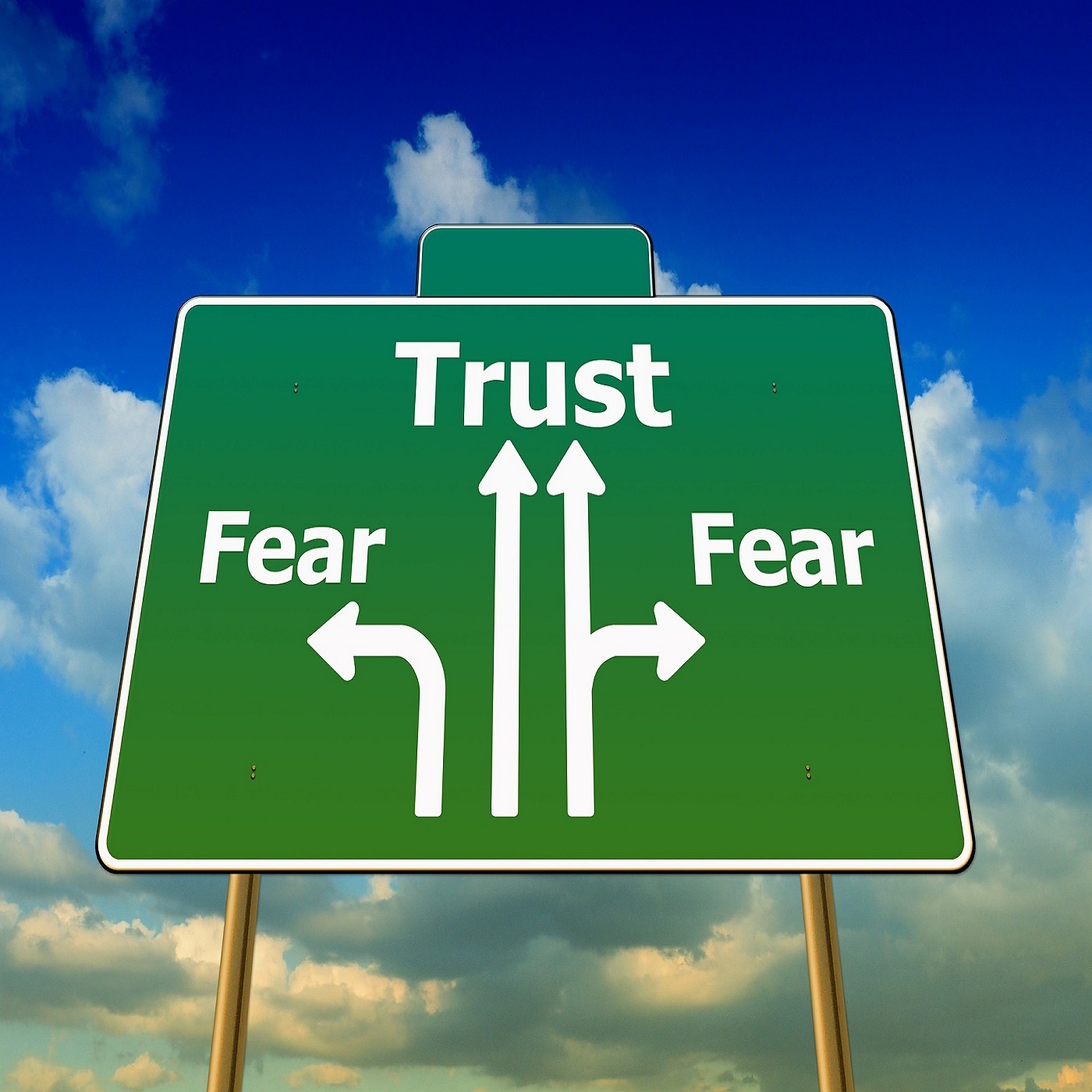
Aug 2, 2024
Aug 2, 2024
9 min
Trust. How do you define it? Typically our definition of it is terribly basic and somewhat shallow. We seem to define it as that ability to rest fully and completely in something or someone. That's about as far as we take it. Yet, the incredible power of trust suggests that it is more . . . much more. Remove trust from a relationship and that relationship simply cannot survive. Extract trust from whatever situation we're in and we will doubt that person or that thing or that event to the point that we withdraw. Erase trust and we simply don't want to go there, wherever "there" is. Take away trust and all you have left is the need to rebuild trust.
You might want to think about this as well. Real trust, trust that does the distance is built over long periods of time with consistency, honesty,commitment and the relentless exhibition of integrity and self-sacrifice. Yet, trust can be destroyed in a matter of seconds. It can come crashing down based on one single action, one errant choice, one impulsive moment, one poor decision, one untimely comment. Trust is both terribly powerful in prompting us to invest in something even at great risk to ourselves. Yet, for all its power it is terribly fragile, undermined and completely fallen with but one word, one choice, one ill-conceived idea, one mistake.
And so, what are the ingredients of trust; the pieces and parts? More importantly, what qualities do we embrace and what characteristics do we live by that builds trust deep into all of our relationships? When we look at trust, we might first ask"what is our role?" The Encarta Dictionary defines trust as possessing a number of key components. Trust is multi-faceted and complex, a labyrinth of pieces that are undergirded by a dualistic theme of integrity and self-sacrifice. And so, do we simply hope for trust, or are we the ones who through our deliberate actions and unwavering choices work to build it? These then are things that we need to build into our lives to build trust in all of our relationships.
1. Reliance. "Confidence in and reliance on good qualities, especially fairness, truth, honor, or ability." In a word, integrity. A person of integrity does the right thing regardless of the cost to themselves. It's an attitude, a life commitment, a unwavering stance that will not bow to unethical pressures, the power of the peer group, the demands of society, or the dictates of the moment. A person of integrity will stand his ground and will choose that which is right and good regardless of the popularity or price of doing so. Such a person naturally cultivates and engenders a foundation of deep trust.
2. Position of Obligation. "The position of somebody who is expected by others to behave responsibly or honorably." There are standards that are good and right. Some call them absolute truths, those standards that dictate all other standards and all other situations. Sometimes embracing and abiding by these brings honor and respect. At other times, abiding by these will incur great cost and potentially damaging rejection. Regardless of the cost, trust is built by standing responsibly and honorably. There is something of consistency is such stands; allowing others to see that regardless of the demands faced and the temptations that might come, the individual will stand firm on principals of justice, truth and integrity. Such actions create a trust that weathers shifting circumstances.
3. Hope for the Future. "Hopeful reliance on what will happen in the future." Trust is about the confidence in people's actions and their commitment to a set standard that creates a confidence regarding future outcomes. We are able to derive from the commitment and actions of others a sense that the future will work out, that will it will have some degree of predictability, and that if it doesn't work out, there will be the means to manage whatever happens. Trust creates stability that even in the midst of instability things will work out. It's about the stuff of consistency; that we are and we will do what we say we are. Trust then is established not just for present, but for the future as well.
4. Care. "Responsibility for taking good care of somebody or something." Trust involves being willing to place that which we value into the hands of others. The things that we value the most, the very things that we have sacrificed for, that we have given our lives over to obtain or protect . . . trust involves placing the things most valued into the care of others. There is a relinquishment in trust; the ability to hand over to someone else all that we cherish and love, knowing that they will be as safe in the hands of another as they would be in our hands. Such a trust means that we can trust even when we cannot be present to insure that things will be well.
5. Responsibility That Somebody Has. "Something entrusted to somebody to be responsible for. Accept responsibility as a sacred trust." Here is the place of sacrifice, where someone holds others interests above their own. Trust means placing the other person first. When someone embraces that kind of attitude and posture, trust is built because the elevation of another insures that any action will be in the best interest of the other despite the cost to the one to whom trust has been extended. This elevates trust to its ultimate level, allowing us to rest in the fact that our best interest will be uncompromisingly held as primary regardless of the situation.
It's About Who We Choose to Be
In the end, trust is built on integrity and self-sacrifice. The exhibition of these attitudes and behaviors automatically engenders trust. Trust is about embracing that which is true and right, that which is honest and just and pure. It's then about relentlessly living those things out in everything that we do, even if living them out incurs a great cost to us. It's a posture of honesty and authentic living that exudes through everything that we do. When these are displayed, trust will follow. We might then ask the question, "are we these kinds of people?" "What have we built our lives on?" "What might others say of us if we asked them?" Trust is about what you stand on and who that makes you. Maybe the building of trust in your life and your relationships is much more about who you are and the things that you have incorporated in your life that make you that person. Maybe the building of trust begins with you. Maybe . . .

Jul 25, 2024
Jul 25, 2024
24 min
We all throw around the idea of having a purpose, or not having one, or wondering if we’re supposed to have one, or whatever we’re wondering. We wonder if we really need a purpose, and if so do we create it or does it already exist and we just haven’t happened to happen upon it just yet. For some of us, we think that the whole idea of having a purpose suggests that life is much more intentional than maybe we thought it was, and that maybe we’re all part of a grand design of some sort.
For others of us who tend to see life as more happenstance, it’s more about figuring out how we can figure ourselves in to whatever’s being figured out around us. In that sense, we create a purpose if what’s around us appears to make it worthwhile or possibly necessary to do so. However, or in whatever way we go about it, we all ponder this whole idea of having a purpose. For having a purpose gives us a desperate sense of purpose when our self-esteem would tell us that we serve none.
There’s something about life that doesn’t quite make sense without a purpose. There’s too much rhythm to life. There’s too much that seamlessly meshes, even when scrutiny of the most exacting kind would not be able to ascertain how it possibly could. There’s a beautiful and even mysterious connectivity that creates a dynamic unifying function, drawing everything together in some jointly corporate effort as a means of keeping everything moving and growing and flourishing. Even the darker side of life, perpetually roiling with its chaos and anarchy has an underlying cadence that maintains the darkness and feeds the destruction. Things have a place and a purpose in that place.
We Need a Purpose
Whatever the nature of our orientation might be, it seems that we need a purpose. There’s a lot of things that we talk about and discuss and debate and ponder and pontificate about in life. We analyze and scrutinize a whole bunch of stuff. And most of those discussions are really all about sizing all of that stuff up in order to determine if we want to engage in them or not. Do we want to invest in those things, or learn more about them, or build some part of them into our lives? Or do we categorize them as wholly irrelevant, blithely toss them aside, and move on from them to whatever the next thing’s going to be? Most of our discussions are a part of this bit of shopping that we’re doing in order to determine to if we want to purchase the product or pass on it.
But when it comes to purpose, it’s not about shopping. Shopping implies that we have a choice. It suggests that we’re leisurely strolling the endless aisles of life working out those endless decisions of whether we want to purchase something or not purchase something. There’s a sense that we can live with or without whatever it is that’s crammed onto the shelves that flank us on our left and on our right. The majority of these things are bright and shiny accessories that simply compliment what we already have or lend a bit of accent to what we already believe in. In the complimenting and the accenting, they don’t necessarily add to what we have nor do they detract from it. Most of them are appealing options designed to supplement something, not sturdy truths constructed to support something. We can take them or leave them without any major repercussions in the taking or the leaving. That’s most of life.
But purpose doesn’t appear to be a bright and shiny accessory. It’s not designed to ‘supplement’ anything because everything else is designed to supplement it. In fact, it’s not an item that we choose to select or not select. Purpose doesn’t leave us with the luxury of deciding whether we’ll choose it or whether we won’t. It’s inborn. It’s how we make sense of our existence as it’s played out within the rest of existence. We have meaning because there’s a role that makes sense of our existence and that serves to compliment everything else in existence. It’s simply not optional for purpose to be an option.
If we’re going to live with fullness, we have to be fully committed to seeking out and working out our purpose. Otherwise, we will exist with a gaping internal vacuum that will leave our lives ill-defined, or worse yet, undefined. And herein we often discover the source of our damaged, raw and bleeding self-esteem. We feel that we have no purpose and that can only mean that we have no value.
The Question Regarding Our Purpose
Therefore, the question regarding purpose is not “do we need one?” The question regarding purpose is far beyond any tangled debate as to whether one is necessary. We can engage in the rather diffuse and ever-shifting debate of whether we have a purpose. We can ponder the subject and bring it under the scrutiny of political leanings, emerging philosophies, wildly divergent doctrines, the voice of the important people in our lives, or other such assorted maladies. Regardless of the microscope under which we put it or the template that we force upon it, it’s not a question to be asked. Rather, it is a reality to be embraced.
Debates such as these often arise from those who would view life as this perpetually shifting expression of whatever they feel moved to express at any given moment. In such scenarios purpose gives way to the randomness of those who demand randomness as a platform to indulge whatever they wish to indulge whenever their mood moves them to indulge it. Or, it arises from those who tightly align the idea of ‘purpose’ with the belief in a Superior Being that orchestrated this existence and our place in it. Wanting to reject all such notions of a God in order to hold tight to the gospel of self-determination, they reject all such notions of a purpose (or at least a divine one). Arguments such as these can likewise arise from those believe there’s a purpose but fear the magnitude of it. In their minds, to know it and to pursue it is to risk failing at it. So, it’s better not to know.
In reality, the question of purpose is simple, direct, but inherently complicated. The question demands bravery. It rises on the belief that we have an utterly indispensable role to play in our own existence because it is not just our own existence. Fulfilling our purpose has an equally critical role to play in the existence of others. It is our part in this ever-unfolding corporate story that we have been granted an indispensable part in.
It is to understand that despite our own sense of unworthiness, we have been given a purpose. The fact that we have a purpose is not so shaky as to be dependent upon our belief as to whether we’re sufficient enough to have one. Quite the opposite. The fact that we have been granted a purpose evidences that we were worthy to have one. But more than that, we were sufficiently competent to play a role whose impact would move far beyond the limits of ourselves.
The Power and Scope of Purpose
To have a purpose is to possess power. For any purpose never begins and ends in itself. It is never that constricted, for then any purpose would be something so anemic that its very existence could not be justified. It never is held to the parameters of the life within which we live. Our purpose always moves out, as it never consolidates itself as a means of always moving in upon itself. Engaging in our purpose and working that purpose out has an influence far beyond the scope of the purpose itself. It is highly influential. It is the thing that builds upon the purposes of those around us, vigorously enhancing communities, nations and the global experience itself. To have a purpose is to possess power. And if we have been granted power of this sort, our value cannot be understated.
In fact, to not ask the question of what our purpose is, is to relegate our lives to mediocrity of the basest sort. It is to question the rationale of our existence as not existing. It causes us to debate the essence of who we are and what we’re supposed to do with who we are, which in fact questions everything that we are. We possess the power and the freedom to ask the question. And I believe that we’ve been granted that authority so that in the asking we might find the purpose. The question is, “What is my purpose?” The question is not, “Do I have one?”
It’s embracing that question and insistently asking it until we have the answer squarely in our hands so that we can begin to live it out squarely in our lives. That action both defines and breaks open our existence in ways few other things do. And it most certainly validates the worth of our existence in ways powerful and profound.
What “Purpose” Tells Us:
First, We’re More Than Just the Sum Total of Our Existence
The fact that we have a purpose evidences the fact that we are more than just the sum total of whoever it is that we are. A purpose says that we have a much larger role in this thing that we call life than just the living out of our individual lives. Life is bigger than any of us will ever be as an individual. Purpose tells us that we’re specifically designed to engage every bit of that expanse. Purpose tells us that everything that’s within us is designed to engage everything that’s outside of us, and there’s a whole lot out there. A purpose tells us that we are far more than just the sum total of our existence because we are called to do something in an existence that far exceeds us. A purpose tells us that we are more than just “us.”
Second, There is Something Greater Than Us That We’re Invited to Participate In
The fact that we have a purpose tells us that is ‘something else’ out there. It tells us that the horizons in life don’t come anywhere close to ending at the end of our existence as the single, solitary human beings that all of us are. The nature of purpose is such that it will always be bigger than us and it always live beyond us. It grants us the opportunity of legacy. It extends our influence beyond our own death when we’re no longer here to extend it. These unshakeable realities substantiate the fact that there’s more out there than we can possibly imagine. Purpose not only invites us out to embrace the wonder of imagining all of that, but it extends us a priceless invitation to actually step out into it. Gratefully, a purpose tells us that we are not the end of all that there is. In fact, ‘we’ are barely the beginning, and that in and of itself is wildly exciting. A purpose says that the ‘out there’ is far, far greater than the ‘in here.’ And it invites us out to freely run in it, to exuberantly play in it, and to potently transform all of it in the running and the playing.
Third, We’re a Piece of a Much Larger Puzzle That’s Would be Incomplete Without Us
Our purpose tells us that this massive world out there, as huge as it is, is sorely incomplete without us. As big and as enormous and as complicated and as intricate as the world is, it remains less than completely complete without us. We have a purpose in this world that only we can complete. Large or small, complicated or simple, breathtaking or life giving, regardless of what our purpose is, the world will be incomplete unless we fulfill it. That makes each and every one of us terribly important in ways that most of us never even consider, and few of us even remotely conceptualize. We are utterly irreplaceable which makes every one of us invaluable beyond any sort of monetary reckoning that we could hope to calculate. Everything that’s out there will be less than everything that’s out there if we forsake our purpose. And that fact makes us incredibly valuable.
Fourth, We Do Not Need to Surrender to the Mundane
Our purpose tells us that life is intentional. It is to live out something not in the frustration of random happenstance, but in something for which this life was purposely designed. It tells us that we have the power and the mission to vividly enhance life, rather than living in some terribly foreboding mindset while we sit on ‘pins and needles’ anxiously waiting to see how life is going to play itself out. There is a destination that has enough meaning and sufficient value to call us to the challenges that will certainly be part of fulfilling that purpose. That we are not here to aimlessly pass by and leaving nothing in the passing. To the contrary, our existence is designed to live on beyond our existence. To leave a bold legacy of generational impact. To fight against all that fights against us in order to create space and grant opportunity for all of the things that would wish to live within us to be expressed outside of us. And to do this for those in that walk beside us as well as those who will come behind us.
Fifth, We Can Deny It
Could it be that the first and foremost purpose of ‘purpose’ is to convince us that we have one? Is it likely that our purpose can only be fully manifest in a manner utterly transformational when we are convinced that we have a purpose to manifest? Possibly the most brilliant way that ‘purpose’ can do that is by granting us permission to deny that we have one. However rigorous the nature of the argument might be against having a purpose, we bring it to bear in our defense and we passionately pound whatever podium we’re pounding on in that defense. And any reasonable person would hold that if we’re putting so much thought, energy and passion into a defense of this sort, there must be something there to defend against. Therefore, it is our own arguments against having a purpose that substantiates our actually having one.
We Don’t Have to Create a Purpose, We Only Have to Find It
Purpose is not something that we create, or have to create, or can create. To do what it does, it must be exceedingly greater than what we could ever create it to be. It’s not something that we create because it eclipses our vision and it lays leagues beyond the scope of our creativity. If we’ve created something that we’ve defined as our ‘purpose’ and we’re chasing after whatever that is, what we’re chasing is probably a nice idea or some collection of ideas. But it’s not our purpose.
Rather, purpose is something that we find. It’s not about tediously constructing some sort of purpose out of the scattered pieces and errant parts of whatever we understand ourselves and our lives to be. It’s not about rummaging around the confines of our existence looking for ideas, or sitting and awaiting the arrival of one of those ever-elusive moments of inspiration. It’s not about figuring out how we build it or where we get the parts from in order to build it. God’s done that work already, and He’s done it with absolute perfection. Neither is it about about earning it, for it was always yours and it was never not yours. Your very existence unarguably speaks to the fact that you have one.
We just need to commit ourselves to finding it. Not earning it, but finding it. Not piecing it together, but discovering that it was never in pieces in the first place. Next to our search for God, seeking out our purpose is one of the most phenomenal adventures that we will ever have the privilege of undertaking. As we’ve noted, it’s a treasure hunt of the greatest sort. It’s an adventure that leaves all other adventures as largely adventure-less. It’s seeking out the very thing that we were designed to do. It undergirds and gives meaning to everything else. It is the rationale for our existence laid out on the table and explained. And it’s there to be found if we commit to the search.
We Were Made for Our Purpose
Once we begin to quit denying our purpose or quit attempting to manufacture it, the nature and fabric of it will begin to coalesce. With this ever-emerging clarity, we may well find ourselves increasingly paralyzed but subsequently awed by both the size and gravity of it. It’s imperative that we understand that what we are seeking is decidedly bigger than the sum total of who we are. In fact, if we dare to explore it fully it will eventually tower over us, for anything less is less than a purpose. It’s big because it’s supposed to be. It’s big because we were created big.
Therefore, the immensity of a purpose too often dictates the intensity with which we are prone to flee it. Yet, if we understand that we are explicitly built to perfectly mesh with this gloriously enormous thing that we call ‘purpose’, we begin to understand that we are finally at home in way we’ve never been at home before. We sit with something huge because we are created by a God Who is huger still. Therefore, to be paralyzed by the size is to miss the fact that a purpose is not to be managed. It is to be done. It’s not to be sized up. It’s to be lived out. And once we’re there, the size of our purpose becomes utterly exhilarating instead of profoundly intimidating.
To Not Seek Out Your Purpose is Only to Exist
Yet, many choose not to believe that they have a purpose, or they believe that they have one but don’t bother themselves with finding it. There are those of us who succumb to a life of mindless tedium, or a pathetic routine where we senselessly march in lock-step with a world around us that’s forsaken its purpose as well. There are those of us who readily embrace the pabulum of mediocrity which declares that things are about as good as they can get, so we’d better just settle for what we’ve got.
We surrender to a purposeless existence which is surrendering to death way ahead of death’s actual arrival. And the sad story around all of this is that the majority of people will walk the journey of life down a road flat, never ascending, and rarely challenging. Many of us will know nothing other than a directionless cadence, having left the footprints of our lives meandering down a road that’s meandering itself. Eventually the road will lead to wherever apathy and mediocrity pave it. And we can be certain that it will never lead to whatever our purpose was.
Your Purpose Awaits
You have a purpose. Despite your low estimation of yourself, you have a purpose. It stands eager and ready to be discovered. Purpose is never going to be so elusive that you can’t find it simply because purpose is deeply desirous of being found, seized, unleashed and ultimately achieved. In doing so, you will change your life and the lives of those around you, because when you embrace your purpose nothing less than change can happen. If you don’t seize your purpose, you will live out an anemic life and the world will be the poorer for it. Your existence will be of marginal effect, if any effect at all. And that reality is nothing short of tragic. It’s time to ask one of the largest questions that you will ever ask yourself. And that question is, “What is my purpose?” The fact that you exist endows you with the right to ask that question. So, let’s begin shaping and exploring that question.

Jul 24, 2024
Jul 24, 2024
25 min
Success has been accorded an endless array of definitions. Some of them are crafted to make failure seem more like success so that we can limp through life and fail without remorse or guilt. Other definitions are quite lofty, written to give us opportunity achieve in a manner that has little to do with the achievement and everything to do with restoring blunted self-esteems. At times success is defined by whatever will accord us the accolades of others or advance us socially or professionally. At yet other times, the definition of success is more about giving ourselves a sorely needed boost when our spirits have been lagging.
Sometimes definitions are crafted as we go along, granting us permission to fluidly and rather nonchalantly alter the definition of success in order to form-fit whatever the outcome of our choices have been. In doing that, we have granted ourselves full license to define the outcome in whatever way suits our choices. We can craft a definition of success to embolden a faltering cause or create support when our base is splintering and our people are wavering.
Then there are other times when the definition of success is modified to diminish the works of those we’ve come to abhor and elevate those upon whom our favor has fallen. Some definitions of success are those shaped by the shifting pen of political correctness, or the placating tenets of the culture, or by the gnawing need for acceptance, or formed from the dictates of a particular social grouping that demands adherence to a prescribed set of standards. Sometimes success is defined by the proclamations of some revered leader, or the family system that we grew up in, or the job description that shapes our nine-to-five lives.
Lost in the Array of Definitions
Whatever and wherever their source, a dizzying array of definitions abound. Many seem to be a target created after the trigger was pulled, making every decision a bulls-eye even if the aim was horrid. Some are thrown out because they’re easy, or we’re not certain what success is so we just come up with something that might pass for success if people don’t pay too much attention. And in the squalor of definitions gone awry and rogue, we seem to have lost a genuine definition of success.
Subsequently, it is this mad array of definitions that sends us scurrying in a million different directions in order to be successful in whatever way success is defined at the moment. We might not know what success is, but if we do well enough in enough areas, or if we adhere to enough of the things defined as trendy and vogue, or if we chase whatever everyone else is chasing we just might happen to land on something successful. Maybe it’s the proverbial ‘shot in the dark’ that might altogether miss, yet the fact that we took the shot itself was defined as success regardless of what it hit. In the end, success becomes more defined by figuring out exactly what success is rather than actually fulfilling the definition.
Why Success?
It's interesting that success, in whatever manner it is defined, has come to define our worth and value. That’s why a lack of perceived success will tank our self-esteem quicker than just about anything else. Success appears to have become the litmus test as to the credibility of our existence and the unforgiving gauge of our worth. Success has evolved into the exclusive commodity by which we ascribe value to ourselves and others. It’s the thing that gives us status, grants us credibility, authenticates what we say, lends weight to our opinions, and awards us with the sense of a life well lived. It is the crown jewel of our existence; something to be vigorously pursued and rigorously obtained at all costs, for not doing so is a life squandered, opportunity lost, and self-esteem decimated. We are led to believe that to ‘not’ be successful is to live out the story of this sorry existence of ours without having validated the legitimacy of the existence that we wasted.
Fear of Questioning the Definition
Success becomes so acutely defined and so irrevocably defining that we seldom entertain any other possible definition. We find ourselves entangled in the culturally mandated definition of success, or the definitions imposed by our families or friends or occupation. We become so absorbed in the sorting out and the achieving of those definitions that the endeavor to achieve them becomes inordinately consuming. We have little tolerance to question the definition of success because we were told that we shouldn’t...so we don’t. Or, the pursuit of it is so intense that we never stop long enough to question it. And if we did, we fear that the cultural definition might be incorrect or our families would get sufficiently perturbed that our lives will have forever run amuck because we missed the cherished mark in the questioning of it. So we don’t question it.
Therefore, given that the defining scale of success has assumed such a dominant role in our culture, and given that we presume there to be some golden definition out there, we must find a definition for it or at least write one that would be approved of. Otherwise we have no precise framework by which to determine our success or lack thereof. Once we feel we’ve landed on the singular definition of success, we throw ourselves into the chase for fear that our lives might devolve into obscurity, our legacy might be pathetic, and we ourselves remain contemptible. But what does this mean in terms of how we’ve come to identify who we are and in that, how we’ve attempted to determine the value of who we are?
What We Do or Who We Are?
As we have noted in a previous chapter, too often the yardstick that we use to measure our worth is defined by ‘what we do.’ What we do is measured by a series of accomplishments, the manner in which we have embellished life through those accomplishments, and the achievement of goals lofty behind the imagination of the common man and far beyond the reach of the hoards. It’s understanding what’s fundamentally achievable and then embracing the belief that our worth is defined as raising oneself significantly above that which is fundamentally achievable. It’s being intentional about ascending to some lofty escarpment that we ourselves had deemed impossible to surmount. Therefore, the definition of success is the measurement of accomplishment.
In applying this standard, we evidence our worth as held up against the enormity of the task itself and the manner in which the everyday person accomplishes the task. If we can eclipse both, we feel that we have established our worth by virtue of these comparisons. But eclipsing both requires determining what success is so that we know we achieved it. ‘What we do’ is granted credibility by whatever our definition of success is. Without the definition, we have nothing by which to measure ‘what we do.’ We won’t know if we hit it or not. And in our minds, if that definition hasn’t been met or if the bullseye hasn’t been hit, everything that we do becomes the everything that achieves nothing.
The Flaw of Success
Yet, the nature of such a mentality of success demands that we constantly achieve. It is an effort of insanely perpetual works that requires that we continually prove our worth as the previous success eventually fades sufficiently to demand a new one. Sure, we can define it. But success as used to determine our worth and value is always temporal. It’s always moving. Therefore, we become enslaved to successes that demand nothing more than other successes. It becomes apparent that success is a temporary aphrodisiac that will always demand more of itself without helping us develop any sense of worth regarding ourselves. Understanding this, success then might be best defined as breaking the need to be successful as a means of proving our value.
We need to break this need to be successful due to the fact that success becomes a morbid cycle where we become successfully defeated. As noted, success in and of itself is not a problem nor is it bad unless it becomes the standard by which we measure our worth and value. Success that evidences our worth must be repeated without an end to the repeating because there is no success great enough to grant us a sustained sense of worth and value. We are worth far more than any success might impute. Because that’s the case, success must be revisited again and again because it can speak little into something as vast as we are.
We Are Too Big to Be Defined By Any Success
As we noted in a previous chapter, our value is not based on ‘what we do.’ Rather, it is based on ‘who we are.’ If we remain stuck with the feeling that our worth is based on ‘what we do,’ the definition of success is what lends credence to those efforts. The definition of success gives ‘what we do’ a mark to shoot for and a distinct line to cross. It lends clarity to where we’re going and when we get there. Yet, we can hit the mark and cross the line and raise our arms in ardent celebration with our self-esteem none the better for the experience.
Success is irrelevant in respect to our self-esteem as any definition of success regardless of how lofty does not possess the power to sustain our sense of worth or feed our sense of value. When it comes to our sense of worth and value, success is the thing that’s not the thing. It’s been marketed as the snake oil for our self-esteem by the carpetbaggers of our culture, but it’s snake oil only. The quietly alluring aspect of success is that it promises a perpetual sustenance and feeding of our self-esteem. It whispers the message in a rather seductive and convincing manner. Given that the culture has fallen for its smooth talk and has subsequently run pell-mell after its message, its legitimacy is reinforced.
However, it is always in need of resuscitation. Success cannot do what it promises to do. It can’t deliver on time in any time. It comes with wild promises but empty hands. It spouts great platitudes that thrill the listener, but it crashes with such force that it shatters the eardrums. With such an apparently irreconcilable flaw in its makeup, it would be worthwhile to postulate that our worth must be based on something significantly more consistent and profoundly more fundamental than success.
We Want to Define What Defines Us
The great rub that keeps us from getting out of this rut is that we want to define what defines us. We can acknowledge that the definition of success does not grant us worth and value. We can understand that, believe that, and come to accept that. We’ve chased these imposed definitions long enough to know that the chasing never resulted in the catching. But instead of understanding that our value is not based on any definition of success, we determine that the definition is wrong and that we can right that.
When the promise of those definitions begin to falter, we secretly being spending our time covertly crafting alternative definitions. Since this other route has failed us, we can craft life, impose the values, shift the circumstances, and modify a host of other variables that eventually shape a fresh definition of success in order to give us a maximum chance of success.
The failure lays of all this in the fact that we did not learn from the failure that we just experienced failing at. We’re repeating the very thing that we said we’re no longer doing. We didn’t learn that it can’t be done. We just thought that it couldn’t be done the way that society did it or our families did it, so we will do it differently. We missed the fundamental lesson our value is not based on what we do as defined by the definition of success, regardless of who creates the definition or how appealing it might be. We lived the lesson, but we missed the very thing that we were living. We missed the lesson that maybe success is believing that we already are a success by virtue of our existence and that our calling is not to prove it, but to act upon it.
It’s the pursuit of success and the failure of what it promises that leads us to errantly believe that we are not successful. That we have failed being successful, or that we were not successful enough. That maybe we were deluded into thinking that we were successful when we weren’t and we just didn’t know it. That in some capacity and in some manner that we’ve yet to identify, we failed even though we honestly thought that we didn’t. In fact, we didn’t fail. Rather, success failed us because it cannot deliver what it promises. So, there must be another avenue.
Value Based on Who We Are
As we noted previously, maybe we should dare to consider that our worth does not need to be established either by effort or definition. Maybe we should consider the possibility that it has never ‘not’ been established. That success was achieved by the fact that God decided to designed us and then deliver us into a far larger design to make an impact in and upon that design. We’re here, and that itself is a success.
Everything that we do from here forward is not about success, for success has already been achieved by the fact of our existence. It’s about calling. It’s about fulfillment of the purpose that we’ve been given the privilege to fulfill. It’s about honing in on our purpose and purposefully carrying it out. It’s about obedience to the call, not the adherence to some definition that measures our obedience to the call. It’s doing all of that knowing that our worth and value exists by virtue of the fact that we exist. From there on out, it’s about the doing and not about the proving.
If this is the case, then the attempt to establish something that is already established is about attempting to prove something that is already true and has always been so. And if that is true, it doesn’t need us to establish its value. The need is for us to believe it. To work it out in our attitudes and live it out in our lives. To rest in it and on it even at those moments when we don’t feel it. To speak it into our existence when the world would speak something entirely different into our existence. And that rests squarely upon us.
Thinking a Bit More Deeply
It would therefore be wise to consider the possibility that our worth is based on something so profound and unerringly rich that its worth singularly speaks for itself. Something that does not need to be proven simply because it is established in a manner that the need of proof is the weakness of our vision and not the fact of reality. It would make sense that our worth should be, and in reality is based on something that cannot be proven for any other reason than its value lies forever beyond the most magnificent achievements that would serve to even remotely evidence it.
Could It Be That We Are More?
Could it be that we are more than we are? That we have a limit that has no limits? That in fact, we are not destined for limits, and that any that we have are those that we have taken upon ourselves? Are we set apart from the rest of our existence because we are not bound to that existence? We are forever pressing against the boundaries because we assume that something exists beyond them and that something exists within us to take us beyond them. We have this sense that our limits are nothing more than opportunities to expose these limits as the next step to the next place. We are always pressing ourselves outside of ourselves. The life truly lived is the life that is always calling itself outside of itself. Therefore, at what point do we reach this impenetrable wall that defines the end of whatever it is that we are? The answer is, we don’t. And we might ask why we don’t.
I would propose that next to God Himself, the thing of single greatest value is ourselves. The priceless nature of a single human life, despite the manner in which we’ve blithely degraded that worth, is wholly immense. And this immensity is utterly inestimable on so many indescribable levels that proof stands as entirely irrelevant.
Human beings stand as the most definitive accomplishment of creation, positioned as the pinnacle of a creation that is indescribably marvelous in and of itself. We are the final touch of the cosmos themselves. We are the defining brush stroke of a creation that encompassed the galaxies, raised up mountains, gouged out canyons, threw birds into flight, painted fiery sunsets, and spun the mesmerizing diversity of the seasons. We are the thing for which these were created and we are the things that have been vested with the most improbable but most privileged job of caring for them.
We are God’s defining work. There can be no shade of arrogance or darkening of pride in such a reality as that would only serve to sadly mar us and leave us with a diminished countenance. Indeed, we should be inordinately humbled that we are God’s crowning achievement and that alone grants us inestimable worth. It is not about proving our worth through the sweaty efforts of success or achieving some definition thereof. It is about realizing successes of even the loftiest sort and boldest character could not in and of themselves prove our worth, for our worth is entirely inherent, undeniably priceless, and established in the fabric of creation itself.
Achieving for Sheer Pleasure, Not Proof of Value
We would be wise to embrace the liberating reality that we can achieve in life for the sheer pleasure of achievement, rather than as a despairing effort to establish our worth. We can walk through life with vigor and tenacity out of a sense of worth, not out of some desperate effort to prove our worth. We change things and we change the course of things because we have been privileged to possess both the ability and the permission to do so. Life is engaged, energized and inspired by our worth, rather than depleted in the pursuit of it. Our days are lived embracing the reality that our value is based on who we are, and to embrace that liberating reality is to embrace a life liberated.
The Viciousness of Low Self-Esteem Explained
In light of this, low self-esteem is the antithesis of who we are. It is ourselves fully removed from ourselves. It is the ultimate scorched-earth mentality that leaves the massiveness of who we are engulfed in smoke and razed in ashes. Of course low self-esteem is brutal. It must be if it is to have any impact upon the immensity of who we are. We are a vigorous lot, despite our frequent ignorance regarding that fact. Therefore, a low self-esteem must be relentless lest we shake it and reclaim our authentic selves in the shaking. Our enemy is formidable. But our resources are more formidable yet. Self-esteem would tell us that this is not true out of the fear that we might discover that it is and therefore bring the full weight of ourselves against it. You are what you don’t see. You will always be what you don’t see even if you choose to never see it. This is who you are and this is what you are.
If we cannot embrace this indispensable reality, we will be irreversibly stunted by the limitations of the achievements we pursue. We will chain our potential to the baseness of achievements. When we do, the infinite worth that defines us will be forever overshadowed by the shallowness of achievements, for the greatest achievements will never come close to reflecting our true value. Your value is based on who you are, despite what you do. And that is a critical but glorious shift that we each must make.
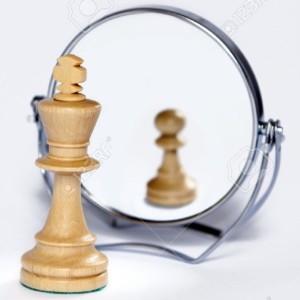
Jul 23, 2024
Jul 23, 2024
24 min
“Who Am I?” What the Question Evidences
“Who am I?” The question seems a bit overused these days. It’s something more like a vogue, trendy kind of question that pulls us out of the doldrums of living among the masses and plants us in the more desirable currents of the intellectual mainstream. In our culture, I tend to think it’s less about thoughtfully unearthing who we are as a means of living in awe of what God wrought within us. Rather, I think it’s more about creating something that’s culturally acceptable and that adheres to the contrivances of whatever trend is currently trending in the culture. It’s the creation of a self suitable to the world rather than discovering who we are as both in and above the world.
The question of ‘who we are’ suggests that we’re exercising our intellectual acumen to probe our existence. That exercise itself lends weight to the fact that we have an intellect to exercise and an existence to live it out in. By its very nature the question of ‘who we are’ poses the thesis that we are something other than being nothing, and that ‘something’ has relevance when ‘nothing’ doesn’t. By asking the question we reveal the need that we possess to believe that we exist and that our existence is purposeful. We want to believe that we are supposed to become ‘something’ rather than float around being ‘nothing’ going nowhere in the going. To ask the question is to evidence the fact that we are beings in need of asking the question. And that in and of itself evidences the incredible depth and unparalleled richness of our humanity.
In addition, the question of ‘who we are’ also suggests that a simple answer is simply not suitable. That some cheesy pabulum will not suffice. That the definitions proposed by innumerable philosophers and those who for centuries have probed the inner-workings of life aren’t quite enough. That holding ourselves up against everyone else in order to grasp some sense of who we are by comparing ourselves to who everyone else is simply repeatedly comes up short. That aligning with political hashtags or running off after a litany of causes that have caught the wandering eye of those without a cause don’t answer the question. That even though we’ve gorged ourselves on self-help philosophies and immersed ourselves in the rigors of mindfulness (or any one of the many other popular contrivances) we still don’t have the answer.
And that is not necessarily that all of these things are incorrect or that they don’t speak something of truth into our lives. It’s not that at some level they don’t have some sort of value. It’s that they’re not enough. The cumulative weight of their collected insights falls short. Mankind has asked the question of “Who am I”? for as long has mankind has existed. And yet in the end, we don’t have an answer that explains the whole of who we are. After untold millennia we are still on this search and we are still asking this question.
And if all of this evidences anything at all, it evidences the depth of our depth. It speaks to the innate and persistent complexity of who we are. Stored within the body, mind and soul of each of us there is a vastness that all of the combined explorations of mankind have yet to fathom, much less understand. And can we not correlate this complexity and depth with our value? Everything in existence has value for the place that it holds in relationship to everything else in existence. But we stand apart in complexity, intellect, reasoning and ability. We have been equipped for and tasked with the responsibility to care for everything else and nothing else has been assigned that role…except us. Indeed, does this not evidence our value?
How Do We Not Know?
The ever-baffling fact regarding the question of ‘who we are’ is that we live with ‘us’ every single solitary day of our existence. Yet, even though we live with ‘us’ with a transparent intimacy that no one else in all of existence ever will, we still don’t know ‘us.’ How could that be? How could we wake up every day and go to bed every night with this person that we are and still not know who we are? How is it that we walk through the myriad array of dynamics and demands of life and living, and somehow not see ourselves in the act of dealing with those things? How have we lived with ourselves yet missed ourselves in the living? Yes, as we have stated, we are phenomenally complex. However, is there something else?
We Don’t Want to See
One answer is that we don’t want to see. We don’t want to see because we fear that if we actually look at who we are, we might not like who or what we see. It may confirm our deepest fears about who we are. It may affirm the presence of something we desperately hoped wasn’t there, or it may confirm the absence of something that we hoped was. It may convince us that we really don’t have the capacity to achieve the dreams that we want to achieve. It may corroborate all of the negative things that people have said we are, when we’ve spent our lives fighting against believing that that’s who we are. We may choose ‘ignorance’ as opposed to ‘knowing’ so that we can continue wearing the weathered façade that we’ve found comforting, in whatever way it might comfort us.
Or, looking at ourselves might actually confirm that we are better than what we thought ourselves to be, which will result in some sort of accountability that we don’t want to be accountable for. It may highlight rather formidable parts of ourselves that we haven’t cultivated, or personal resources that we’ve wasted in the wasting. It may reveal potential that has languished in the pit of ignorance, or giftings that have been left to rot in the sewers of apathy. It may call us up to places that we don’t believe we can go, leaving us greatly vexed by the contradiction of it all. So, we don’t want to see because seeing is just too painful, or too demanding, or too burdensome, or it comes weighted with too much guilt.
Becoming What They Want
Or, we’ve spent our energies not coming to understand who we are, but vesting those precious energies in becoming whoever it is that everyone says we should become. There are demanding social pressures to adhere to. Heavy-handed societal expectations that press us for compliance. There are those who are committed to whatever politically-correct agenda they’re committed to who are easily aroused and readily enflamed to rage should we refuse alignment with their agendas. There are the voguish trends that demand adherence lest we be labeled as outdated or just plain ignorant. There are the expectations of parents that rest heavy upon us, and the voices of well-meaning mentors that too often called us to some vision of who they thought we were. Therefore, we don’t have time to see ourselves because we’re spending our time trying to become another ‘self.’
Pressured to conformity by these elements, we develop this sectarian view of what we should be. We’ve collected this societal and relational collage that appears to be a perpetually changing montage of what we’re supposed to be. Somehow this becomes the standard template in place of ourselves being that standard. Over time, we are lulled into believing that the pursuit of this template is the truest pursuit of self, when it is nothing of the kind. And we become what we are not.
Being What Circumstances Made Us
It’s possible that we might have determined that it’s not who we are, but who circumstances made us to be. Abuse as a child. Bullying at the hands of thoughtless people bent on propping up their own fragile insecurities at our expense. Jobs lost in acquisitions that sacrificed employees on the cold altar of budget and profit. Marriages that collapsed at the hands of spouses who decided that the trade-off for personal agendas as held against the life of a marriage and a family was legitimate. Enemies that we mistook for friends who slowly circled around behind us and stabbed us in one of the many ways that people stab others. For us, these answer the question, “Who am I?”
The wounds, the disappointments, the betrayals, and the losses both large and small have defined us. In addition, the process of healing from the wounds inflicted, as well as angst involved in waiting for the ones that are yet to happen further define who we are. The embracing of an existence defined by what happened to us, further shaped by what we fear will happen becomes the sum total of who we are. Our lives become a tragically circular story of being wounded and then healing only to be wounded yet again. The difficult issue in being defined by our circumstances is that to understand how all of that has defined us means that we have to think about how all of that has defined us. And in our mind, the pain of doing that far, far offsets any potential self-discoveries. So we don’t think about them (or at least we try not to).
There’s Nothing to Discover
Or, we don’t feel that there’s any identity to discover. That somehow we are the embodiment of a bunch of ‘nothing’ that will only add up to nothing. That because there’s nothing there, the need for some sort of pursuit becomes unnecessary and embarrassingly ridiculous. We are what we already know, despite how little that might be. Somehow we ended up at the shallow end of the gene pool, or we showed up late when things were being handed out. We got to rummage through the left-overs or we were looked over. There was no motivation to develop anything along the way, or the opportunities to do so simply never came our way. Therefore, we don’t know who we are because we’re pretty much nothing and we already know that.
From nothing you can only get nothing. So we become embedded in a sense of hopelessness regarding both the present that we live in and the future that we have come to dread. The journey of self doesn’t exist because there’s nothing to journey from, and nothing to journey to. There’s a settling of sorts, where we fall into a sedentary malaise. And in this place where everything is nothing, our soul slowly stops breathing.
Other Reasons
Or could it be something entirely different? Could it be that we are vast beyond comprehension? That we’ve mistaken this journey of ‘who am I’ for a destination that gives us a clear and solid answer verses seeing it as a journey where the answer is always fleshing itself out with ever-great clarity as we go along? That we are someone who is perpetually in the process of becoming more of whoever that someone is? That we are not meant to be something that’s stagnant in time and space, but we are something that is always evolving in a manner that we are constantly advancing into time and growing in space? And to understand that is to begin to build a sense of self that will effectively begin to disassemble our negative sense of self.
All of this implies that we are, in fact, created vast beyond comprehension. And this personal vastness is so vast that it gifts us with resources that are beyond the years that we have to live out those resources. We are bigger than our own lifespan. Therefore, ‘who we are’ is based on ‘who we are in the becoming of who we are.’ Who we are is not defined by some sedentary event such as an alliance, or someone’s expectations of us, or the events that have befallen us. And unless we understand that, we will have missed the process of becoming who we are by looking for an answer in all the other things that can’t answer the question.
The Size of ‘Who I Am’
We have been gifted with a depth that will invite exploration and make space for such exploration for the entirety of our lives. We will never discover something about ourselves that will be that distinctly final discovery that concludes the journey. New vistas, fresh insights, and breathtakingly vast levels of awareness always await. We are entirely fluid, having each thing we learn expand upon everything that we learned before it, and subsequently enhancing everything that we’ve yet to learn. We grow geometrically, moving out in every direction at every moment in a continual cascade of growth. The end of who we are exists only as a figment of our sorely limited imaginations and is an outcome of the fear that maybe we are more than we’ve allowed ourselves to be.
What we do know is that we are the sum total of what we know about ourselves, plus the infinitely larger part that we don’t know. There will never be the final question. That every answer to every question is an invitation to the next question and the next one after that. We are people made of horizons and for horizons, and if perchance we live within walls, it is we who have created them. The question of “Who am I?” is not one question answered by one answer. It is a robust collection of questions that slowly but deliberately reveal the tantalizing picture of who we are. It is an adventure of the greatest sort. The hunt for treasure that captivates all of our imaginations. It is discovering the genius of God as that genius was manifest within us without any hesitation of any kind. Hence the question, “Who am I?”
This search itself blatantly evidences the fact that we are bigger than ourselves, for if we knew everything about ourselves a search would be unnecessary and the questions unprovoked. There is more to us than we know, and even though we live in union with ourselves every day we remain a mystery to ourselves. Despite our low self-esteem and incessant deprecation, the question of who we are evidences that there is more to us than we realize. And if we walk this search for self out, at some inherently deep level we know that ‘who we are’ is so vast that we will spend the entirety of our lives in search of it, yet we will never know all of it. And if the whole of us is beyond the whole of a lifetime to discover, how indescribably grand must we be? And maybe this is what should shape our self-esteem. This is how we should view ourselves. This is what fires our imagination and fuels our journey.
Seeking the Answer Verses Searching for Peace
The question then begs the search, which can be unsettling for many. The penetrating angst and unrelenting curiosity generated by the question of ‘who we are’ is the impetus that sends us searching for some sense of peace about who we are. This peace is not necessarily obtained by having some answer to the question of who we are. To our own demise, the frenzied search to calm our souls in this grand search often sends us into the ‘plug-and-play’ of a culture ready to give us the once-over and then plug us into whatever the once-over has determined us to be. It becomes something of a search for the defining box that our careers hand us, or the identifying label that our social circles have crafted for us, or the place that our socio-economic defines as ours, or the role that our family or friends have etched out for us.
There’s a myriad army of people and philosophies and social structures ready to dress-us-up and deck-us-out in the borrowed garments woven of their biases and stitched tight by their sordid agendas. Should it have its way, the world would abscond with us, embezzling our resources in the service of its agendas. And while all of these might give us an identity, that identity is borrowed or imposed or both. Suffice it to say, an identity either borrowed or imposed is a costume parading itself around as something it is not. At best, it may grant us a fragile and fraudulent peace that we gladly mistake for the real thing.
However, it lacks sustenance and stability. Typically, it’s constructed to fit a space suited for those who created it, rather than knock down the walls that have constricted us. It’s what fits them, but what enslaves us. Therefore, we have to repeatedly adjust it as we might, tear it down when we tire of it, build it back up when we’re scolded for tearing it down, and repeat the worn out narrative of why this is us and why it works…when it’s not and it doesn’t. Subsequently, the question goes unanswered because we don’t have the time to ask it.
Because it doesn’t work, our low self-esteem sits on forlorn hands and tells itself that the search is impossibly complex and that we would wise to relegate ourselves to some static existence of some sort. We are either nothing, or we are something that we are not, or we are all things bad built upon all things bad. We end up in one of these places because we’ve come at this defining question from every possible angle except the right one.
Within Not Without
As patently simplistic as it sounds, we are defined by who we are. We need not reach out to everything around us in order to define that which is within us. If we reach out to something or someone outside of us in this search for self, whatever or whoever we reach out to needs to walk us back inside of us because that’s where we are. It’s about being intelligently introspective in a manner that is intentional, thoughtful and relentless. It is about peeling away the sticky layers of culturally imposed norms, digging through the impregnable strata of our histories, breaking out of all of the superimposed roles, and rigorously erasing all of the rogue messages that others have penned across the tablet of our souls. And in the upheaval of a process that grand, it’s then formulating the right questions hoping that we’re actually daring enough to ask them.
In this rigorous process, it’s not about evaluating what we see as held against some clandestine societal rubric or chafing personal bias. Rather, it’s more about accepting what we see and asking how it can be shaped, honed, cultivated and nurtured. It’s about believing that we were created with all the essential elements to become the essential person that we were intentionally and rather ingeniously designed to be. It’s about understanding that there is a specific role out there somewhere that’s waiting for us to show up and that it’s probably sitting a whole lot closer to us than we think it is. And the best way that we can show up for that role is to come as we are and not as the world says we should come. It’s presenting ourselves before the God that created us, stepping into the life He set in front of us, and believing that it will unfold if we just show up for everything to unfold.
This is not about giving ourselves permission to spin off on some ill-defined quest of self-indulgence, for our true selves won’t find themselves shaped for that kind of agenda. This is not about permission to become absorbed in a self-satiating endeavor where we suddenly realize that life is ours for the taking when we’ve spent our lives having life take from us. Rather, it’s respecting our authenticity as being something that adds to life rather than adds to self. It’s about realizing that our true self will never detract from the true selves of those around us nor will it ever impinge upon them. And if perchance it does, it wasn’t ‘us’ to begin with.
You are uniquely designed with everything you need to be everything that you are. And that design is sufficient to be able to do everything that you were designed to do. It is big enough to exceed your lifetime. You may not see it, but as have noted, seeing something does not evidence its existence or lack thereof. It’s coming against the lies that have been spun about us, the identities that have been forced upon us, and breaking the box that other more fearful people have crafted for us. Despite the nature of your self-esteem and the darkness that it has layered ‘round about you, may the quest to discover all of this be relentless in it’s scope, potent in it’s process, and blessed throughout.
Jul 22, 2024
Jul 22, 2024
26 min
The Self That I Long to Believe In - The Challenge of Building Self-Esteem
“We’re driven. Whether that’s for our good or our ill, we’re driven. That drivenness may be born of a free spirit bent on living with unimpeded freedom, or it might be a drivenness used to hold ourselves captive. It might be a drivenness to face ourselves, or a drivenness to run from ourselves. We can be driven to do great things, or to hide from great things. Being driven grants us the ability to fly, but we can use it just as readily to die.
If we are bent under the weight of a low self-esteem, our drivenness is often exercised to our own demise. It’s used to create places to hide, excuses to run, rationalizations to justify the awful person that we are not, and the freedom to embrace beliefs about ourselves that have no basis in reality other than the reality we’ve crafted from the skewed messages of others. On the other hand, we might become driven to prove ourselves as worthy through various accomplishments and achievements. We work, we strive, we reach, and we relentlessly press on to show that we are more than what we’ve come to believe ourselves to be. If we fail in such an endeavor, we’re driven to convince ourselves that we are nothing of the sort so that we don’t ever take on such a preposterous task ever again. Either way, we possess a drivenness even if it isn’t used in our best interest.
Driven to Prove Our Worth
Maybe this whole mentality of drivenness has been a product of our life story; having to do it all ourselves because no one was there to help us. Maybe this left us with the need to prove ourselves and to establish our worth by whatever means we chose to prove that. Often we have the need to display our intellectual prowess, to exercise the muscle of our skill-set, or flaunt our expertise in order to secure our place in some sort of ill-defined and vague pecking order that defines our sense of worth and value. Our identity then becomes entirely defined by all of the things that we do to prove our worth and the efforts that we put forth in doing them.
In some instances this happens because we’ve lived in someone’s shadow and we need to show ourselves as bigger than the shadow that was cast upon us, or at least prove that we’re as big as whosever’s shadow that was. At other times we’re out to prove people wrong, to conclusively show beyond any shadow of a doubt that we’re competent even though people repeatedly said we were entirely incompetent. It can be the product of a deeply ingrained behavioral pattern where we grew up being affirmed when we performed, with such affirmation being clearly withheld when we didn’t. In the end, it’s typically ourselves that we’re really trying to convince simply because the toughest audience that we play to is ‘us.’
Driven to Prove Our Lack of Worth
Or we’ve done the opposite of all of this by being driven to surrender to minimums. We’ve decided to withdraw from it all and just do what we need to do to get to the next day. It’s about being driven to draw away and hide so that others won’t see us for who we are and thereby judge us, or we won’t see them and subsequently judge ourselves by comparison. We’re driven not to be driven so that we avoid failure, or anything might even remotely resemble failure. Or, we’re often driven to surrender before the battle ever shows up so that surrender was a choice and not a pathetic manifestation of our inabilities to fight the battle.
In embracing this mentality, we’re not driven to disprove this sense of worthlessness. Rather, we’re driven to prove it by not disproving it. It’s a battle of a different sort. It’s not a surrendering to any battle that we’ve fought. To the contrary, it’s a surrendering to the need to fight for something that doesn’t exist to be fought for. Surrender then indisputably evidences our worthlessness while simultaneously granting us full license to walk away without guilt or remorse. And while such a package seems marvelously relieving, it is in fact horribly life-killing.
The Failure of Trying to Proving Ourselves
Proving Our Worthlessness
The drivenness to prove ourselves is wildly relentless. But what are we trying to prove and in what way are we trying to prove it? If we wish to prove ourselves as inadequate or inferior, we do so by acting in ways that substantiate those things. Our lives become a reflexive response to the preconceived notion that we are worthless. Therefore, our actions reinforce what we have come to believe ourselves to be.
We can sabotage our own good fortune. We can take opportunity and destroy it, thereby declaring that it was never really opportunity in the first place. We can shrug off compliments, offset every positive with a blistering array of negatives, or endlessly compare ourselves to others by dramatically inflating them to be far more than what they really are so that we look far less than what we really are.
Proving Our Value
Or, we try to work against this despairingly negative sense of self by expending all of our energies to prove it wrong. Our lives devolve into these incessant tasks that never achieve their stated goal, leaving us convinced that despite our best efforts we are not worthy of our best efforts. Fundamentally, at the core of the desire to prove ourselves through achievement there lies two fundamental needs. First is the need for identity. And second, is the need for worth and value. If the basis of our identity and our sense of worth and value is rooted in achievement, (which is the stuff that we do), then we’ve always got to be doing. We’ve got no alternative except to always be on the run, always planning the next thing, always tediously mapping out the next endeavor to insure that it’s better than the last one, and always taking everything that we lay our hands on to the next level to the point that we eventually end up putting the next level entirely out of reach anyway.
Part of the perpetual frustration lays in the fact that the point at which we hope to gain this cherished sense of accomplishment to build ourselves or diminish ourselves is ill-defined. We have some vague and often wandering sense of it, or we’ve determined a general proximity of sorts. If it has sufficient clarity, we can be fairly certain that we’ve arrived. However, we’re often doomed to realize that what we wanted this to do for us upon our arrival did not happen. Therefore, there’s a sense that we failed on our way here, thereby robbing our arrival of what we hoped to gain from it. If our sense of it was unclear, we typically determine that we really have not arrived or we’ve arrived at the wrong place. Whether we are driven to prove ourselves worthy or unworthy, either way failure is certain.
Who or What’s Driving Us?
William Frederick Book wrote that “A man must drive his energy, not be driven by it.” We know that we expend energy, and typically we expend a lot of it. But we rarely question if we’re driving our energy or if our energy is driving us. Who’s in control here? We pound and we push and we perseverate and we plod along and when we get pummeled we pick ourselves up and press on. The relentless nature of it all rarely if ever gives us the time or the resolve to pull back, pause and ask who or what’s controlling the energy that we’re expending? And if we were to define success either in proving our worth or showing ourselves as worthless, defining what we’re doing and why we’re doing it would be a vitally important part of that process.
It would be reasonable to say that if we’re not controlling the expenditure of our energy, if we’re simply responding or reacting or being driven by something that we can’t in reality achieve through whatever our efforts are, then the energy spent is wasted. The deceptive nature of it all is that just because we’re expending energy we assume that something’s being accomplished. The fact that we’re doing so much could only result in some sort of goal attainment. Something good and successful (in whatever way we’ve defined success) must be coming out of this simply because the energy we’re putting out has to be resulting in something . . . doesn’t it?
Productivity as Value
Productivity is often defined by expenditure, even though the two may not correlate at all. We’re busy about being busy, and somehow being busy suggests purpose. We’re pounding out this thing that we call life, as if the pounding has a purpose other than the pounding. We’re fighting the battles, climbing the mountains, forging though whatever wilderness we think we’re in, and charting out journeys of glorious adventure. We’re pressing through the obligations of the day and the challenges of the week. Or, we’re working hard to believe that we’re not worth believing in so that we can finally lay ourselves to rest because we have no value to lay our lives upon. Either way, we’re busy and we believe that our busyness evidences our value.
Our value however, is not believed to be a constant. Therefore, to maintain our value we have to remain busy. Yet beyond that, there is some glitch in the human psyche that says that to have consistent value, we have to be consistently busier. That what worked today, will be inadequate tomorrow. That what was sufficient this week, will be woefully insufficient next week. That proving one’s worth through busyness requires a perpetual escalation of busyness to the point that there are simply not enough hours in a single day, or a collection of days to be that busy. We will fail. But we will view ourselves as the failure rather than understanding the sheer impossibility of the dynamic.
The Privilege of a Place
However, the things that we do, despite the positive or negative nature of them, illustrate the fact that life has crafted a place for us and therefore we have a purpose. Life has deemed us of sufficient value to carve out a spot that is uniquely ours. We have the privilege of having been gifted with this life and having been handed the authority to live it in out in whatever way we choose to live it out. In fact, we have been tasked with living it in a way that is entirely unique to us. We have been granted a privilege unlike anyone we will ever meet.
We might be using that privilege negatively. We might be using it to our own demise. We might be turning it against ourselves. But we have the privilege of having a place that is uniquely ours, regardless of what we choose to do with it. And because we have all of these things that life has granted us and subsequently called us to do, we obviously must have value. We have been granted the privilege of both life and choice because we have sufficient value to have been granted those privileges in the first place. We might misuse them, but we have them to misuse. And that means that we were good enough to be granted them in the first place.
What Drives Us Drives Our Energy
It’s the fact that we’ve been called. We have a purpose that is uniquely ours. We’ve been granted a niche. We have a place at the table. We have a place that has been specifically reserved in this eons long thing that we call life. Yes, deep down we want to be successful. As we have said, the reality that we have been granted this place is life evidences the fact that we are of sufficient worth to be there regardless of success or lack thereof.
However, having been granted this place does not appear sufficient for us to feel that we have real worth and substantive value. Our low self-esteem lulls us into believing that we don’t actually belong here…at all. It speaks to us in tones either loud and deafening or quiet and bedeviling that this is not our place. Therefore, we have to prove that we are worthy to be here. We have to show that this calling or these privileges weren’t a fluke, or something that we fabricated out of our desperation to feel that we have value. We have to make this real. We can’t simply bow in grateful appreciation for what life has bestowed upon us. Rather, we have to prove that we are worth the bestowing.
Because we have embraced this line of thinking, our energies are expended on our attempts at achieving something in order to prove our worth in the place that we’ve been granted. We’ve got to achieve, for if we don’t maybe we weren’t good enough for this place in the first place. We’ve got to earn our place. But while we’re expending energy holding our place through the earning of that place, we have to earn our way to the next place at the very same time. We have this sense that the place we’re at has limited value. That in the ever-incessant flow of life, wherever we’re at has a really short shelf-life. We know that soon it will become the place that we should have left in pursuit of the place that we should be going. The accolades of today’s achievement can quickly become the murmuring of tomorrow’s questions as people begin to wonder why we’re still sitting in yesterday.
Therefore, we fight to stay where we’re at while simultaneously fighting to move into tomorrow. We desperately want to solidify our current position, but not so much that we inadvertently lock ourselves into it. We must lay rigorous claim to the moment in order to preserve it as the step to the next moment, for if the former fails that latter will never exist to be given a chance to fail.
It Doesn’t Work – Wasted Energy
With that all said, whether we actually achieve what we’re out to achieve or not (whether that be good or bad), in reality it neither defines us nor establishes our worth. Whether we rise to some position of prominence, or achieve some step, or have a litany of letters stacked up behind our name, or cross some ill-defined finish line; none of these have any bearing on our worth or value. Our energies have all been about the achievement of whatever goals we’ve set for ourselves as a means of evidencing the fact that we are worth a place at the table. And while all of the trappings of doing all of this stuff appears to build us up, the trappings are in fact the very trap that will leave us living out our lives surrounded by successes, but engulfed in the forever question of “Am I good enough?”
The need to achieve these goals controls our energy, not us. We have this terribly rampant fear of not knowing who we are and subsequently having absolutely no grounding at all to effectively engage life as it roars at us, spins around us, and challenges us to do something with it and about it. Or, we have this terribly desperate feeling that our worthlessness has become completely exposed due to the fact that we stand here with nothing to hold up to show that we have value, and that based on our inability to evidence our value we have no inherent right to the place we’ve been granted. Therefore, we stand shamed before the whole world. Or, we do the opposite and we sabotage our situation to prove that we don’t belong here rather than working to prove that we do (which isn’t any more helpful).
And then we start asking ourselves a host of terrifying questions. What if none of this works? What if we don’t measure up? What if we fail life? What if we look the part but are nothing of the part? What if it was all energy spent and wasted in the spending? What if we were the fool and we just postponed the reveal? Living with ourselves in a manner such as this is dying dressed in the façade of living.
Easing the Panic
And so we default to achievement to rectify it all and get rid of the questions. If we achieve, it all goes away. If we achieve we can hold up the mirror of whatever we’ve achieved, point to it and say, “See, that’s me, that’s who I am, and therefore I do belong in the place life afforded me.” We can grab that mirror and gaze into it every time our self-esteem wanes or teeters on some precarious edge. We can carry it around with us and peer into it when this perpetually flagging sense of self starts to flag. We can do this until the mirror doesn’t work anymore and we begin to fall into the trap of believing that maybe we don’t belong here.
Achievement says we have value because we can point to the validation of the achievement; that we took nothing and made something from it which says that we do have a place and a purpose. That we stood in the face of both searing criticism and daunting obstacles, and in the standing we bested them both. That we overcame. We won.
And in reality, these things neither define who we are or substantiate our value. Our energies are horribly misdirected and tragically wasted because those precious energies are entirely controlled and completely disseminated by these convincing illusions that are destined to fade and die. We can’t prove our worth and value through achievement of any sort. And until we recognize this, we will live our lives very much ‘out-of-sorts.’
However, rather than understanding that these never work despite the best of our energies, we fall into the trap and we assume that ‘we’ didn’t make them work. We presume that we just weren’t good enough. We determined that we didn’t have the wherewithal and that we lacked enough of everything that was need to become something. It just wasn’t in us. Subsequently, we mentally and emotionally bury ourselves in a place that we never should have been in in the first place.
Our Value as Internal, Not External
Despite the screaming message of the culture and the declarations of those on lesser ventures, our value rests in who we are, not in what we do with who we are. Without a doubt, what we do with who we are has value, but it does not grant us value because that value already existed prior to any achievement. Our existence alone is the greatest statement of our worth and the clearest evidence as to our value. What we do with that existence is up to us. But the sheer reality of that existence evidences value. The fact I am writing this and you are reading this attests to the fact that we both have immense value because we both exist to do both of those things.
Have you considered the fact that without who we are, what we do would not exist? Every victory, every achievement, every accomplishment hinges on the fact that we were there to do it. Therefore, what we do is entirely dependent upon our existence. All that we do emerges from everything that we are; our gifts, our talents, our abilities, our qualities, our characteristics, our attributes and so on. What we do is simply a manifestation of all of those things expressing themselves in whatever we’ve put our mind to expressing them.
Deserving Our Place at the Table
That is why we were granted the place of privilege that we were granted. That is why we have a seat at the table. What we do is simply a manifestation of who we are working itself out in who and what God already knows us to be. We would be much better served to use our energies to bring growth and maturation to who we are, not to squander those energies in our attempts to prove who we are or establish who we are not. This is not to say that achievement is bad. In reality, achievement is very good and we are privileged to do it. Rather, it’s to say that achievement for the wrong reasons or misplaced motivations is damaging.
We don’t have to prove that we are worthy of the places that life has granted us. Yes, we need to be thankful for them. We need to cherish them. We need to hold them in high regard and never minimize them. But we’ve been given them because we’ve been deemed equipped for them. There’s nothing to prove. What’s the sense in attempting to prove what’s already been proven? There’s just the work that we’ve been blessed to do and the positions we’ve been blessed to have. And those are not granted to us to prove anything to anybody. Rather they are given to us to bless and maximize everything.
Mentally that’s a tough shift to make. It’s a reversal of epic proportions and the fact that it is evidences the depth of the lie that we’ve been living. Each of us needs to embrace the fact that our value is in who we are. And we need to widen that thought by understanding that this value that we carry within us exceeds our greatest estimation of it. It will readily eclipse anything that we do. That value is already there within us, even if we don’t see the far-reaching nature of it. Seeing something is not necessary to evidence its existence. It rests in exercising the faith that to be human is to possess potential. To be a child of God is to possess the infinite. And to possess infinite potential means that there’s a grand mission for the manifestation of it. Therefore we don’t need to create something or prove that potential. We only need to rest in it and let everything flow from it.”
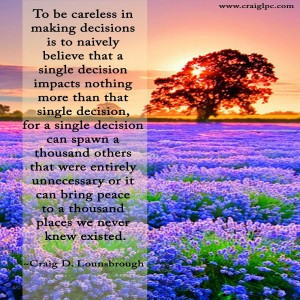
Jul 20, 2024
Jul 20, 2024
9 min
Do we realize that the choices that we make today lay the foundation for tomorrow's outcomes? Do we really think that things just happen, or do we understand that what happens today is the consequence of a series of choices that we made yesterday? We seem to stand stunned and perplexed by what we see in our culture. But are these things really happenstance and the turn of fate, or are they simply the consequences of the choices we have made along the way?
As the old saying goes, "You reap what you sow." We are certainly reaping. While we need to understand and accept that central reality, our time would be better spent asking how we learn from those choices. Why did we make them? What was it that we hoped to get out of them? How do we stop making them? What would better choices look like? What ethics, morals, values and principles should guide the choices that we make in the future so the consequences of those choices work for us instead of working against us? We are the cause. And since we are, we can also be the cure.
Jul 15, 2024
Jul 15, 2024
7 min
I often think about what I would say to the world. In the pain, confusion, fear, and rampant disorientation…what would I say? With the deceit, the manipulation, the less than admirable agendas being floated on all fronts…what would I say? With marriages fracturing under the weight of a culture gone rogue, with teenagers taking their lives before they ever have a chance to even understand what life is, with eyes cast to a hopeless future that seems to become dimmer by the day…what would I say? What would I say? And as I speak to an audience of patients that day-after-day sit crumpled and bent, as I speak to those who tolerate my penmanship and read the words that I stitch together, as I come across the innumerable people wounded and bleeding in whatever way they are wounded and bleeding, what would I say?
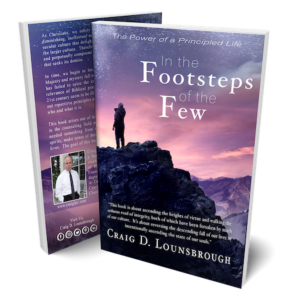
Jun 24, 2024
Jun 24, 2024
14 min
"In the Footsteps of the Few - The Power of a Principled Life"
Not Where We Were - Finding Ourselves Somewhere Else
It seems that we have some vague and rather ethereal sense of where we’re going in this thing called life. For the more contemplative soul, that sense might be quite refined. For the casual traveler, it might be a bit more nebulous and scattered. For many, where they’re going is defined by the tasks of the day, rather than enlarged by a vision for tomorrow.
In many cases where we’re going is far more rigorously defined by all the places where we don’t want to go, rather than the places where we do want to go. At other times its definition is rather handily shaped by the opinions of others, or it’s carved directly from the bedrock of the value systems that have been built into our lives throughout the whole of our lives. For others, it’s based on the need to avoid the pain of our past or somehow prove our worth in the face of a self-image that lays battered and bloodied. Vague or refined, we all have some sense of where we’re going. And too often, we find ourselves ending up someplace else.
Some of us are not necessarily in conscious pursuit of wherever this place is. We have this instinctually primal sense that it’s there and we intuitively assume that our path will take a natural course to wherever that place is. Then, there are others of us who are myopically focused on where we’re going to the degree that everything that we do is wholly defined by that singularly beguiling destination. Some of the more adventurous souls among us nimbly pursue that destination, spiritedly pulling in as much of everything that we can along the way to accentuate both the journey as well as the destination. In whatever way we do it, we all have some sense of where we’re going. And too often, we find ourselves ending up someplace else.
The Detours We Create
Yet, life is not so predictable as to always wind its way to the places that we presumed it to be going. There are those times when where we were going was bafflingly mistaken as some sort of final destination when in reality it was only a step to a final destination. At other times the place where we’re going is really a destination that we had fabricated because the place to which life had originally called us appeared too big, or too far, or too steep, or simply impossible in whatever way our limited vision happened to interpret it. At such times we craft some other less intimidating and thoroughly unfulfilling destination. Sometimes our destination is to set a course away from our destination so that we can dispense with whatever responsibility or obligation our original destination might have demanded of us.
And then in the magic of life, there are those times where we have actually pursued some authentic destination with such rigorous tenacity that the trajectory of our efforts has catapulted us past our destination to places that are everything of our furthest and fondest imagination. However, it might play out, we’re all headed somewhere.
The Detours Life Creates
But then there are those other times when life takes a sharp turn that seems little of our actions, nothing of our destination, but everything of circumstances designed to kill our journey and crush our destination long before we get within arm’s length of it. There’s a sense that something intrinsically unjust, stealthy and evil is always about and on the prowl, and whatever it is, it’s bound to show up if it hasn’t already. When it does, it undoes everything that we thought was secure and certain, wreaking havoc on whatever our journey had been to that point. And to whatever degree it wrecks the road underneath our feet, we’re left in a blurring trauma that renders our journey disjointed, our destination uncertain, and our lives dispirited.
The Explanation of Detours Missed
How It Happens
Yet, more often than not it’s the not the obvious shifts in our journey that are the core problem. Sure, life shows up and we get shoved down. There’s no question that the natural ebb and flow of life, whether it be titanic or miniscule, will happen to us. Despite our frequently ego-centric inclinations to the contrary, we are not so shrewd or ingenious as to be able to traverse life in a manner that deftly side-steps everything that comes at us. We don’t dance as well as we think we do. Our ingenuity falls prey to our arrogance, and the winds that we assumed to be reliable often shift and drive our genius toward some rocky shoal. And so, life will fall upon us, or ram against us, or pull the ground out from under us, or wreck us.
Casual and Careless
Yet, more often than not, the explanation doesn’t rest in life having shown up. The much more poignant issue is that too often we are passive, flabby and lax in rigorously living out our lives. We’re far too casual and careless. Somehow, somewhere the exquisite sanctity of life and the priceless privilege of living it out was supplanted with some sense that it’s too much work or that it’s not going to work, so why try? The gift is lost in the grind and we lose a sustaining sense of gratitude.
We get caught in the shallows, forgetting that the deepest waters hold the greatest treasures. But we would rather forage for trinkets because treasures are too stubborn to just hand themselves to us and we will not succumb to such preposterous demands. The shallows become our calling when they are nothing more than our coffin. Therefore, we drift without knowing that we’re drifting because we’re no longer paying attention. We come to believe that we are living a life of great things because it is too overwhelming to embrace the truth that we have forfeited great things. The outcome of such passive living is that we end up finding ourselves somewhere else without ever seeing it coming.
Preoccupied with Pabulum
Too often we’re too preoccupied with pabulum. We’re tediously engaged with tiny things and we’re caught in the tedium of minutia because we can gather these things around us and control them when the bigger things are out of our control. Too frequently we’re goaded by the fear of big dreams and massive possibilities, so we dumb down our lives to anesthetize those fears.
There’s plenty of pablum to go around. Therefore, we assume that if we collect sufficient quantities of it, it will add up to something bigger than pablum. Yet, dreams are never constructed of pablum and our fears are never put at bay by any collection of it, regardless of how massive. It is an escape, but it is never an answer. It’s a detour, but it is never a destination. It is an imitation of what we are attempting to avoid. Subsequently, pablum gives us a sense that we can circumvent everything that we fear and still achieve everything that we dream. We’re caught in small things, and the outcome is that we end up finding ourselves somewhere else without ever seeing it coming.
Along for the Ride
Frequently we presume that we’re some docile passenger along for a ride that’s going wherever it’s going, so we just let it go to wherever that place is. We freely surrender to passivity which is an invitation to meaninglessness. And meaninglessness is the death of the soul itself. Life is a river, we say. And the best course of action is to navigate it because entertaining the far-fetched notion of swimming against it is utterly preposterous.
Assuming that we are along for the ride releases us from any accountability for the ride and where it might end up. We are innocent. Or we’re victims of circumstance. Or our families put us here because they didn’t know any other place to put us. Or we’re simply being obedient to whatever we’ve subjected ourselves to. Assuming we’re on a ride that we can’t direct, the outcome is that we end up finding ourselves somewhere else without ever seeing it coming.
The Walls of Denial
At other times, we live in the constructed confines erected from the raw material of denial, causing us to live out a life that is in denial of life itself. We become squatters living in a squatter’s camp constructed by the flimsy materials of justification, rationalization, blame-placing and projecting. We pull in the walls due to the reality that materials of this sort are always pulling inward because they will die if we dare to press them outward. Hemmed in by walls of this sort, the world around us is shut out and moves on without our awareness of it.
We live in walls that we pretend are horizons, or vast doorways that open to massive expanses and marvelous places. In time, we come to believe that they are not walls at all as we’ve visualized them as something that they will never be. We then live out our lives in these confining hovels, convinced that we are forging great mountains and running in wild places. The outcome is that we end up finding ourselves somewhere else without ever seeing it coming.
Ending Up Where We Wish to Be
We will end up somewhere. The fact that we have a destination is irrefutable as life is a journey that presents us with no option other than the journey. We may decide that the nature and course of the journey is irrelevant, and we may take a backseat to passivity. If we do, we have no right to complain when we end up in some place other than what we may have thought or preferred.
Yet, we can recognize that we are not automatons subject to the flux of the world within which we have found ourselves. It would seem advisable to recognize that we have an obligation to the course that our life is taking, and that along with that obligation we have been granted a profound degree of power to bring to the course. If we imprudently succumb to carelessness, or become engrossed by pabulum, or if we just let the ride go wherever circumstances take it, or if we pull close the walls of denial this thing that we call life will wind itself to wherever it’s going with no one at the helm. And that kind of destination cannot be good.
We would be wise to inventory our lives and determine if we are in some way large or small participating in any of these behaviors. If so, we need to root them out and expunge them from our lives. Reclaiming a sense of vision, and then seizing our lives with discipline and intentionality will set us on a path that will land us in places that we’ve dreamt to land. If we don’t, the place we land may not be on any land that we even remotely recognize.

Sep 29, 2023
Sep 29, 2023
35 min
Jesus calls us to be the "light of the world." The fact is, we are all lamps. We all have the capability to cast light into a darkened world. And furthermore, we can actually cast a compelling and far-reaching light if we choose to.
But even though we are a lamp with great potential, is that lamp ever lit? Are our lives ever really bright and casting something hopeful into the darkness around us. Yes, we are all lamps. But few of us are lit. And the question is, "Are you a lamp that's lit?" The answer to that question will have immense bearing on your life and the lives of those around you.
Discover additional podcasts as well other resources on our website at www.craiglpc.com.
Sep 22, 2023
Sep 22, 2023
9 min
Sometimes fully being oneself in plain sight can be viewed as rather weird or downright odd. Sometimes our uniqueness is labeled as strange, bizarre, quirky or slightly peculiar. ‘Different’ in a culture of uniformity is too frequently labeled as eccentric, curious, “out there,” slightly unconventional, eerie, a tad bit unorthodox, or being something akin to being a dork. Our uniqueness can have dramatic social implications, causing us to be the outsider, the alien, the cultural misfit or just so plain weird that we’re a social phenomenon entirely unto ourselves with no place within which to fit at all; being relegated to the outcast.
These kinds of conclusions are quickly drawn and judgments are carelessly rendered rather than seeing uniqueness as potentially fresh, distinctive, or entirely singular. Far too often uniqueness is directly correlated with weirdness, dumping it into an entirely negative and typically unredeemable social sideshow. Uniqueness is pathetically reduced to oddity.It is then seen as entertaining because face it, “odd” is entertaining. The throngs of society curiously mill about these sideshows seeking some form of entertainment or amusement at the ignorant expense of the miracle of uniqueness. If you happen to have had the misfortune of having been dumped in some sort of sideshow because of your uniqueness, you’re seen as a permanent resident unless you reinvent yourself and sacrifice your uniqueness as part of that reinvention. The cost to do that is astronomical and deadening.
The Loss of Rendering Conclusions and Judgments
These various labels that we apply to others or have applied to us create a sharp and tainting distinctiveness that separates and excludes, rather than incorporates and includes. The profound asset of our uniqueness becomes a crippling liability. We have these various labels dogmatically slapped on our foreheads in exceedingly bold type with the whole of our person then being identified based on whatever’s been scrawled on the label and slapped on our foreheads. Following the brutality and ignorance of uniqueness branded as oddity, or worse yet as a deficit, we are forever relegated to the sideshow of life. The richness of our uniqueness is then lost to us, and lost to a world wallowing in stereotypes. In such a“lose-lose” situation, we are all diminished in ways that we may never make up.
Rightly Exercising Our Uniqueness
In a culture that embraces tolerance and diversity, let’s make one point very clear. Being unique is not about taking license by being oneself and using it as a stage to elicit attention, or make some sort of controversial cultural statement, or use it as a pedestal to flaunt immoral behavior, or generate some sort of shock factor in those who are watching us be “us.” Simply put, possession of uniqueness does not include permission to use that uniqueness with impunity to create something that we’re not in order to fulfill a personal agenda or fuel a social mission of some sort. Our uniqueness is not a lifeless stool to be snatched up and errantly or thoughtlessly used in the service of whatever cause we choose to use it in. Being authentically oneself is much more responsible and careful than that.
Being oneself is about embracing a deep respect for the stunning and entirely vibrant uniqueness of all of creation; a uniqueness that has been carefully crafted, unapologetically exercised and fully manifest in each and every one of us. It’s respecting that uniqueness within us not as license to be itself at the cost of everyone else around it, but something that builds upon everything else around it. It is not a pedestal to demand tolerance of the aberrant behaviors that we take license to construct from of our uniqueness. Rather it’s a place where we bow in some soulful combination of deep appreciation and mind-boggling awe as we look to carefully unearth who and what we are without twisting or tainting who we are in the process. It’s has nothing to do with revisionist mentalities or self-decreed permission where we seize our uniqueness, plop it as some lump of clay on a potter’s wheel and methodically shape it to our designs or our likening without regard for what it really is. Uniqueness used in these ways will cease to be unique.
Uniqueness Gone Bad
The uniqueness of our individuality under the total control of the individual is likely to be driven by selfish and self-centered agendas that will make us unique, but uniquely troubled, dysfunctional, disoriented and distorted. The power of uniqueness in the hands of limited people with unlimited parameters is dangerous indeed. In a culture of self-determination, personal rights and the territorial thumping of our chests to declare that we’re the masters of our own fates we take license with our uniqueness that is not necessarily ours to take. The cultural mindset of brazen independence creates a misguided sense that we are indeed of our own making, and that if we don’t shape who we are in whatever image we’ve determined that to be, we will have completely squandered our lives.
Uniqueness Well Handled
It seems that our uniqueness is not something to be shaped by us, but understood by us. It’s not to be engineered by us, but explored by us. It’s not to be created by us, but cultivated by us. We do not set its agenda; rather we discern it so that we know enough of it to know the agenda it has set for us. Our uniqueness is a precious gift that’s designed to be understood so that we can participate in making it the most that it can be, not shaping it into what we want it to be.
Our uniqueness holds within it the clues and the resources that tell us who we are, why we’re here and what we’re supposed to do with this gift called life.Our uniqueness is most effectively nurtured and cultivated within moral and ethical parameters that don’t inhibit that individuality as the culture assumes, but rather creates a place for us to maximize that individuality. Moral and ethical parameters keep our uniqueness pure, supple and free from all the things that would tarnish it and ultimately destroy it. Uniqueness is a priceless gift that is as fragile as fine china, as tough as fired steel, and as broadly expansive as the creative genius of God. It is a gift beyond our ability to handle, but not beyond our ability to surrender to something greater than us so that it will eventually become something greater than us. Uniqueness surrendered and lived out in the enabling power and protective place of moral principles and ethical standards paves the way for that uniqueness to rise to unparalleled heights, to be more than we can think or imagine, and to grow far beyond the horizons of any vision we could craft for it.
You are unique . . . that’s already an established reality. Amazingly, you are one of a kind. You’ve got one and only one shot at life. So, what are you going to do with the immense gift of your uniqueness? You will kill it or cultivate it. What will you do? Consider it.
Additional Resources
Discover an array of additional resources on our website at www.craiglpc.com. Find all of Craig's thoughtful, timely, and inspirational books at Amazon. com, Barnes and Noble, or wherever books are sold. Also, take a moment to explore Craig's Public Speaking Resources for information regarding the resources available to your business, ministry, or organization.
Read the rest of this entry »
Sep 20, 2023
Sep 20, 2023
21 min
We seem small. We look around at the mounting difficulties and challenges in our world today and we simply seem too small to make any sort of meaningful impact. We witness the flood of irrational agendas, the rampant greed, the destruction of morality, the corruption in leadership, and the insanity of organizations that propagate questionable platforms, and we feel far too small to speak into any of those things.
Yet, small is big when understood correctly. After all, everything big started as something small. Everything big is a compilation of small things. Everything big requires the work of small things to sustain them. In essence, small is big.
Craig's recent message outlines the fact that size does not suggest power. That we are capable of making a significant impact despite how small we might feel. Take a moment and enjoy this thought-provoking and timely message.

Sep 15, 2023
Sep 15, 2023
22 min
Being a Lamp That's Lit
So let’s begin at the beginning and ask the first question that needs to be asked . . . are you a lamp that's lit? Matthew chapter 5 talks about being a light, but we might want to first ask the fundamental question, am I a lamp that's lit in the first place?
How many of us are lit and ablaze? We’re all lamps . . . every one of us. But how many of us are lit and burning and casting light, because it’s one thing to be a lamp, and it’s quite another thing to be lit. If you walk through life being a lamp that’s not lit, you will live a diminished life and you will add to the diminishment of those around you. And that is tragic.
The Irish play-write, George Bernard Shaw was interviewed by a reporter who asked him, “Mr. Shaw, if you could live your life over and be anybody you’ve known, any person from history, who would you be?” Listen carefully to what he said. George Bernard Shaw said this. He replied, “I would choose to be the man George Bernard Shaw could have been, but never was.” Will that be your commentary on your life? When the end comes and the years are dwindling, will you say, I would choose to be the man I could have been, but never was?
George Bernard Shaw was a lamp that, by his own admission, was never lit.
“Neither do people light a lamp and put it under a bowl.” You . . . all of you . . . all of us are lamps. And the question that I have for you is “are you lit?
Additional Resources
Discover an array of additional resources on our website at www.craiglpc.com. Find all of Craig's thoughtful, timely, and inspirational books at Amazon. com, Barnes and Noble, or wherever books are sold. Also, take a moment to explore Craig's Public Speaking Resources for information regarding the resources available to your business, ministry, or organization.
Sep 13, 2023
Sep 13, 2023
42 min
Grief and loss are something with which we are all well acquainted. Some of the losses that we've experienced are small, while others are utterly overwhelming.
Our natural response in our loss is to press past the pain in an effort to resume our normal lives as quickly as possible. But in the rush to heal and free ourselves from the pain, we miss the immense growth that is awaiting us in the pain itself.
Craig's recent message outlines the fact that "There is great purpose in great pain." However, if we live in denial of our pain or place all of our efforts on simply stopping the pain we will forfeited the priceless growth that await us in the pain.
Take a moment and enjoy this thought-provoking and timely message.

Sep 8, 2023
Sep 8, 2023
16 min
Being a Lamp That's Lit
So let’s begin at the beginning and ask the first question that needs to be asked . . . are you a lamp that's lit? Matthew chapter 5 talks about being a light, but we might want to first ask the fundamental question, am I a lamp that's lit in the first place?
How many of us are lit and ablaze? We’re all lamps . . . every one of us. But how many of us are lit and burning and casting light, because it’s one thing to be a lamp, and it’s quite another thing to be lit. If you walk through life being a lamp that’s not lit, you will live a diminished life and you will add to the diminishment of those around you. And that is tragic.
The Irish play-write, George Bernard Shaw was interviewed by a reporter who asked him, “Mr. Shaw, if you could live your life over and be anybody you’ve known, any person from history, who would you be?” Listen carefully to what he said. George Bernard Shaw said this. He replied, “I would choose to be the man George Bernard Shaw could have been, but never was.” Will that be your commentary on your life? When the end comes and the years are dwindling, will you say, I would choose to be the man I could have been, but never was?
George Bernard Shaw was a lamp that, by his own admission, was never lit.
“Neither do people light a lamp and put it under a bowl.” You . . . all of you . . . all of us are lamps. And the question that I have for you is “are you lit?
Additional Resources
Discover an array of additional resources on our website at www.craiglpc.com. Find all of Craig's thoughtful, timely, and inspirational books at Amazon. com, Barnes and Noble, or wherever books are sold. Also, take a moment to explore Craig's Public Speaking Resources for information regarding the resources available to your business, ministry, or organization.