Episodes

Monday Nov 10, 2025
Monday Nov 10, 2025
Thanksgiving. To the destruction and detriment of those who live there, it will perish in an environment within which a sense of entitlement and greed rules the day. Conversely, on the opposite end of that spectrum, a sense of thanksgiving will thrive and it will breathe life into any place where a heart of appreciation and gratitude refuses to give way to a brooding sense of entitlement, the scourge of greed, or any other lesser attitudes that keep company with such things.
But in whatever place we might find ourselves on this spectrum, we must understand that the remarkable power of Thanksgiving will live undiminished regardless of where we fall, simply because our determined adherence to it, or our blatant rejection of it cannot touch or in any way diminish something spun of things eternal.

Friday Nov 07, 2025
Friday Nov 07, 2025
Flying with the geese. Following the seasons instead of being left behind in whatever season that we are in. Taking wing and launching ourselves off to new horizons, fresh goals, untainted opportunities, and unexplored places. To live life as an ever-unfolding adventure that is always anticipating the next adventure. We want to live life like this. We really do. We might fear it sometimes. We might think that it takes too much energy or we don't have the time. We might believe that we don't have the abilities to live a life like that. We can think a lot of things, but we want to fly.
At Thanksgiving, we need to be thankful for the fact that we can fly. Maybe not like the geese that head south every year. But we have opportunities to fly in different ways that are even more magnificent and breathtaking. We are only relegated to the sidelines of life because we have put ourselves there. Life does present us with opportunities that are beyond the scope of our own understanding. But we have to take hold of them. We must press past our fears, refuse our desire for comfort, be willing to head somewhere that we've never been, and then we must then go. I am thankful that all of us can fly. The question is, will we?
Resources for Your Holiday Celebrations
Discover an array of holiday resources designed to enhance your celebrations on our website at www.craiglpc.com. Craig's thoughtful, timely, and inspirational books make lasting gifts. Discover all of his books at Amazon. com, Barnes and Noble, or wherever books are sold. Also, take a moment to explore Craig's Public Speaking Resources for information regarding the resources available to your business, ministry, or organization.
Monday Nov 03, 2025
Monday Nov 03, 2025
Rich living has nothing to do with wealth...depending upon the kind of wealth we're referring to. Rich living is found far more frequently in impoverished lives. It is in these lives that the clutter of material wealth is absent so that these lives are free to see what is truly precious. Life is not about the pursuit of 'stuff.' Rather, it's about the pursuit of the everyday experiences that are handed to us without cost or obligation. It's about 'being thankful that we can be thankful' and that such thankfulness is not based on possessions, but on the privilege we have to be possessed by life itself.
Rich living means that we live with a sense of gratitude. Life may be easy or it may be difficult, but we find a space for gratitude in either place. It's recognizing that life is a privilege, even at those times when it doesn't necessarily feel that way. It's an appreciate for the little things that we lose in the search of bigger things. It's realizing that thankfulness is not about great accomplishments, but little gifts. That all around us are things that we can savor and enjoy because God scatters such things every place we go. It's about climbing trees and mending shoes.
Resources for Your Holiday Celebrations
Discover an array of holiday resources designed to enhance your celebrations on our website at www.craiglpc.com. Craig's thoughtful, timely, and inspirational books make lasting gifts. Discover all of his books at Amazon. com, Barnes and Noble, or wherever books are sold. Also, take a moment to explore Craig's Public Speaking Resources for information regarding the resources available to your business, ministry, or organization.
Wednesday Oct 29, 2025
Taking It to Our Knees - Day 10 - The Loss of Hope
Wednesday Oct 29, 2025
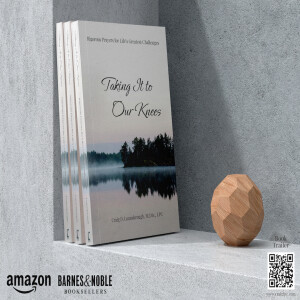
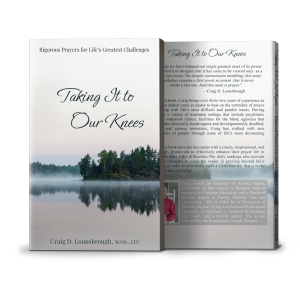
Welcome to Day Ten of the devotional series taken from the book, “Taking It to Our Knees – Rigorous Prayers for Life’s Greatest Challenges.”
Today’s These is “The Loss of Hope”
The Quote for Today Is This:
“Therefore we do not lose heart. Though outwardly we are wasting away, yet inwardly we are being renewed day by day. For our light and momentary troubles are achieving for us an eternal glory that far outweighs them all. So we fix our eyes not on what is seen, but on what is unseen, since what is seen is temporary, but what is unseen is eternal.”
- 2 Corinthians 4:16-18
Hope. Life drains us of it. It almost seems that life is constantly on the hunt for what little bit of hope we might have left. And life knows exactly what to do in order to home in on it and destroy it. That might be a child gone rogue. An unfaithful spouse. A boss who’s passed you up for a promotion three different times. Unexpected debt. A medical issue that only gets worse the more it gets treated. Promises broken. A turn of events that puts a cherished dream forever out of reach…and so on. Life targets that stuff to target our hope.
The issue is not that we lose hope. Most often, the issue is based on what we have chosen to hope in. We hope in many things that we have no business hoping in. We lean on teetering promises that appeal to some selfish streak in us. We haphazardly hitch our wagon to something that doesn’t have any horses pulling it. We fall for brilliantly crafted sales pitches that promise something that they don’t even possess. We get swept up in the meaningless verbiage of smooth talking people because sixty seconds of fantasy is better than an hour of reality. We’re desperate for some shred of hope, and so we make choices without a shred of common sense.
It's not that hope doesn’t exist. It’s that it doesn’t exist in the places that we end up looking for it. It’s really quite easy. Our only real hope is in God. Everything else is a flimsy facsimile that will continue to pretend it’s real long after it’s failed us.
Let’s Pray
Dear God:
I don’t know if I can hope again. Ever. There’s just been too much heartbreak and too much disappointment. The human heart can only take just so much. There’s that final time when we take what little bit of hope that we have left, we cautiously gather it up, and we invest that hope in something that ends up failing. I’ve had too many of those. And so, I don’t know if I can sustain one more disappointment.
I know that You are God. And I know that Your promises are trustworthy. I know that there’s no risk in You. But the trauma of hope broken, and dreams smashed, and relationships destroyed, and betrayal at every turn, and dreams upended, and the bleakness that has now become the essence of my existence…all of that sitting in me makes it hard to trust You.
And so, help me to hope in You. Help me to take one final shot at hope. Do not let me walk away from You because if I do, there truly is no hope.
I pray all of this in Jesus’s Name. Amen.
Here’s a thought to carry with you today: “The darkness might keep us from seeing the hope around us, but it does not have the power to remove the hope around us.”
Thanks for joining us today on this thirty-day devotional series taken from the book, “Taking It to Our Knees – Rigorous Prayers for Life’s Greatest Challenges.” You will find “Taking It to Our Knees” on Amazon, Barnes and Noble, or wherever books are sold.
Also discover our daily inspirational quotes on Facebook, Pinterest, X, LinkedIn, Twitter, Instagram, TikTok and more.
Have a great day!

Monday Oct 27, 2025
Podcast Short: We Are More - Understanding Our Capacity
Monday Oct 27, 2025
Monday Oct 27, 2025
We Are More - Understanding Our Capacity
“Whatever you see within yourself, let it be the whole of yourself. For too often we have been brutalized by our own sense of inadequacy and we’ve been held hostage to the lesser choices born of such a debilitating sense of self. Know this, that latent within you there lies more than ample resources begging to be called forth to smash the chains forged of such an incapacitating sense of self. And it is my prayer that you would press against everything within you that would hold you back, and that you would raise whatever voice you have and extend that call.”
You are more than you realize. A lot more. You’ve probably heard that before, and if you haven’t, you’re long overdue. You are more than you realize. But the thing is, we don’t feel that we are ‘more.’ If anything, the things that happened to us would suggest the opposite…that we’re less than what we hoped we were (and probably a whole lot less). Whether that’s failure (in any of the million different ways that we fail), or ridicule, or jobs lost, or relationships that blew up, or dreams that went up in smoke, or friends that walked away, or opportunities that drifted away, or family members who were critical to the point that we wished they went away…or whatever it might be. The statement that “we are more than we realize” just doesn’t seem to fit this stuff.
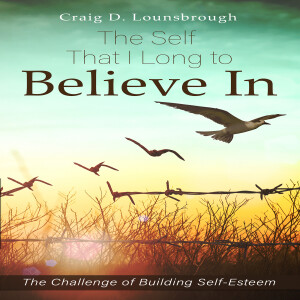
In my recent book, “The Self That I Long to Believe In,” I wrote this:
“The majesty of our humanity and the capabilities laid out within us are nothing short of marvelous; so much so that we are barely cognizant of it. That in and of itself may be why we don’t recognize them and therefore don’t believe that they exist. All of us run deep with untapped potential that is rustling just under the surface of our lives waiting to be unleashed.”
We are ‘more.’ Our circumstances don’t have the power to refute that or change that. For sure, our circumstances can lead us to believe that we’re not ‘more,’ and they can be very convincing in doing that. Our circumstances can also lead us to believe that we’re a whole lot less than we thought ourselves to be, and those circumstances can be incredibly convincing as well. But our capacity exceeds the failures that we experience and the criticisms that are thrown in our faces. Our abilities are not defined by what people have said, or the choices that we have made. Our abilities exceed all of those. They are greater than the limits of our imaginations, and they are not limited by people or choices that have proven to be less than imaginative.
That “more” will always be there whether you use it or not. It sits at the ready whether we recognize it or not. We are ‘more.’ That’s not the issue. The issue is will we understand that we are ‘more,’ and will we allow that ‘more’ begin to shape us into ‘more.’
Additional Resources
Discover an array of additional resources on our website at www.craiglpc.com. Find all of Craig's thoughtful, timely, and inspirational books at Amazon. com, Barnes and Noble, or wherever books are sold. Also, take a moment to explore Craig's Public Speaking Resources for information regarding the resources available to your business, ministry, or organization.

Thursday Oct 23, 2025
Podcast Short: Becoming Accountable
Thursday Oct 23, 2025
Becoming Accountable
Accountability…might it be time to be accountable to who we’ve become so that we can make ourselves accountable to what we can be? Are we willing to divest ourselves of all the lesser things that we have elevated as greater things and engage in both a pointed and painful evaluation of who we’ve become? And once we’ve done that, are we brave enough to look at the damage that we’re incurred in the becoming? Can we relinquish our claim to whatever bit of turf we’ve claimed and lay our playground feuds to rest in deference to a cause far greater than the tiny space that we occupy? Can we shake ourselves out of ourselves sufficiently to wake up to the far greater things that lay ‘round about us? Can we begin to see others as less enemies and more people whose differing views may inform our own? At what point we will understand that partnership and camaraderie must be preserved even when differences of beliefs or opinions would do their level best to blast us into warring camps? When will we forfeit what we’ve become in order to become something so vastly superior to what we’ve become?
It’s not that such a shift is impossible (despite the fact that the behaviors exhibited in our world might suggest otherwise). But in the face of the reckless insanity all around us, will we dare to dare? Will we raise ourselves up to embrace the fullness of our humanity? Will we cast off the scourge of selfish agendas and the saber-rattling born of insatiable egos? Will we be what we’ve chosen not to be at whatever cost we might pay to do so, recognizing that the cost of not doing so is far, far greater? Will we shed all that we’ve become to become all that we can be? In essence, will we reclaim the majesty of our humanity as it was created and tenderly fashioned to be?
I believe that we have not done well, but I believe we can yet do very well. I believe in something better. I believe that we can join together in a mutual assault on the mounting challenges in our world instead of engaging in mounting assaults on each other. I believe, and I hope that everyone of us might join me in that belief. And in that joining might we rigorously inventory how we can be different. And then let us go and begin the process of making things different. Let us reclaim the majesty of our humanity in the care of humanity.
Additional Resources
Discover an array of additional resources on our website at www.craiglpc.com. Find all of Craig's thoughtful, timely, and inspirational books at Amazon. com, Barnes and Noble, or wherever books are sold. Also, take a moment to explore Craig's Public Speaking Resources for information regarding the resources available to your business, ministry, or organization.

Tuesday Oct 21, 2025
Day 9 - The Plague of Self-Esteem
Tuesday Oct 21, 2025
Welcome to Day Nine of the devotional series taken from the book, “Taking It to Our Knees – Rigorous Prayers for Life’s Greatest Challenges.”
Today’s Theme is “The Plague of Low Self-Esteem.”
The Quote for Today Is This:
“For you created my inmost being; you knit me together in my mother’s womb. I praise you because I am fearfully and wonderfully made; your works are wonderful, I know that full well.”
- Psalm 139:13-14
We have difficulty believing that we are “fearfully and wonderfully made.” That’s a hard one sometimes. We look into the mirror or our decisions, and all that we see are the numerous cracks and spidery fissures in that mirror that speak to the destruction wrought by those decisions. We glance into the mirror of our achievements, and what stares back at us are a host of failures so numerous that the mirror is packed tight with them. We peer into the mirror of our relationships only to have no one peering back at us. And if we wipe the mirror clean of all of that stuff and simply glance at our own reflection, we wish that mirrors were never invented.
We don’t like ourselves a whole lot. But what we don’t like often goes much deeper than that which any mirror can reflect back to us. What we don’t like is how people have defined us, or how we let them do that. We don’t like how they have projected their own issues on us. How they blamed us for their mistakes so that they didn’t have to face them. We are left sullen and sad by expectations that we didn’t even come close to meeting because they were designed not to be met. And in the end, this very convincing definition of ourselves is compiled from a bunch of stuff that is far more a compilation of everyone else who had something to do with us than it was about us.
It's hard to believe that we are more than what we perceive ourselves to be. It’s difficult to embrace the reality that we are truly made in God’s image. That stuff doesn’t resonate. We don’t see that in the mirror, even if we squint and lean into it. But the greatest truths about us often don’t resonate because we have difficulty believing that we could actually be something so wonderful.
Prayer
Dear God:
Please help me to like me. Or better yet…help me to love me. I’m not all that certain about how to do that. There’s a lot of self-help stuff out there and catchy ideas to help build my self-esteem. It’s all man-made stuff that never really addresses the heart stuff.
You made me, “fearfully and wonderfully.” You uniquely designed me. You intentionally placed me here, at this exact time in history. There was something very intentional in the way that You did all of that. You have a purpose and a plan for me that is bigger than anything that I could imagine. And that purpose and that plan is uniquely gifted to me and me alone. That’s the truth about me.
I confess to You that I don’t feel that way…at all. I just can’t wrap my head around that no matter how hard I try. All of that’s beyond me. But I want to believe it. I want to know that there’s something of great value sitting within me just waiting to be released. I want to see ‘me’ how You see me, not how others have caused me to see me. Show me who I am through Your eyes. Help me to see my reflection in Your mirror.
I pray all of this in Jesus’s Name. Amen.
Here’s a thought to carry with you today:
“Look in the mirror. Go ahead and look yet again. And look not at the reflection, for while this body of yours is marvelously complex in ways that continue to elude the reach of modern science, it is but a simple shell that holds the image of God within you. And if the shell is that grand, how much more what God has placed inside of it.”
Thanks for joining us today on this thirty-day devotional series taken from the book, “Taking It to Our Knees – Rigorous Prayers for Life’s Greatest Challenges.” You will find “Taking It to Our Knees” on Amazon, Barnes and Noble, or wherever books are sold.
Also discover our daily inspirational quotes on Facebook, Pinterest, X, LinkedIn, Twitter, Instagram, Tik-Tok and more.
Have a great day!

Monday Oct 20, 2025
Podcast Short: Dead-End Roads of Our Making
Monday Oct 20, 2025
Monday Oct 20, 2025
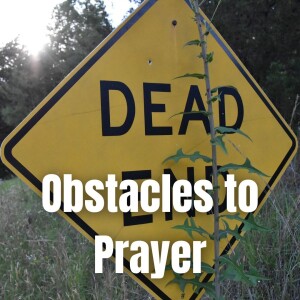
Dead-End Roads of Our Making
We chart these paths. We set these goals. We ponder where we are, and from there we determine where we want to go. There’s some sort of road that we’re walking, whether that’s a road of our own making, or it’s a road that everybody is walking, or it’s the road that culturally vogue or socially trending. Sometimes that road is well defined and clear. Sometimes there’s very little definition to it all, and we end up wondering if we’re really on any sort of road at all. And then some of us are just plain lost in the woods. “There’s some sort of road that we’re all walking.”
Whatever kind of road that we’re on, it’s both amazing and frustrating how many of those roads end up at dead-ends. It’s stunning that there are millions of people who are standing at the end of some road (or what they thought was a road) and it ends. It just ends. They had visualized it going somewhere great, or exciting, or meaningful. It was the path to their dreams. It was the road to a life-long relationship. The highway to fiscal wealth or career advancement. The byway that led them to everything that everyone else said that they could never do or never be…but it doesn’t go to any of those kinds of places at all. It dead-ends. In the middle of nowhere.
A dead-end is likely the product of being on the wrong road. And if I created the road, it’s probably going to dead-end because it’s probably the wrong road. Frequently, the dead-end will be up out of sight from where we started this journey (so that we won’t have second-thoughts taking it). Or, we can actually see the dead-end, but we live in denial of it because we want what we want. Or, the people around us took it and were too embarrassed to tell us that we would run into a dead-end because they were embarrassed that they ran into a dead-end. Or, the culture has deluded us into believing that it’s not a dead-end at all (even though it looks strikingly similar to a dead-end).
Dead-ends. The only road that I know of that has no dead-ends is the one that God lays out for us. Those are roads of no dead-ends. Rather, those are roads of endless beginnings. Forever beginnings. Perpetual beginnings. Where the world says that the road will stop, the roads God creates keep right on going. When the mountains become too high, or the valleys become too low and the roads come to a screaming halt, God has already constructed a bridge or leveled the valley. “There’s some sort of road that we’re walking.” And if God didn’t create it, your dead-end is just around the ‘corner.’ If He did create it, you don’t need to worry about the ‘corners.’
Additional Resources
Discover an array of additional resources on our website at www.craiglpc.com. Find all of Craig's thoughtful, timely, and inspirational books at Amazon. com, Barnes and Noble, or wherever books are sold. Also, take a moment to explore Craig's Public Speaking Resources for information regarding the resources available to your business, ministry, or organization.

Thursday Oct 16, 2025
Podcast Short: Do We Search for the Truth?
Thursday Oct 16, 2025
Do We Search for the Truth?
Do we search for the truth, or do we search for ways around the truth? Do we even take the time to consider a question like that out of the long-held assumption that we are, in fact, looking for the truth because (we assume) that that’s the obvious thing to do? What insanity would behoove us to do anything less? But do we search for the truth, or do we search for ways around the truth? Maybe we should consider the fact that there are a whole lot of reasons why we actually might stoop to something less.
Truth be told, the truth may not be what we want it to be. It may not support our agendas, or our desires. In fact, it might actually render those things as erroneous and all-together ill-fated. The truth may not support all of the things that we passionately wish to believe, or have talked ourselves into believing. Or truth may dare to go so far as to actually call the entirety of those beliefs into question, and call us out for believing in them in the first place. Do we search for the truth even when it takes the foundations that we’ve laboriously built with the sweat of our brow and the best of our years, and does truth handily expose those foundations as weak, entirely misappropriated, and as nothing more than sand piled in every place except the right place? Will we search for truth even when it looks us square in the face and tells us this kind of stuff? Will we search for it knowing that there is a very distinct possibility that it will tell us everything that we don’t want to hear in every way that we don’t want to hear it? Will we search for truth even then?
I don’t know that we do. In fact, what we seem to search for the most are ways to circumvent the truth. Our search does not seem to be ‘for’ the truth, but rather it seems to be far more vested in ways to get ‘around’ the truth. We would not even begin to label our actions as such because such actions would immediately call the whole of our character into question. But what we label something does not make it what we’ve labeled it. Our search seems to be one of committed avoidance. It is one of intentional evasion, of manufactured detours, of clever deviations that are so slick that we don’t even realize that we deviated. It’s not that we run from the truth as much as we diligently work to create pathways around it, that in the end, never get us around anything. I wonder if that’s really more of what we do.
And as such, these evasive endeavors are quite naturally filled with such familiar things as slippery denials, evasive rationalizations, ambiguous justifications, relentless blame-placing, rogue fear-mongering, the incessant spinning of events, the bogus editing of facts, and the mind-boggling contortions where we take reality and make it something other than reality.
But likely the most dangerous of these is the self-endowed liberty that we have granted ourselves to make truth whatever we wish to make it. Therefore, it’s not about avoidance, because conveniently, that’s no longer necessary. Rather, it’s about creating, which is avoidance of the most calculated, but ill-fated sort. It’s about making truth whatever we want it to be. It’s about making it fit whatever agenda, or belief system, or value system, or platform, or whatever it is that we want it to fit. If truth will not grant us that which we wish, we will simply edit it until it does. But in the end, it is no longer truth, and truth be told, we will eventually find that out, and we’ll probably find it out the hard way.
Truth. Do we search for it, or do we do something else with it? You might ask yourself, in a truthful kind of way, what you’re doing with it.
“Then you will know the truth, and the truth will set you free.”
- Jesus Christ

Wednesday Oct 15, 2025
Day 8 - Taking It to Our Knees - The Painful Struggle of Infertility
Wednesday Oct 15, 2025
Welcome to Day Eight of the devotional series taken from the book, “Taking It to Our Knees – Rigorous Prayers for Life’s Greatest Challenges.”
Today’s Theme is “The Painful Struggle of Infertility.”
The quote for today reads this way:
“I will repay you for the years the locusts have eaten— the great locust and the young locust, the other locusts and the locust swarm— my great army that I sent among you..”
- Joel 2:25
What many people are desperate to have are the very things that others recklessly throw away. What is cherished, intimately longed for, and desperately sought after by so many is discarded by others without so much as a fleeting thought.
Such is the agonizing dilemma of those facing the pain of infertility. Having squarely set decades of dreams on the immense privilege of having a child, couples find their dreams brought to a jarring and often unexpected halt. Facing the brutal possibility of being childless, these couples expend massive amounts of time, emotional energy, and personal resources to salvage a dream that seems to slip further away with every attempt to save it.
Wildly gyrating emotions spin off sporadic thoughts of physical or personal inadequacy. We wonder if this is punishment for some perceived offense that is only now being executed on our passion to hold a child. Thoughts of injustice as held against the reality that life is unjust. An uninvited jealousy of other couples who were able to bear children that runs head-long against the very real joy that we have for them. And then, the brutal thought of those who recklessly abort the very thing that we would give the entirety our lives to hold. The turmoil is unspeakable. The pain unfathomable.
Life robs us in many ways. But God enriches us in every way. What the world takes, God will restore. We will never lose anything that God cannot and will not give back to us many times over. The shape and form of what He gives may not resemble what we lost, but it will provide the healing that we need. The truth of these statements will never and can never be offset by the depth, intensity, size, or pain of any loss…ever.
Prayer
Dear God:
I know that life is full of loss. It’s all around me and it’s everywhere within me. In this world, we can’t get away from it. I know that because I’ve done my level best to do exactly that. And despite those efforts, it seems like some sort of loss is always lying in wait just around the corner of every dream that I’ve ever had.
But Lord, sometimes the losses are so big, so deep, so life-altering, so unjust, so seemingly impossible to live with…so everything that they should not be that I have a hard time accepting them. The inability to conceive a child is one of those. I’m way too human and way too fragile to take the really brutal losses and somehow find a safe or reasonable place for them despite how much I want to do that.
You know life can be brutal. You’re no stranger to any of that. You lived it. You endured it. You knew it was coming for You from the beginning of creation. You stepped into this world knowing that it was staring You in the face.
But knowing that kind of brutality, You said, “Blessed are those who mourn, for they shall be comforted.” Dear God, fill the hole left by the hope of a child. I don’t want to play the victim; I want to be the victor. I don’t want to spend the rest of my life pouting; I want to live my days prevailing. I want to rest on the fact that nothing can be taken from me that You cannot replace many times over in whatever way You decide to do that. I desperately want to live with that reality, with that hope, and with that peace.
I pray all of this in Jesus’s Name. Amen.
A Thought to Carry With Me Today
“If I have never had, or worse yet, I have lost the conviction that life (despite all of the blows it wields and the savagery that it spawns) is nonetheless an incalculable privilege, I will have in that single loss forfeited the whole of my life and effectively wiped out any hope that I can or will do anything other than exist.”
Thanks for joining us today on this thirty-day devotional series taken from the book, “Taking It to Our Knees – Rigorous Prayers for Life’s Greatest Challenges.” You will find “Taking It to Our Knees” on Amazon, Barnes and Noble, or wherever books are sold.
Also discover our daily inspirational quotes on Facebook, Pinterest, X, LinkedIn, Twitter, Instagram, Tik-Tok and more.
Have a great day!

Monday Oct 13, 2025
Podcast Short: Thinking It’s Over When It’s Not
Monday Oct 13, 2025
Monday Oct 13, 2025
Thinking It's Over When It's Not
It’s over…we tell ourselves. It’s over. Whatever it might be (or might have been) it’s gone and there’s no getting it back. The loss is too big. The obstacles are too daunting. Things have changed so much that whatever we lost no longer has a place in the current reality that we’re living in. We’re one person (just one person) trapped in a downward spiral that’s far more powerful than all of us put together. The glass isn’t half empty. The fact is, there is no glass. We can’t pick up where we left off because where we left off...left. It’s over…so we think.
In processing all of this for myself, I wrote this quote:
“The last time I saw it, its hull was crushed and it laid helpless against the incessant swells that rolled up upon the shallows within which it laid canted and broken. Yet, in the hands of a seasoned sailor who saw potential in the carnage, it was hauled out the swells, lovingly repaired, and the next year it pushed out past the swells that had held it helpless and it sailed again. And although our hulls are crushed beyond hope of repair and we find ourselves helplessly awash in the incessant swells of our sin, with God we too can sail again.”
Sometimes things are ‘over’ only because we believe them to be over. We’ve been told that they’re over. Or everyone around us says that they’re over. Or the cultural climate seems to say that they’re over. Or those without vision have never realized that they lost anything because they never saw what they had in the first place, so they tell us that nothing’s over because nothing was lost to begin with. Or people have chosen to believe that they’re over because that’s easier than hoping that they’re not. We don’t want to look the fool and try to save something that’s no longer there to save, so we tell ourselves and those around us that it’s over…so we think. But we can sail again.
Is something really over? Have we actually lost something that we can’t reclaim? Is it gone forever? Or, is that what we’ve chosen to believe. It’s my sense that most things aren’t over (at all). Rather, it’s our belief that they are (which is a ‘belief,’ but not necessarily a ‘reality’). It’s more our attitude, or our fears, or our unwillingness to challenge popular thinking, or our unwillingness to risk grabbing hold of a vision, or a lack of belief in ourselves, or more importantly, a lack of belief in God. In the Bible, Jesus said, “What is impossible with man is possible with God.” Do you get that? Do you understand what that opens up? Do you understand that our perception that something is over does not take into account that with God, nothing is over? That our families, our communities, our dreams, our relationships, our nation can sail again? That there are always possibilities, even when all we see are massive impossibilities? That what we feel we have to walk away from are things that have a ton of possibilities still living and breathing within them? Is something really over? Really? You might want to think about that because you’d be amazed at all of the things that can sail again.
Additional Resources
Discover an array of additional resources on our website at www.craiglpc.com. Find all of Craig's thoughtful, timely, and inspirational books at Amazon. com, Barnes and Noble, or wherever books are sold. Also, take a moment to explore Craig's Public Speaking Resources for information regarding the resources available to your business, ministry, or organization.

Friday Oct 10, 2025
Podcast Short: We Are a Mess
Friday Oct 10, 2025
Friday Oct 10, 2025
We Are a Mess
We are a mess. We are a mess because we are a people on a mad rant. Sadly, we have become blinded to the fact that we are blinded by a host of pathetically self-serving agendas. And the pathetic nature of these agendas are evidenced by the fact that they are unable to stand up to the slightest scrutiny despite how rigorous our justifications of those agendas might be. We create a litany of agendas whose basis is indefensible, for any self-serving agenda will always be indefensible.
Therefore, we shut down anyone who wishes to do something as simple as dialogue with us about those agendas. The simple and potentially enriching exchange of differing ideas and perspectives is viewed as an inexcusably prejudiced and an entirely unwarranted threat. And such a radicalized stance is based on the insecurities of an agenda that is too weak to entertain anything other than its own indefensible platform. Therefore, we instantly shut down dialogue in order to side-step the painful reality that the agenda is simply too flimsy and too ill-conceived to be defended. And the fact that it cannot be responsibly defended calls into question the very legitimacy of the very agenda that has come to define who we are. For many, this then becomes horribly frightening as it also calls into question the very culture that they are desperately attempting to create that will grant them permission to live out an indefensible agenda.
The concept of personal rights is exercised to near insanity, resulting in demands for liberties that are far more about license to be what we are not, and to do what we should not. We have placed the desires of self over an abiding respect of the liberties that give us the ability to express those desires in the first place. Many in our culture have utilized scare tactics simply because reason cannot support these agendas, therefore it is assumed that fear will press resistant individuals to accept those agendas. We create paradigms that instantly and rather immediately renders anyone in opposition to these agendas as holding some sort of unacceptable bias or ignorant prejudice or ill-informed option that is immediately ruled as simply and utterly intolerable. Once these paradigms are forced upon these individuals, they are immediately labeled as the bane of the culture and unworthy of anything but to be deported to the far fringes of the culture where all of the ignorant and uninformed are banished. All the while, these unsustainable agendas tear at the very fabric of the culture, leaving these individuals entirely unaware that their self-declared and indefensible freedoms will be the destruction of those freedoms.
In it all, we are in desperate need of perspective; of clear, clean, fresh, and undiluted perspective free of bias and wiped clear of agendas. We are in desperate need of balance long lost. We are in desperate need of a recalibration that pulls us away from the insanity of a culture gone rogue, to a reality where things such as selflessness, and integrity, and truth, and morality, and sacrifice, and love for all are granted permission to run rogue and live rogue.
And to do that, we need to be shaken awake and slapped upside the head in order to open our eyes and re-engage a sense of common sense. We need to have something pull us out of our own heads for a moment in order to understand that ‘our own heads’ will only cause us to ‘head’ in all the wrong directions. We need something that will blow the walls off of the confining and selfish vision that our agendas hold us hostage to in order to understand our need to be liberated from our tiny agendas in order to help a world that’s held hostage to horrific things that completely shame our tiny agendas. We need to be broken open, shaken from slumber, rocked out of our mediocrity, shamed by our laziness, humiliated by our greed, thrust out of our complacency, and brought to both our knees and our senses regarding who we’ve become verses who we should and can become.
And to do that, all we have to do is look at the world around us. All we have to do is to take our heads out of our ‘heads’ and look at the world around us. At war. At poverty. At oppression. At dictatorial leaders who enslave entire nations in unspeakable bondage. All that we have to do is to look at disease and those who have no means to fight it. At children picking through garbage heaps and people sleeping in boxes. At nations that recklessly invade other nations for reasons that are both pathetic and the stuff of political manipulation and power-mongering. At rampant crime that pillages the innocent in order to line the pockets of those who are not. At the hundreds of millions of people for whom an education is an impossible dream and food on the table a fading hope. Get out of your own head and look around. And once we do, we must keep looking ‘around until we have chosen to get out of our comfort zones and place our tiny, selfish agendas aside in order to step out into everything that’s ‘around.’ Look around. Get out of your head and look around. And then do something other than live to preserve an agenda that can’t stand on its own two legs, for there are seven and a half billion people out there, many of which need help standing on their own two legs.
“…if my people, who are called by my name, will humble themselves and pray and seek my face and turn from their wicked ways, then I will hear from heaven, and I will forgive their sin and will heal their land.”
- 2 Chronicles 7:14

Wednesday Oct 08, 2025
Day 7 - Taking It to Our Knees - The Plague of Addictions
Wednesday Oct 08, 2025
Welcome to Day Seven of the devotional series taken from the book, “Taking It to Our Knees – Rigorous Prayers for Life’s Greatest Challenges.”
Today’s Theme is “The Plague of Addictions.”
The Quote for Today Is This:
"Like a city whose walls are broken through is a person who lacks self-control."
- Proverbs 25:28
Life is filled with pain. Or maybe more accurately, our lives are engulfed in pain. We’ve all run into it, or have had it run into us, or have had it run over us. That pain can be physical, emotional, mental, or spiritual. It can be a product of the people around us, or the person within us. It can come to us in the form of circumstances beyond our control, or circumstances that we should have controlled. We might have had nothing to do with it, or everything to do with it. In whatever way it comes, pain comes to all of us.
The perpetually debilitating nature of our pain gradually weakens our resolve to fight it. Our belief that we can somehow beat it dissolves into some sort of mythical fantasy that becomes dimmer with each passing day. Desperate to have even a moment of relief from the pain that dogs our steps, we turn to self-medication. Self-medication can take on any number of forms, but the desire to seek relief is what drives them all. If these methods of self-medication deliver the desired relief, our decision to use them is reinforced. In time, we can begin to develop a gradually increasing dependency upon them that is far beyond their intended use or actual benefit.
These means of self-medication soothe our emotional state, grant us a sense of control over our pain, and become so thoroughly integrated into our daily lifestyle that to remove them would cause a disruption in our lives that we perceive as far greater than the disruption of the dependency that we have now created. We soon discover that the means of self-medication has created its own pain. And in time that pain replaces the pain that we were originally self-medicating against, leaving us in the perpetually debilitating state that is certain to be our fate if we decide to swap one kind of pain for another in order to somehow remedy our pain.
The longer the dependency, the tighter its grip. We fear the seemingly insurmountable challenge of breaking the addiction. This fear is compounded by our concern that what we medicated ourselves against will return in force if we forsake our addiction. In essence, we are held hostage to a something that numbs but never cures.
Prayer
Dear God:
There are things that enslave me. I am bound by shackles of all kinds. I know what many of them are and I am tired of every one of them. But I also know that there are many that I’m not aware of. There are things that I’ve been bound by for so long that I’ve allowed them to become part of who I am and what I do. I am tired of the shackles.
And so Lord, whatever it is that binds me, whatever dependency I have that I’ve cultivated or given permission to, whatever the addiction is that I readily admit to or constantly deny…whatever these things are, I am asking You to free me from them. Free me from them in ways that I thought to be impossible. You said, “If the Son sets you free, you will be free indeed.” Free me because I do not have the power nor the courage to be any kind of liberator by myself, for I fear that liberation from my addiction may open the door for me to be enslaved by that which I’ve spent my life running from.
The only thing that I want to serve in life is You. I want to be give the entirety of myself to You and You alone, for in being surrendered to You I am freed from everything and to everything. Therefore, please take away all of the lesser things that I’ve allowed to enslave me and fill me with everything that will free me.
I pray all of this in Jesus’ Name. Amen.
Here’s a thought to carry with you today:
“What will I do when all of my shackles lay shattered and broken at my feet? I will reach over and begin breaking the shackles of the person standing next to me. And I would challenge you to envision a world where we’re all doing that every day.”
- Craig D. Lounsbrough
Thanks for joining us today on this thirty-day devotional series taken from the book, “Taking It to Our Knees – Rigorous Prayers for Life’s Greatest Challenges.” You will find “Taking It to Our Knees” on Amazon, Barnes and Noble, or wherever books are sold.
Also discover our daily inspirational quotes on Facebook, Pinterest, X, LinkedIn, Twitter, Instagram, Tik-Tok and more.
Have a great day!

Sunday Oct 05, 2025
Podcast Short: How Do We Look at Time?
Sunday Oct 05, 2025
Sunday Oct 05, 2025
How Do We Look at Time?
“Time is the great intimidator, steadily stealing away precious seconds with no pause in the stealing. And such thievery leads us to believe that in time, the pilfering of these seconds will eventually exhaust all such seconds, leaving us at the ‘end’ of everything. Yet, God states that the seconds are actually the countdown to the ‘beginning’ of everything.”
How do we look at time? As a thief? As something that moves way too fast? As something that robbed our youth and is eroding our lives with every tick of the clock? Do we see it as something that there’s never enough of? Do we see it as something that moves faster the busier that we become, so there’s never any chance that we will ever be able to catch up? Or, do we see it as something that drags when we’re bored, so much so that we’d gladly forfeit the time just to get out of the boredom? If we’re tired of life, or frustrated with our circumstances, or if we just don’t care anymore, do we wish that time didn’t exist in the first place so that we’d be free of whatever it is that we want to be free of? How do we look at time?
But is it possible that time is a resource? And in the expending of that resource (that we call time) is it possible that we can invest in something that we never really thought of? Something that we never really considered? Is the trade-off expending time that we can’t get back, for something that we can? Are we investing in something that can change a life, or alter the trajectory of a marriage gone sideways, or bring healing to someone who’s wounded, or give a bit of light to someone who’s living out their life in nothing but darkness? Is time a resource (when used wisely) can shape a community, touch a nation, or change the world? And more profoundly than all of that, is it something that God has given us to use now that it can have an eternal impact that is not bound by time at all? Is time the thing that we use to bring people to a God Who’s deepest desire is to ultimately bring all of those people to a place called “eternity” where there is no time?
If we use our time to achieve things like this, the passing of time and the loss of that time in the passing is infinitely offset by the good that came out of that time. No, we can’t get time back. No, it’s not a renewable resource. When it’s gone, it’s gone. But what if the expenditure was offset by the good that came out of that time? What about that? And what if that expenditure touches a life for an eternity of time? I would think that that is time well spent, and I would think that it makes the time we have the place from which we change things for all of time.

Thursday Oct 02, 2025
Day 6 - Taking It to Our Knees - Discovering My Purpose
Thursday Oct 02, 2025
Welcome to Day Six of the devotional series taken from the book, “Taking It to Our Knees – Rigorous Prayers for Life’s Greatest Challenges.”
Today’s Theme is “Discovering My Purpose.”
The Quote for Today Is This:
“Many are the plans in a person’s heart, but it is the LORD’s purpose that prevails..”
- Proverbs 19:21
Purpose. Without it, life has no meaning. Without it, life is empty. We can liberally pour all kinds of questionable things into our lives every day of our lives, but without purpose the emptiness remains despite the pouring. In fact, pour in the wrong stuff and the emptiness becomes more empty.
We are all created with an innate need for purpose that will not relent. A sense that we matter. A belief that in the chaos of life we have a purpose in the chaos. A conviction that we are here because to ‘not’ be here is an unacceptable option. A deep sense that we were created because not to be created was too great a mistake.
Many can argue that life is random and happenstance. Yet, that argument itself is neither random nor happenstance, which turns that argument back on itself. The reality is that the core needs of our shared humanity don’t resonate with such a perspective. Such an argument makes our existence accidental. And such randomness strips us of any value, or purpose, or calling, or whatever it is that we might choose to call it.
We need a purpose. Not just something that we do, but something that we were created to do. Not a reason that we create for our existence, but the reason for which we were created. We need something that identifies who we are, the place that we are to occupy during this time in history into which we’ve been both called and inserted, and the impact that we’re supposed to have while doing all of that.
Purpose is the great “why” as to our existence. It’s the pristine goal, our truest north, our destination in a world that is always changing its destination based on preference, current trends, and flawed ideologies. You have a purpose that is uniquely yours. Yours for the taking. Yours for the living.
Prayer
Dear God:
I wander…way too much. I live thinking that just living is the purpose of it all. What I’ve missed is that living is the thing that I do while I’m pursuing my purpose. My purpose makes living purposeful. Dear God, I don’t know that I know what my purpose is, at least with any kind of specificity. However, You do.
I know that You created me “for such a time as this.” And I know that I came into all of this as a marvelously complete package. Dear God, You are wildly ingenious. And I know You were brilliant enough to place within me everything that I need to be in order to do everything that You created me to do. I am complete, and I claim that right now.
I confess to You that I don’t see all of that, and most times I don’t believe it either. But You know that I want to believe it. Yet more than that, I want to act on it. I don’t want to miss anything that You’ve created me to be, or anything that You created me to do. I want to be the sum total of everything that I am, and everything that I am purposed to do. So, help me find my purpose, help me to fall in love with it, and then help me to pursue it for the rest of my life.
I pray all of this in Jesus’ Name. Amen.
Here’s a thought to carry with you today:
“Right now I am making the choice to live out this day choosing to be intentional about not being unintentional.”
- Craig D. Lounsbrough
Thanks for joining us today on this thirty-day devotional series taken from the book, “Taking It to Our Knees – Rigorous Prayers for Life’s Greatest Challenges.” You will find “Taking It to Our Knees” on Amazon, Barnes and Noble, or wherever books are sold.
Also discover our daily inspirational quotes on Facebook, Pinterest, X, LinkedIn, Twitter, Instagram, TikTok and more.
Have a great day!

Wednesday Oct 01, 2025
Podcast Short: Beating the Herd Mentality - Living With Our Eyes Open
Wednesday Oct 01, 2025
We hear a lot of things. A whole lot of things. We’re incessantly bombarded with sheets and shards and streams of information. It’s about bits and bytes and boatloads of data that we ingest and digest without even realizing that we’re doing that. Either consciously or unconsciously we compile all of that sordid stuff into some sort of choppy mosaic about the life around us and the world within us. And as insidiously dangerous as it is, in time this rather indistinct and somewhat dubious mosaic becomes our reality. In essence, it becomes our existence.
It seems that we tend to be busy about a whole lot of nothing. We can meticulously tally the tasks of the day only to be inordinately perplexed that for some reason the sum total doesn’t come anywhere close to reflecting the sum total of everything that we expended in accomplishing those things. So consumed are we in the tasks of ‘nothing’ that we don’t have time to think about ‘something’. Therefore, we have irreparably fallen in love with plug-and-play and pre-fab. We like things pre-packaged, prepared, and predetermined. We’re looking for answers that were already ingested, digested and reflexively regurgitated for our reflexive consumption by whatever source we happen to have happened upon. In essence, we don’t think. And in fact, there are few things as dangerous as that.
We’re going to ingest a whole lot of something. That’s inevitable. And if that ‘something’ shapes us with that much force, we might be wise to ask what that ‘something’ is.
We live in a world roiling with bias and flushed murky with politically-correct agendas. We have splintering splinter groups proffering philosophies of every shape and sort. We’ve got the thematic propagation of ‘diversity’ that’s more about a permission to be permissive. Too often it’s about the ‘spin to win’. It’s less about truth and it’s more about triumph. It’s about the resolute and rather gritty proliferation of the agenda to the degree that truth becomes the agenda and the agenda becomes the truth. Therefore, truth becomes negotiable and pliable in a forced and placating servitude to an onslaught of dubious agendas. However, truth in the service of an agenda becomes opinion. And too often opinion is bias off the leash and running wild.
So, we need to listen for a change. We need to question…aggressively and responsibly. We need to ruthlessly investigate and corroborate. We need to quit being complacent consumers and become invested investigators. We need to use truth as a steeled template, not as a fluffy convenience. We need to bring the sturdy compass of ethics to point out the true north in every decision whether that true north is to our liking or not. We don’t need to be worldly wise, for that’s an oxymoron of the most deceptive kind. Rather, we need to be wise in the ways of God and life. We need to be sufficiently stubborn to reject the pabulum of the masses, yet pliable enough to hear the beating hearts underneath the pabulum. We need to be bold and brazen in a manner stitched tight by wisdom and lent compelling by reason. We need to be beacons of light knowing that the crowd is apt to label us as sorely antiquated and ridiculously ill-informed. We need to listen in the bravest form imaginable.
It would behoove us to remember that to live passively is to live dangerously. To live inquisitively is to live wisely. To live boldly is to live robustly. And to live our lives based on timeless principles is to honor God rather than worship everything else that pretends to be God. May we choose to abandon the former and judiciously embrace all of the latter.
“Be very careful, then, how you live—not as unwise but as wise, making the most of every opportunity, because the days are evil.”
- Ephesians 5:15-16

Monday Sep 29, 2025
Podcast Short: There Is No God - Evidence
Monday Sep 29, 2025
Monday Sep 29, 2025
There Is No God - Evidence
There is no God. It’s not an unfamiliar statement. In fact, it permeates much of our modern thinking, which begs the question if our modern thinking is really either ‘modern’ or ‘thinking.’
I think that the mentality that ‘there is no God’ is centered primarily on the fact that we don’t want a God. Therefore, out of convenience, we simply declare that there is none, for we fear that the experiences that we crave will be snatched from us, the pleasures that we wish to indulge in will be made taboo, that we will somehow be punished if things feel too good, and that this doting judge-like figure will frown on most everything that makes us happy. So, we decide that we don’t want a God. And subsequently, we declare that there is no God.
Subsequently, we then become our own gods, for the absence of a God does not eliminate our need of one. So, we fill the role. But because we demanded that we be these little gods and become the captain of our own ships, sunken ships litter the seas of our lives and they lay strewn across the endless shoals and windswept beaches as far as the eye can see. Because we want to be our own gods, wreckage is everywhere. Everywhere.
And because the validity of our god-hood is thrown into question by the repeated occurrence of such disasters, we shake our fists and we declare that there must be no God because He would not have allowed tragedies of this magnitude to happen. How could a loving God permit so much carnage? We ask how a compassionate God could stand by and consent to devastation and destruction of this magnitude. Clearly then, our hypothesis that ‘there is no God’ is supported by the shipwrecks, when what we’re really proving is that we are no god.
So really, the issue is ‘not’ that there is no God. The issue is that we are trying to be god, and that we don’t do it all that well. In fact, we are reaping the consequences in monumental ways. And if we are enraged by the shipwrecks made up of missed opportunities, broken marriages, fractured families, financial destitution, crushed dreams, hopes gone hopeless, friendships aborted, a culture in demise, losses without number, and so much more, it is ourselves to whom we must be enraged. For we said, there is no God, and we presumed the power, and the wisdom, and the intelligence, and the discernment to take the place of the God that we said didn’t exist. And if we are actually going to do that, we also have to assume the consequences of that choice.
Therefore, maybe the greatest evidence ‘for’ God is the destruction that we have caused in claiming to be god. Maybe the thing that we should be looking at is the failure of mankind to be his own god and the captain of his own ship. For if you look around you today, all that we have done is to sink those ships. And we’ve sunk thousands of them. We’ve sunk opportunities, marriages, families, finances, dreams, hopes, friendships, and a entire culture. And does not the evidence ‘for’ God shout from every shattered hull and every broken bow. There is no God, we say. But doesn’t the evidence of our attempts to be god suggest the existence of the very thing that we deny? Does not what we have done evidence the God that we say doesn’t exist? Maybe we want to think about that before we sink any other ships.
“The fool says in his heart, ‘There is no God.’”
Psalm 14:1

Friday Sep 26, 2025
Podcast Short: Fear - How We Create It
Friday Sep 26, 2025
Friday Sep 26, 2025
Fear – How We Create It
Fear. We all have it. Sometimes it’s just this slight apprehension, or this bit of inner angst, or this uncomfortable twinge that we experience. At other times it’s utterly overwhelming, leaving us helplessly paralyzed and violently shaken right down to the core of everything that we are. At certain times and in certain situations, fear seems to stalk us. It seems to relentlessly circle us, waiting for some opportunity to pounce on what little bit of sanity and what tiny shred of hope we have left. Fear. It can be brutal. And we all have it.
In grappling with fear, we might ask ourselves how many times have our choices set the stage for the fear that we’re experiencing? How many times have our choices, in fact, resulted in the very actions that created the very things that we fear? How many times have our choices presented opportunities for fear to find some space in our lives, or increased our susceptibility to what we already fear, or made what we fear bigger than what it already is? How many times has our fear been a product of our choices?
And in contemplating these thoughts, we might ask two very profound, yet very fundamental questions. First, where am I walking? And second, who am I walking with? Where am I walking in life, and who am I walking with?
First, where do we walk? What kind of places are we walking in anyway? In good places? In the wisest of places? Are we walking in the places that everyone else is walking in simple because everyone else in walking in them? Are we walking in the kinds of places that are trendy now, but will likely fall out of favor as quickly as they fell into favor? Are we walking in places where we can fly under the radar, because in today’s cultural climate we’re frequently too afraid to be on anyone’s radar? Are we walking in places that have thrown ethics to the wind, so that we find our life’s a journey where we’re always walking into the wind? Have we chosen the places where we’re walking based on some politically-correct notion, or some vogue philosophy, or some fleeting agenda that’s not grounded in much of anything other than not being grounded?
We can walk in all kinds of places. Some are places that are good to be in. Others are not. Some will strengthen us in preparation for the next place, and others will keep us from getting to the next place at all. Some are wise and others are foolish, even though those walking in foolish places claim those places to be wise indeed. However, the question remains, where do we walk…because our fear often arises from the very places where we’ve chosen to walk. Therefore, have we chosen wisely?
Second, who are we walking with? What kind of companions have we chosen? What kind of people are walking along with us? Are they for us? Are they against us? Or are they altogether apathetic about us? Do they care are about us, or are we largely irrelevant to them? Is the journey viewed as a joint venture, or have they declared (either silently or not so silently) that it’s “every man is for himself?” Is it about the destination, or is it about a partnership in the journey to the destination? Can we count on them, or can we count on not counting on them? Who are we walking with, because our fear often arises from the people we’ve chosen to walk with.
Where am I walking, and who am I walking with? Have we chosen the right places and the right people? Or do we look around us and realize that we’re in all the wrong places with all the wrong people. Or maybe we’re in all the wrong places without any people at all. Or maybe we’re not even certain as to exactly what place we’re in or who’s in whatever place this happens to be. In other words, we’re lost. Really lost. And there’s a good chance that we’ve been lost for a long, long time. A really long time. So long in fact that we wonder if we can ever be found, and that creates a lot of fear all by itself.
Where am I walking, and who am I walking with? You might want to think about that, because those might be the very questions that you need to ask in light of the very fears that you are grappling with. It’s likely that your choices generated a lot of your fears. And so maybe you need to walk in an entirely different place, and you need to walk that ‘different place’ with the God Who is never the wrong person.
“Even though I walk through the darkest valley, I will fear no evil, for you are with me; your rod and your staff, they comfort me.”
Psalm 23:4

Wednesday Sep 24, 2025
Day 5 - The Agonizing Tragedy of Suicide
Wednesday Sep 24, 2025
Welcome to Day Five of the devotional series taken from the book, “Taking It to Our Knees – Rigorous Prayers for Life’s Greatest Challenges.”
Today’s Theme is “The Agonizing Tragedy of Suicide.”
The Quote for Today Is This:
“Do you not know that your body is a temple of the Holy Spirit, who is in you, whom you have received from God? You are not your own; you were bought at a price. Therefore honor God with your body.
- I Corinthians 6:19-20
Life is precious. Therefore, the loss of it goes deep. There are losses that are a natural part of our existence. They hurt, but at least they make sense. But then there are the losses that don’t make sense. The losses that didn’t need to happen. The losses that were premature, unnecessary, avoidable, and entirely out of step with life as we know it (or would like to know it).
Suicide is one of these. This loss was a choice. In all likelihood it involved the convergence of many things dark and weighty; hopelessness, despair, life gone wrong, self-hatred, incessant failures, the inability to find a niche, dreams smashed, relationships lost, faith gone. And the pressing compilation of such things tips the scales and renders death preferable to life. At some point of darkest desperation, a decision is made and an action is taken. And suddenly we are left with a loss that doesn’t make sense. A loss that didn’t need to happen. A loss that was premature and unnecessary. A loss that doesn’t fit because it shouldn’t. And despite our best effort to understand it all, resolution eludes us and people continue to die.
And all of those who live out their lives in those places are eventually left asking the question of “why?” But maybe we need to replace the question of “why” with the question of “how” because that question holds the answers to what we need to change in our lives, our families, our communities, and our nation to save the next life.
Prayer
Dear God:
Yes, I want to heal from those I’ve lost through suicide. But I don’t want to heal so much that I forget the desperation that can cause a human being to forsake the privilege of living. I want to be sensitive to how difficult life can be and how fragile all of us can become, including myself.
Help me to hate it when the gift of life is snacked away at the hands of the very one to whom this gift was given. But more than that, help me to love the person so much, and to see the value in the life that they lived that they never become identified by the choice that they made. Rather, might they always be identified by the person that they were.
Today, right now, there are many, many people who are weighing out the value of their lives as held against the suffering in their lives. And in the weighing, they are finding little reason to live. Remind them that they are made in Your image, and that such an image is something at which to marvel.
And so, I ask You to crush the dark voices within these people. In their place, I ask You to speak into their lives an equally formidable sense of their worth, their value, and their immense potential. I am asking You to create a compelling feeling of self-love within them, a surging passion for life that won’t be denied, an electrifying vision for their existence, and a belief that they have a place that no one can fill but them.
I pray all of this in Jesus’ Name. Amen.
Here’s a thought to carry with you today:
“Although the limb fell to the weight of winter’s snow, the tree did not. And as I deal with my losses, I work to remember that I may lose a limb, but a limb is never a tree.”
- Craig D. Lounsbrough
Thanks for joining us today on this thirty-day devotional series taken from the book, “Taking It to Our Knees – Rigorous Prayers for Life’s Greatest Challenges.” You will find “Taking It to Our Knees” on Amazon, Barnes and Noble, or wherever books are sold.
Also discover our daily inspirational quotes on Facebook, Pinterest, X, LinkedIn, Twitter, Instagram, Tik-Tok and more.
Have a great day!

Monday Sep 22, 2025
Podcast Short: Repentance - Reconfigured Standards
Monday Sep 22, 2025
Monday Sep 22, 2025
Repentance
Reconfigured Standards
We all have standards, even if our standard is not to have one. We all live by something, even if it’s the denial of that ‘something.’ There’s some sort of inherent code that creates a framework that provides direction to our actions. There’s a paradigm that we all work within. Call it genetics, call it cultural, call it greed, call it fear, call it upbringing, call it faith, call it whatever you want…but we all have standards shaped by something. We each have them.
But the thing that shapes them the most is us. We want standards because we’re supposed to have them, or they were inbred within us, or we just picked them up growing up, or whatever the case might be. But we want standards of convenience. We want standards that are fluidly permissive and that grant us ample free reign to do what we want when we want. We want standards that won’t hold us back if we hold them up. At times, we want standards that give us permission to do what, in fact, standards tell us not to do. We want standards that are standards in name only. We want standards so that we can say to others and to ourselves that we are people of standards…when, in fact, the standard is not to have one.
And to pull all of that off, we tediously and rather ingeniously reconfigure our standards to the point that they’re not quite empty, but pretty much empty. They have a slight hint of ethics or morals or principles or values hidden away somewhere within them. But that slight hint is left there solely as a means of granting those standards a soothing illusion of legitimacy. But they are not left there as something to which the standard adheres. And then we intricately weave these largely empty standards into our lives just enough to provide the illusion that we are indeed people of standards. We make them sufficiently legitimate to look the part. We make them tolerable. We make them doable. We take the ‘standard’ out of the standard, but we leave them with the name. And in the end, we are utterly fooled into believing that we are people who live by standards. That we are people of principle. That we walk the hard road of integrity. That we live right. That we stand for all that is good and just.
But we are not. We are people living a distortion of what we say we’re living. And that is utterly heart-breaking. If we honestly face that reality, it’s nothing short of catastrophic. It’s a shock to our system. It’s a blow to everything that we’ve built. It’s a pill that’s far, far too big to swallow. It’s a reality check that upends this incredibly fragile and permissive narrative that we’ve built the entirety of our lives on.
And it is in the acceptance of this painful and often devastating truth that repentance is born. This is where we stand before all of the good that we thought we were, and we recognize that this ‘good’ is a myth convincingly spun by this horribly comprised standard that we fashioned. Repentance is a stark realization and a horribly jarring awakening that we’re living a life of reconfigured standards that are not standards at all. Repentance is a hard and terribly frank look at the flimsy narrative that we created to grant us permission to live a fluidly permissive life of self-serving, dark, and personally destructive agendas. Life is full of this stuff. They’re everywhere in every place. These permeate everything, including you and including me.
Repentance is acknowledging these behaviors, and then rejecting these behaviors as destructive for us and everything around us. It’s confessing the destruction we’ve brought on ourselves and everyone around us, and it’s repenting of such an inexcusable and wholly squandered life in a manner so comprehensive that no moment, from this one forward, will ever be squandered again.
And once we’ve cleared the house of all of that stuff, repentance is being sufficiently bold to ask what the great standard is. The final standard. The ultimate standard. The real standard. That standard that will stand no matter what. The standard that will stand upon, against, and over every other standard. What is it, where is it, how do I draw it into every shred of my being, and how do I live by it in a manner entirely uncompromised? Repentance is uncompromisingly abandoning every reconfigured standard that we ever created and embracing the only standard that will outlive every other standard. Ever. And that is repentance.
And so where are those kinds of standards. Those are the standards that God, and only God, can create. Therefore, it is God to whom we should repent, for He holds the only standards worth dying for and living out. He holds the only standards that will still be standards when all other standards have long fallen away. He holds the great standards, the final standards, the ultimate standards, the real standards. That’s where they are. In fact, that’s the only place that they are. Repentance. Abandon your reconfigured standards and seize God’s eternal standards. That’s what will save you. That’s what will bless you. That’s what will transform you.
“If my people, who are called by my name, will humble themselves and pray and seek my face and turn from their wicked ways, then I will hear from heaven, and I will forgive their sin and heal their land.”
2 Corinthians 7:14

Wednesday Sep 17, 2025
Day Four - Wresting With the Discouragement of Failure
Wednesday Sep 17, 2025
Welcome to Day Four of the devotional series taken from the book, “Taking It to Our Knees – Rigorous Prayers for Life’s Greatest Challenges.”
Today’s Theme is “Wrestling With the Discouragement of Failure.”
The Quote for Today Is This:
“…for all have sinned and fallen short of the glory of God.’”
- Romans 3:23
Failure. It’s having set out to do something, or not do something, and having failed to achieve the goal either way. It’s falling short. It’s having missed the mark, or having pulled out of the race long before we came anywhere close to the mark. It’s the dream that we couldn’t breathe life into, or the fear that we couldn’t breathe the life out of. It’s the relationship that we couldn’t hold because we were not worth being held. It’s the thing that puts us in our place because we foolishly thought that we might be better than that place. It’s falling down and finding no reason to get back up.
Failure is a stark message regarding our ability or lack thereof. It is the undeniable evidence of what we feared might be true, that we are in fact inadequate or incompetent or whatever we feared that we might be. It reminds us of our misdirected efforts to elevate our place in life, and it assigns us the very station that we worked so hard to avoid. It tells us that our dreams are bigger than our ability to achieve them. That mediocrity is our lot in life, so we’d be wise to settle there and at least do that well.
But we forget that failure is the refusal to try. Trying and not succeeding is the very place where God has placed the richest cache of learning opportunities available to us. It’s a chance to try again, but to try differently. It’s an opportunity to become everything that failure says we cannot become because it is failure itself that has taught us how to outflank it. Falling short, missing the mark, or pulling out of the race are nothing more than events packed rich with learning opportunities that set the stage for greater things…possibly great things. It is not the fact that these things happened. It is what we do with the fact that they happened. And if we seize the opportunities for growth that God has graciously planted within each of these, failure will fall to a life rich with success.
“Failure is the prerequisite to success, not the elimination of it.”
- Craig D. Lounsbrough
Prayer
Dear God:
I know that failure is the lie told by men without vision. For I know that You have placed growth opportunities in everything. And I pray that I can be wise enough to seek them out until I find them, learn from them until I know their lessons well, and then apply them until I have forcefully drawn every morsel of growth out of them.
My failures are many. Many. And maybe the most painful ones are those that I walked away from without harvesting the bountiful lessons that You had embedded within them. I confess that I have failed here. But where I have probably failed the most is believing that You will never fail me. Despite the fact that I’ve given far less than I should, that I’ve compromised my values in order to bypass the work involved in defending them, that I’ve chosen the easy road which never runs to You, and that I’ve betrayed others including You in order to advance myself…if I have failed You, it is here.
But it is not my failures that are Your focus. It is my redemption. It is my pursuit of You that is enlivened by Your pursuit of me. It is your relentless commitment to salvaging what I’ve made of my life, and then constructing something wildly phenomenal out the wreckage. Despite it all, You’ve never failed me. Not once. Not ever. May I become what You are. May I become faithful, trustworthy, ever reliable, and always obedient. “Help me overcome my unbelief,” so that I might be empowered to do these things so that I will never fail at doing great things.
In pray all of this in Jesus’ Name. Amen.
A Thought to Carry With Me Today
“Failure is opportunity. As such, I am never surrounded by a bunch of failures. Rather, I am engulfed by a mass of opportunity.”

Wednesday Sep 17, 2025
Podcast Short: Change - It Begins With Us
Wednesday Sep 17, 2025
Change - It Begins With Us
Change. It’s needed for sure…just look around. But if our posture is to wait for someone else to create the change that we’re waiting for, we’re probably going to just keep right on waiting.
As a part of my own processing in trying to understand what change is, and how ‘real’ change is caused, I wrote this:
“Change. It's needed, but maybe not in the way that we think it's needed. It seems that we need to be thoughtful about the values that we've embraced because of the ethics that we've discarded. We need to challenge the apathy that we've fallen into because of the convictions that we've fallen out of. Make no mistake about it, the collapse of the world around us began with the darkening of the souls within us. Therefore, it's not about changing a nation that's in turmoil out there. It's about changing a soul that's gone dark in here.”
Change begins with us. With you and with me. It begins here…right here. The kind of change that we need…that we want, isn’t going to come from ‘out there.’ It’s going to come from everyday people like you and like me who decide to be different, to act different, to think different, and to live different. It’s the impact of the single human being touching the lives of other single human beings in the process of living out our lives as human beings. It’s how we celebrate with others when all is good, and how we lift them up when it’s not. It’s determining that if we’re going to live out this life, we’re going to live it out so that when our days come to end, whatever’s left after we’re gone is better than whatever it was when we first showed up. It’s about deciding to ‘be’ the person to other people that we want them to ‘be’ to us, and not waiting for them to ‘be’ that to us first.
It’s about asking if we’ve let our values slip. If we’ve abandoned some ethics that we shouldn’t have abandoned. If the principles by which we should be living have been lost because we got caught up in the flood of people, who themselves are lost. It’s about asking if we’ve let our character be less than what it should be (or less than what we really want it to be). If we’ve compromised standards, or become apathetic, or given the circumstances around us the power to make us jaded and negative and ultimately toxic to ourselves and to everyone around us. It’s asking if we’ve let the deterioration of the culture define us, instead of us working to define the culture and turn back the deterioration. Have we become what we hate and therefore we hate what we’ve become, so we’re stuck in what we’ve become (but not what we are).
And in all of that, it’s recognizing that we don’t need to be any of that, or do any of that. We can be different. We can set ourselves apart from a culture that’s tearing itself apart. We can be an agent of change. It is within us to do that. And in choosing to be different in order to bring change, we cause those around us to be different as well, which can change everything.
Change. It’s needed for sure. But let’s quit waiting on someone else to do it.

Monday Sep 15, 2025
Podcast Short: What Are We Focusing On?
Monday Sep 15, 2025
Monday Sep 15, 2025
What Are We Focusing On?
We can be very focused people. We can decide that there is something that we want to do, or not do, or get, or not get, or complete, or not complete, or argue, or not argue, or whatever it is that we want to focus on. Indeed, we can be very focused people. In fact, we can be focused to the point of being quite stubborn about whatever it is that we’re focusing on.
The issue is not about being focused, as that’s simply part of our nature. The issue is what we’re focusing on. What has captured our attention? What has challenged us, or captivated us, or made us angry, or riled us up and incited us to some kind of action, whatever that action might be? What is it that we have latched onto, or what is it that has latched on to us? What is it that’s seized the whole of our imagination and inspired us to throw off all caution, step up and run after dreams of the most magnificent sort? Or, at the other end of that spectrum, what’s frightened us to the point that we’ve turned away from our dreams, fled in utter panic, and rushed off to hide ourselves in whatever place we feel has afforded us a safe place to hide? What are we focusing on?
Whatever it is that we’ve given ourselves over to and focused all of our energies on, it’s typically something that we don’t have. Whatever it is, it’s something that we’re ‘not’ in possession of. It’s something that’s eluded us, possibly over and over and over. Or something that’s teasing us because we can’t quite get our hands on it. It might be something that we’ve got pieces and parts of, but we can’t quite get enough of it to have the whole of whatever it is. It could be that critical and absolutely essential next step in a career, or something that’s just enough of whatever it is to nudge our position in our social group to that next cherished and sought after level. It could be that one thing that will give us the financial prowess that we yearn for, or that bit of power that will allow us to leverage ourselves to some ascended position, or that one last resource that will, once and for all, liberate us from the grind of the daily grind.
But whatever it is that we’re focusing on, it’s something that we don’t have. It’s something that we don’t possess. It’s something that’s not in our grasp, or our control, or our bank account, or in our collection of successes and accomplishments that finally defines us in a way that we feel we are worth being defined as. Whatever it is, it’s something that we don’t have. And that’s something to think about.
That means that, quite frankly, we’re not focusing on what we ‘do’ have. What we do have falls into irrelevance because it’s not what we don’t have. It appears that part of the value of what we have (possibly the greater part) is more about achieving it and less about possessing it. Somehow its value seems to get diminished by the sheer acquisition of it. And so we press it aside in the famished pursuit of the next thing, when what we possess is the very thing that’s allowed us to pursue the next thing. We lose the appreciation of all of the resources that we have as we immerse ourselves in the race for what we don’t have. We sit amidst all of the resources that nurture us, protect us, feed us, grant us rest when we need it, give us needed refuge when the day has battered us, and solace when the world around us is too loud and overly demanding. And we end up focusing on everything but that. We focus on what we don’t have, and in doing so, we abuse and neglect what we do have.
And so, maybe you should take moment and ask what am I focusing on? What has my attention? Where are my energies being directed? But more importantly than all of that, maybe you should think about what you’re ‘not’ focusing on? For that is going to be far more telling.
“Then he said, ‘This is what I’ll do. I will tear down my barns and build bigger ones, and there I will store my surplus grain.’ And I’ll say to myself, ‘You have plenty of grain laid up for many years. Take life easy; eat, drink and be merry.’ But God said to him, ‘You fool! This very night your life will be demanded from you. Then who will get what you have prepared for yourself?’ This is how it will be with whoever stores up things for themselves but is not rich toward God.”
- Luke 12:18-21

Saturday Sep 13, 2025
Podcast Short: We Reap What We Sow
Saturday Sep 13, 2025
We Reap What We Sow
We reap what we sow. In other words, what we do is never free of an outcome that will be shaped by what we do. The ‘cause-and-effect’ of life is such that what we do will always cause an outcome that is fashioned directly by what we do. Despite the fact that we often think (or would prefer to think) that what we do is somehow isolated to the action or the choice itself, by doing something we have, in fact, set the stage for a future outcome that will reflect whatever the action or choice was that we made. We reap what we sow. And that is an immovable reality.
And if we look around us, what we see today will tell us, quite clearly, the stuff that we sowed yesterday. The events of today grew out of the choices of yesterday. We can complain about the world today. We can bemoan our lot in life, or we can find ourselves becoming deeply hopeless and darkly dismayed about the state of our culture. We can grieve deeply over tragedies that seem to befall us at every turn and that leave us drowning in an agony so consuming that we don’t have time to heal before the next one befalls us. We can be utterly stunned at the nature of events and the course of the culture, having believed that such things were leagues beyond the scope of reality…but here they are. The headlines are strewn with news so dark that it sometimes seems nearly apocalyptic and we sit teetering on some abyss that our choices delivered us to. But does not our surprise reveal our ignorance, because the fact of the matter is, we reap what we sow.
Have we been so oblivious as to somehow think that this would not be the case? And are we so adamant about wanting to preserve our so-called ‘rights’ to engage in whatever destructive behavior that we choose to engage in that we altogether deny the cause-and-effect of those choices? Will we pretend that we are somehow above such an immovable reality. Will we delude ourselves with the belief that we have license do whatever we want, and that we somehow have obtained the power to grant ourselves a free pass from the consequences of doing what we want? Are we foolish enough to believe that we can indulge in the most rogue and base passions imaginable, and do so in some sort of perfect isolation?
Or do we actually accept the fact that we will reap what we sow, but that in time what we reap will somehow magically become better, despite the fact that it was, and will continue to be sown from the same exact stuff from which we’ve reaped the bad stuff? Or have we been sufficiently fooled by those who would declare that what we’ve reaped was actually that of others who have liberally sown our cherished and rather admirable efforts with toxic seeds designed to undermine our efforts, and it is their seeds which we have reaped? Let’s not be fooled, for we’ve been fooled for far too long already. We reap what we sow.
And so maybe we should look at what we’re sowing. Honestly. Frankly. With great pause and even greater thought. And maybe we should think about what the things that we’re sowing are going to result in. And maybe we need to refuse to live in denial of that painful and frequently disappointing reality. Maybe we should understand that while we might like to believe that we will reap something good from compromised seeds, that that is not the case, nor will it ever be despite how much sowing we might do. And maybe, just maybe we should start sowing something different. Something very different. Something radically different. Maybe it’s time for a change of seeds, a real change, an honest change. Maybe it’s time to sow something better because we cannot afford to continue to reap things that are this bad.
“A man reaps what he sows. The one who sows to please his sinful nature, from that nature will reap destruction; the one who sows to please the Spirit, from the Spirit will reap eternal life. Let us not become weary in doing good, for at the proper time we will reap a harvest if we do not give up.”
- Galatians 6:7-9

Friday Sep 05, 2025
Podcast Short: Better or Worse?
Friday Sep 05, 2025
Friday Sep 05, 2025
Better or Worse?
Will the choice that you’re about to make, make you better or worse? Will it improve your life, or diminish your life? The fact of the matter is, it’s going to do one or the other. And because it is, it’s worth asking the question, will it make me better or worse?
But that question itself can be clouded by a whole lot of things. First, there can be people telling us that the choice that we are about to make will, in fact, make us better. They will look at us square in the face and say that without a doubt, this decision will improve our lives. And these people can put forth all kinds of reasons as to why it’s absolutely certain to do that. But do we see that kind of growth in their lives, or do we just hear that in their words? Are we hearing real life principles and sound values and a truly refined wisdom, or are we listening to flimsy agendas and self-proclaimed platforms and substance-less statements dressed in the finery of something that they are not? Will these choices make us better or worse?
Second, the question of whether a choice is going to make things better or worse can also be clouded by whatever is vogue or trending. We want to be in step with the culture around us so as to not look the fool, or the ill-informed, or worse yet, the rebel. And it is assumed that if we are in step with the culture, and if we align these choices with whatever is currently trending, these choices are certain to make us better. They will improve our lives. And while the likelihood is that any improvement will be superficial and fleeting at best, they will only serve us until that which is vogue is no longer vogue, and that which is trendy is now outdated and a burden to whatever has now been proclaimed as new and cutting-edge. The question then remains…will these choices make us better or worse?
Thirdly, the question of whether a choice will make us better or worse is also clouded by our own greed and short-sightedness. We ask ourselves questions of what a decision will get us, and not so much if the decision is right regardless of what it gets us. We ask if our choices will position us nicely in whatever way that we want to be positioned, rather than asking how the decision positions us relative to sound principles and a set of morals to which we too often turn a blind eye. We ask how it will make us look to those around us whom we wish to impress, rather than ask how it will make us look once time has peeled away everything that is false and less than admirable, all of which will eventually reveal the true nature of our choices. And the question remains…will these choices make us better or worse?
Will the choices in front of us make us better or worse? Will they improve our lives, or diminish our lives? That depends on who and what is informing those decisions. Is it people with questionable agendas, or is it a culture trending on a rogue wave of self-gratification, or is it our own lack of thoughtfulness and integrity? Whatever it might be, we might ask who and/or what is informing our decisions? And how much are they clouding that decision to the point that we will be set up to pay a potentially unimaginable price in making it…for we have all paid such prices before and we would be the fool to pay them again. For the wrong information, and the wrong motives, and the wrong value system will leave you on the wrong side of every choice, and choices that leave you on the wrong side never make your life better.
Will the choices in front of us make us better or worse? And if Godly principles and Biblical values are not providing the guiding function for those choices, we are doomed to live out a life of ‘worse.’
“Listen to advice and accept discipline, and at the end you will be counted among the wise. Many are the plans in a person’s heart, but it is the Lord’s purpose that prevails.”
- Proverbs 19:20-21

Wednesday Sep 03, 2025
Day Three - Taking Jesus to a Gender Confused Culture
Wednesday Sep 03, 2025
Welcome to Day Three of the devotional series taken from the book, “Taking It to Our Knees – Rigorous Prayers for Life’s Greatest Challenges.”
Today’s Theme is “Being Jesus to a Gender Confused Culture”
The Quote for Today Is This:
“I praise you because I am fearfully and wonderfully made; your works are wonderful, I know that full well.”
- Psalm 139:14
One of the worst things is not knowing who you are. And probably a close second to that is to hate what you do know. And right behind that there’s the effort to create something that you think you’ll like in order to solve both of those problems.
But all of this misses the only battle that’s worth fighting, and the only effort that will insure success. Life is not about creating ourselves. Rather, it’s about discovering ourselves. It’s not about assuming some presumed right to make ourselves what we’re not. Rather, it’s about the privilege of discovering who we already are. And that journey is one of the most profound journeys that we are each privileged to take.
Yet we live in a world bent on creating what cannot be created. Certainly, we can mimic many things, but the mimicking will never make us those things. We stand by and watch those committed to becoming what they are not, realizing that the greatest pain experienced by these persons is not the struggle of loving themselves. Rather, it’s the heartbreaking failure that they will experience in the persistent effort to make themselves what they are not. And the self-hatred that is certain to follow that failure will handily surpass that which drove them to this decision in the first place.
The rampant declaration to pursue such agendas and to force them on larger society illustrates the failed nature of the endeavor. It would be wise to remember that if something is based in truth it will not need us to sell it simply because the priceless nature of truth always places it beyond the reach of any such market. And one of the greatest truths that we are in desperate need of embracing is the truth of who we are, along with the equally great truth of who we are not.
The Quote for Today Is This:
“You can borrow an identity if you want. But that’s something akin to spending the whole of your life in a fitting room full of clothes that never fit because you’re embarrassed by the ones that do”.
- Craig D. Lounsbrough
Today’s Prayer
Dear God:
There are those who can’t find who they are, or who have found themselves and are running from what they’ve found. These people are spending their lives trying to become something that they are not because they don’t like what they see. I know that our greatest satisfaction and most profound life is found is discovering who You created us to be and then spending our lives cultivating that person. I know that these are hurting people. Confused people. People embracing a path of failure. People who do not believe that who they are is adequate, appealing, authentic, or worth discovering.
I ask that You help these people come face-to-face with their true, authentic selves. And in that encounter, I ask that You help them engender a robust excitement for who they are and who that true self has the potential of becoming. Help them see the beautiful, entirely unique, and utterly fascinating person that they already are. Help them to understand that they are “fearfully and wonderfully made” in a way that they cannot afford to abandon, forsake, or diminish through lesser choices.
God, I pray for these people, as well as the ones who are watching them walk a road to their own demise. Lord, cause them to fall desperately and deeply in love with who You made them to be.
Thanks for joining us today on this thirty-day devotional series taken from the book, “Taking It to Our Knees – Rigorous Prayers for Life’s Greatest Challenges.” You will find “Taking It to Our Knees” on Amazon, Barnes and Noble, or wherever books are sold.
Also discover our daily inspirational quotes on Facebook, Pinterest, X, LinkedIn, Twitter, Instagram, Tik-Tok and more.
Have a great day!

Tuesday Sep 02, 2025
Podcast Short: Who Are You Giving Yourself Away To?
Tuesday Sep 02, 2025
Who Are You Giving Yourself Away To?
Who are you giving yourself away to? To what propaganda have you come to subscribe? To what bit of media polished bias or refined political spin have you succumb? Who has your ear, and therefore holds the heart to which your ear is attached? What are the voices that have methodically and patiently lulled you into some sort of comatose complacency where you no longer engage this rare, but incredibly precious thing that we call common sense? What podium have you obediently sat in front of that has led you to believe that you cannot think for yourself, or maybe that you can, but that you don’t need to? Who has told you that facts are irrelevant, and that the truth is simply an irritating obstacle to be quickly discarded if they don’t neatly fit on the preferred end of some ever-changing political spectrum? Who are you giving yourself away to?
We would likely say that we have not given ourselves to anyone. That none of these things are happening, and if perchance they are, we have successfully and rather astutely avoided them. We would say that we are not so gullible nor so pathetically naïve as to fall for such trickery. But are we? Have we? Really?
How often are we deceived into believing that some shining leader has been intimately touched by the cry of our hearts, and has been so moved by those cries as to lay aside everything near and dear to them in order to respond to those cries, despite the cost to them to do so? How many times have we been fooled into believing that some cause been raised up because the collective voice of the people has been blatantly ignored by all of the other causes that purported to serve those people and heed those voices? How many times have we been beguiled by the rhetoric of power-mongers’ who are quick to prey upon the disadvantaged in the culture in order to build small camps that are then set to war against each other, for the way to control is to divide. Who are you giving yourself away to?
Are these ideals and causes and beliefs and values ours? Really? Or were they made to appear that way? Have we been bamboozled? Have we fallen for the old snake-oil sales pitch? Have we drunken the Kool-Aid not by the glass, but by the gallon? Have we been sold a bill-of-goods while believing that we have hit the mother-load? Have we been so deceived that we are living out someone else’s convictions that having nothing to do with us? Are we nursing someone’s else’s agenda we our life blood? Are we erecting podiums built for some leader who will soon forget every single person who built it for them before the leader themselves falls away from that very podium? Are we slaves who don’t recognize the fact that we have sold ourselves over to slavery? The question remains…who have we given ourselves away to?
What are you giving yourself away to? Into whose web have you fallen? For you were not created for the convictions, or the agendas, or the podiums driven by someone else’s self-serving purposes or self-glorifying agendas. You were created for greater things. Life-altering things. Things that make history as much as it changes it. You were made for much greater things than the slavery of deceit. So don’t squander your life falling for someone’s slight-of-hand, or slippery spins, or buttery smooth verbiage.
Rather, discover what God placed you here to do and refuse to do nothing less than that. Be who God created you to be and not what someone else wants you to be, for to be ‘you’ is to be the greatest person that you possibly can be. Do not give yourself away to those who are certain to throw you away. Rather, give yourself over to be the person God infused you with the life and the power and the authority and the wisdom and the privilege to be. Be you, for your greatest life lies in doing that.
“Your eyes saw my unformed body; all the days ordained for me were written in your book before one of them came to be.”
Psalm 139:16

Friday Aug 29, 2025
Podcast Short: What Is Our Narrative?
Friday Aug 29, 2025
Friday Aug 29, 2025
What Is Our Narrative?
What is our narrative? What is the story-line that we’ve authored to explain our world, or allay our fears, or justify our agendas, or excuse our behaviors? What is the narrative that we’ve created to give ourselves permission to do whatever we want permission to do? What are the story-lines, the spins, the bits of fiction that we create so that we don’t have to face the truth, or face the world, or worse yet, face ourselves? What is our narrative?
And have we immersed ourselves in our narratives to the point that they have become our truth? Can we lie to ourselves long enough, hard enough, and convincingly enough that we become entirely deceived by the lies that we ourselves have created? And in these pathetic narratives borne of rampant fear, famished greed, mis-placed motives, and ethics long cast aside in the crazed search of pleasure mongering…in these sordid narratives, have we likewise penned the lines of our own destruction? Are we, in fact, the authors of our own demise? For in the words of Walt Kelly, “We have met the enemy, and he is us.”
We would be wise to heed these words… “The greatest fool is not the person who has been fooled by the lies of others, despite how crafty and ingenious those lies might have been. Rather, it is the fool who has lied with such amazing dexterity and subtle finesse that he himself has come to believe his own lies. And this is the most forlorn and yet the most dangerous person that I can imagine.”
Are we the fool of the narrative? Whether we have tediously written out the narratives to explain our world, or allay our fears, or justify our agendas, or excuse our behaviors. Or whether we have given ourselves entirely over the narratives of others who write them for the same reasons. Are we the fool of the narrative?
For we are better than this. We are better than to be hauled off to destruction through the lines that we have penned, or to fall prey to the narratives of others. We are better than this. For God can explain our world, but He can also explain how He has overcome it. God can ally our fears, for He is never smaller than that which we fear. There is no need to justify God’s agenda, for it is always for the good of all. And if we commit to live in the manner that God has outlined, there will never be anything to excuse.
Maybe, just maybe we should forsake every narrative…those of others and those of our own. And maybe, just maybe we should embrace God’s narrative…for that will always stand as the greatest narrative ever told.
“For as he thinks in his heart, so is he.
- Proverbs 23:7

Wednesday Aug 27, 2025
Podcast Short: Am I Passionate for the Right Things?
Wednesday Aug 27, 2025
“In full uniform, the color guard marched by as part of the parade. And as they did, he forced his horribly slumped and deeply aged body out of his worn wheelchair and stood to ram-rod attention. He held a salute until the guard had passed, and then he feebly collapsed back into his wheelchair. As I stared in ever-warming admiration, emblazoned across his hat I saw the words “WWII Veteran.” And while I deeply admire his stirring passion for our country, I stood there wishing that my passion for the cause of Christ might someday be strong enough to lift me out of the many wheelchairs within which I sit.”
Am I passionate for the right things? Not just passionate. But passionate in the right way. Sure, there’s a lot of voices out there. There’s a lot of causes out there. There’s a lot of yelling, and screaming, and arguing, and hostile behaviors, and noisy propaganda, and a bunch of edgy people on more than one rant advocating for these causes. On top of that, the causes themselves shift depending upon the temperature of the culture, or the agenda of the people pulling long strings behind closed doors. There are causes that represent the demands of a handful of people who find the foundations of their cause so ill-defined or fragile that constructive dialogue is replaced with destructive actions. Greed is rampant. Power-mongering runs wild. Principles have been discarded because they impede the progressive thinking that end up resulting in regressive outcomes. And in this mess and in the midst of all of this noise, am I passionate for the right things?
Consider this. There are some things that are timeless. There are some things that are woven into this existence that you can’t remove. There are principles and ethics that are foundational. You can try and remove them, but there’s a huge cost to that. Civilizations throughout history have messed with them, or attempted to adjust them to suit a particular cause, or worked to rid their culture of them altogether. And the outcomes are never good. History will tell us that rather plainly, if we’re willing to be honest about history.
And so, I want to be passionate about something that’s timeless, because I want it to live on beyond my life. Something that this culture can reliably build on both today and tomorrow and for every tomorrow after that. Something that’s certain to sustain my kids and grandkids and great-grandkids. And nothing that we can create on our own will do that. What we create is too weak, and too fragile, and too shallow, and too lackluster to do that. That kind of stuff is only something that God can create.
And so, it’s this God and what He created and principles that He built it all around, it’s that stuff that I choose to be passionate about. Not man-made stuff because that doesn’t last. Rather, it’s God-created stuff. It’s the principles that shaped this existence at its core that I will surrender my passions to and be passionate about. Because if I’m not passionate about that stuff, passion won’t matter because very shortly nothing will.

Tuesday Aug 26, 2025
Taking It to Our Knees Devotional - Day Two
Tuesday Aug 26, 2025
Welcome to Day One of the devotional series taken from the book, “Taking It to Our Knees – Rigorous Prayers for Life’s Greatest Challenges.”
Today’s Theme is “The Aching Void of an Absent Parent
“Even if my father and mother abandon me, the LORD will hold me close.’”
- Psalm 27:10
There are many things that are meant to be forever. There are those things whose permanence in our lives is never questioned because they are designed to be permanent. Their role in our lives had nothing of a temporary nature built into them. Therefore, we have no reason to doubt their permanence. As such, we never stop to consider what life would be like without them because such a thought is entirely at odds with their permanence. Yet, we live in a world where permanence can be traded for lesser agendas and what should never have left us does.
When a parent abandons us, the immense internal conflict of their supposed permanence as held in juxtaposition against their absence rocks our world to dark places. In our desperate efforts to correlate the irreconcilable discrepancies of permanence as held against abandonment, we rationalize the loss of the parent or we work to suppress the pain by denying the loss altogether. We work to believe that this might be better anyway, or that they were going to leave sooner or later, or that they needed their space to live their lives. Yet we soon discover that no rationalization is ever big enough or convincing enough to release someone of a commitment for which there is no release.
And in the desperation of times like these we begin to realize that we’ve turned to God because He has remained permanent. It is His permanence that becomes our sure refuge. Our sense of stability arises from His stability. Our ability to somehow craft a future empty of a parent that should have been part of that crafting is centered on the fact that God is a certain part of that future as much as He is a part of the present that is shaping that future. And we have the certainty that He will never abandon us in either.
The Quote for Today Is This:
“At the point that I can look into my children’s faces and say that my life is about their lives, I have finally come to the point that I can now start becoming a parent. And if I’ve not reached this point, I might be a parent by birth but it all ends there..”
- Craig D. Lounsbrough
Today’s Prayer
Dear God:
I am lonely. The people that were supposed to be here…are not. You know the reasons that they’ve left, and You know the hole within me that their departure has created. You know how dark this hole is and how impossible it feels that it will ever be filled. You also know the hole within them that caused them to leave. You know that the hole within them will never be filled by their choices. And You know that even though the hole within them and the hole within me are very different, they are both in desperate need of healing.
And so, I’m asking You to fill the hole within both of us. You know that it’s hard for me to pray for the hole within them, but I know that for myself to heal in the way that I want to heal I must pray for their healing as well. They ran ‘to’ something because they were running ‘from’ something. Help them stop the running and start the healing.
Dear God, I believe that You can do more than just fill the hole. You said that you will “supply all [my] need according to [Your] riches in glory by Christ Jesus.” This need is big. It’s bigger than any collection of words could ever hope to explain. But You are bigger. So, I’m counting on You to fill this hole, heal it, and use this experience to grow me, deepen me, better root me in you, and position me to reach others for You in ways that I could not have done so were it not for this hole.
I pray all of this in Jesus’ Name. Amen.
Thanks for joining us today on this thirty-day devotional series taken from the book, “Taking It to Our Knees – Rigorous Prayers for Life’s Greatest Challenges.” You will find “Taking It to Our Knees” on Amazon, Barnes and Noble, or wherever books are sold.
Also discover our daily inspirational quotes on Facebook, Pinterest, X, LinkedIn, Twitter, Instagram, Tik-Tok and more.
Have a great day!

Friday Aug 22, 2025
Podcast Short: Digging Holes - Throwing Away Our Shovels
Friday Aug 22, 2025
Friday Aug 22, 2025
“When I’m at the bottom looking up, the main question may not be ‘how do I get out of this hole?’ In reality, the main question might be ‘how do I get rid of the shovel that I used to dig it?”
We dig holes. Lots of them. With all kinds of shovels. But the interesting thing is that we dig most of these holes without even recognizing that we’re digging holes right in the middle of digging them. We dig a lot of holes and we have all kinds of shovels to dig them with. We dig these holes through the decisions that we make, or the people that we tend to spend our time with, or the activities that we engage in, or the lifestyle choices that we’ve made, or the way that we spend our money, or the belief systems that we adhere to, or the habits that we develop, or the choices that we make to advance our careers, or the people that we marry and the people that we don’t. We dig all kinds of holes with all kinds of shovels.
And maybe what we should do with our lives is stop digging holes. And maybe we should stop all the digging by being thoughtful about what we’re doing. Maybe we should stop the digging by refusing to be reactive. By rejecting greedy impulses and refusing to get caught up in those impulses. By starting to ask who we’re listening to and why. Maybe we need to stop digging holes by asking where our ethics went, or who we’re hanging around with, or what habits we need to seriously consider getting rid of, or what principles we’ve left behind us that maybe we need to put in front of us, or the incessant denial that we live in and all of the rationalizes that we create to justify that denial. Maybe we need to stop all the digging.
So take a moment. Put down all of your shovels. Be brutally honest with yourself and ask yourself these questions, as well as some others that maybe you should be asking yourself. Put down the shovels, stop the digging, and get rid of the holes. Life is a whole lot less stressful when you’re not spending the better part of it trying to figure out how you’re going to get out of the hole that you’re currently in, and what you’re going to do to avoid falling into the next one. Take a moment, get rid of the shovels, and stop the digging.

Thursday Aug 21, 2025
Podcast Short: Battle Fatigue - Fighting Life’s Battles
Thursday Aug 21, 2025
“The most critical time in any battle is not when I’m fatigued, it’s when I no longer care.”
Too often we don’t care, or that’s what we tell ourselves. We work really hard not to care because we’ve figured out that caring is just too risky, in whatever way it happens to be too risky for us. We get the idea in our head that ‘not’ caring is just easier, because we don’t care. Or it’s safer, because we don’t care. We’re not in a position to get hurt, because we don’t care. If things don’t go our way it doesn’t matter, because we don’t care. If something or someone fails us, there’s no loss to us because we don’t care. And this whole mindset of not caring is not about not caring at all. It’s about protecting ourselves from the pain that we fear we’ll experience if we do care.
But, by assuming this self-protective position, we’re doing something that we may not be thinking about at all. We’re retreating. Basically, we’re retreating from any situations that have caused us pain before, or from situations that we feel will cause us pain if we deal with them.
And in all that retreating, maybe there’s a stance that we should have taken, or some action that we should have engaged in, or some decision that we should have stood in opposition to or in support of. But we don’t. We don’t. Instead, we retreat. And we retreat because we’ve worked real hard to convince ourselves that we don’t care, and we’ve done that so that we won’t get hurt. And therefore, the battle that maybe should have been ours, or the battle that we should have contributed to, or the battle that was critical for us or someone else is fought without us being in it. Or worse yet, maybe it never got fought at all because we didn’t show up to fight it. And the loss that we incur, however we incurred it, is likely to cause a level of pain far, far greater than the pain that we were working to avoid feeling in the first place.
And in the end, there’s a good chance that we’ll end up caring that we didn’t care. And because we end up caring that we didn’t care, we’ll create a battle in the last place that we ever want to fight one…and that’s within ourselves.

Tuesday Aug 19, 2025
Taking It to Our Knees Devotional - Day One
Tuesday Aug 19, 2025
Betrayal Is the Manifestation of Someone’s Greed, Not a Commentary of Our Worth
“After saying these things, Jesus was troubled in his spirit, and testified, ‘Truly, truly, I say to you, one of you will betray me.’”
John 13:21
Here’s the Thought for Today:
Betrayal is intentional…ruthlessly so. It is the deliberate choice of someone to hold their interests as so superior to our well-being that the cost of crushing us in order to advance their agendas is deemed as entirely reasonable and indisputably acceptable. In this horrifically devastating scenario, we become fodder in someone’s blind pursuit of objectives that such an action will, in fact, never achieve.
Once the perpetrator comes to understand that both the agenda and the means chosen to achieve it accomplish neither, they will quickly fabricate a distorted narrative crafted to sustain the acceptability of what they’ve done. Such a short-sighted effort will demand repeated editing as the narratives cannot keep step with the ever-emerging realities of the betrayal. And herein the betrayal multiplies as the increasingly frustrated perpetrator fruitlessly attempts to justify choices that are ever more intensely being revealed as flawed, failed, and beyond the scope of every fresh iteration.
Yet, we are not human fodder. Betrayal is not a reflection of who ‘we’ are. It is, in fact, a reflection of who ‘they’ are. And although the person who betrayed us will adamantly deny such a reality, we must remember that this is simply a failed means by which the betrayer will work to justify unjustifiable actions. You are not human fodder. You are not refuse to be discarded at someone else’s whim. Quite the opposite…you are a child of God. You are a manifestation of His amazing ingenuity. You are cherished royalty. You are a one-of-a-kind person with a one-of-a-kind calling. That is who you are.
The Quote for Today is this:
“No betrayal is so big that God’s commitment to us and presence within us is not bigger.”
Today’s Prayer
Dear God:
It is likely that the one who betrayed me is already experiencing the pain of an agenda not achieved and is even now working diligently to avoid that reality. I know that they will work to keep the consequences of their choices at bay, and I know that they will ultimately fail in achieving that goal. And whatever all of this does to them, it is my prayer that they may surrender to those realities and in doing so find their way to You.
As for me, heal the wounds within me, for they are deep. You say that You “heal the brokenhearted and bind up their wounds,” and I believe that You’re doing that right now because You promised to. And in the healing, may I come to understand myself better, may I grow as I press in and through this time in my life, and may I find myself turning to You with an ever-increasing intensity and ever-growing commitment. I know that my heart will be peppered with hate and I will tend toward revenge as that is part of my humanity. But as this happens, build within me an ability to see the other person as a wounded human being who has only served to increase their own woundedness. And may that soften me sufficiently to begin to forgive them, knowing that such an action will not come easily, but it will come.

Monday Aug 18, 2025
Finding Ourselves Somewhere Else - "In the Footsteps of the Few"
Monday Aug 18, 2025
Monday Aug 18, 2025
Not Where We Were
It seems that we have some vague and rather ethereal sense of where we’re going in this thing called life. For the more contemplative soul, that sense might be quite refined. For the casual traveler, it might be a bit more nebulous and scattered. For many, where they’re going is defined by the tasks of the day, rather than enlarged by a vision for tomorrow.
In many cases where we’re going is far more rigorously defined by all the places where we don’t want to go, rather than the places where we do want to go. At other times its definition is shaped by the opinions of others, or it’s carved directly from the bedrock of the value systems that have been built into our lives throughout the whole of our lives. In whatever way we do it, we all have some sense of where we’re going. And too often, we find ourselves ending up someplace else.
The Detours We Create
Yet, life is not so predictable as to always wind its way to the places that we presumed it to be going. There are those times when where we were going was mistaken as some sort of final destination when in reality it was only a step to a final destination. At other times the place where we’re going is really a destination that we had fabricated because the place to which life had originally called us appeared too big, or too far, or too steep, or simply impossible in whatever way our limited vision happened to interpret it. Sometimes our destination is to set a course away from our destination so that we can dispense with whatever responsibility or obligation our original destination might have demanded of us. But then there are those other times when life takes a sharp turn that seems little of our actions, nothing of our destination, but everything of circumstances designed to kill our journey and crush our destination long before we get within arm’s length of it.
And then in the magic of life, there are those times where we have actually pursued some authentic destination with such rigor that the trajectory has catapulted us past our destination to places that are everything of our fondest imagination. However, it might play out, we’re all headed somewhere.
The Explanation of Detours Missed
How It Happens
Yet, more often than not it’s the not the obvious shifts in our journey that are the core problem. Sure, life shows up and we get shoved down. There’s no question that the natural ebb and flow of life, whether it be titanic or miniscule, will happen to us. Despite our frequently ego-centric inclinations to the contrary, we are not so shrewd or ingenious as to be able to traverse life in a manner that deftly side-steps everything that comes at us. We don’t dance as well as we think we do.
Casual and Careless
Yet, more often than not, the explanation doesn’t rest in life having shown up. The much more poignant issue is that too often we are passive, flabby and lax in rigorously living out our lives. We’re far too casual and careless. Somehow, somewhere the sanctity of life and the privilege of living it out was supplanted with some sense that it’s too much work or that it’s not going to work, so why try?
Preoccupied with Pabulum
Too often we’re too preoccupied with pabulum. We’re tediously engaged with tiny things and we’re caught in the tedium of minutia because we can gather these things around us and control them when the bigger things are out of our control. Too frequently we’re goaded by the fear of big dreams and massive possibilities, so we dumb down our lives to anesthetize those fears.
Along for the Ride
Frequently we presume that we’re some docile passenger along for a ride that’s going wherever it’s going, so we just let it go to wherever that place is. We freely surrender to passivity which is an invitation to meaninglessness. And meaninglessness is the death of the soul itself. Life is a river, we say. And the best course of action is to navigate it because entertaining the far-fetched notion of swimming against it is utterly preposterous.
The Walls of Denial
At other times, we live in the constructed confines erected from the raw material of denial, causing us to live out a life that is in denial of life itself. We become squatters living in a squatter’s camp constructed by the flimsy materials of justification, rationalization, blame-placing and projecting. We pull in the walls due to the reality that materials of this sort are always pulling inward because they will die if we dare to press them outward. Hemmed in by walls of this sort, the world around us is shut out and moves on without our awareness of it.
Ending Up Where We Wish to Be
We will end up somewhere. The fact that we have a destination is irrefutable as life is a journey that presents us with no option other than the journey. We may decide that the nature and course of the journey is irrelevant, and we may take a backseat to passivity. If we do, we have no right to complain when we end up in some place other than what we may have thought or preferred.
Yet, we can recognize that we are not automatons subject to the flux of the world within which we have found ourselves. It would seem advisable to recognize that we have an obligation to the course that our life is taking, and that along with that obligation we have been granted a profound degree of power to bring to the course. If we succumb to carelessness, or become engrossed by pabulum, or if we just let the ride go wherever circumstances take it, or if we pull close the walls of denial this thing that we call life will wind itself to wherever it’s going with no one at the helm. And that kind of destination cannot be good.
We would be wise to inventory our lives and determine if we are in some way large or small participating in any of these behaviors. If so, we need to root them out and expunge them from our lives. Reclaiming a sense of vision, and then seizing our lives with discipline and intentionality will set us on a path that will land us in places that we’ve dreamt to land. If we don’t, the place we land may not be on any land that we even remotely recognize.
Thanks for joining us today. You will discover “In the Footsteps of the Few – The Power of a Principled Life,” as well as all of my books on Amazon, Barnes and Noble, or wherever books are sold. It’s my hope that you find these books are meaningful and restorative in your life. Also, visit us daily on all of our Social Media sites to find inspirational quotes and videos.

Friday Aug 15, 2025
Podcast Short: What I Would Say to the World
Friday Aug 15, 2025
Friday Aug 15, 2025
What I Would Say to the World
I often think about what I would say to the world. In the pain, confusion, fear, and rampant disorientation…what would I say? With the deceit, the manipulation, the less than admirable agendas being floated on all fronts…what would I say? With marriages fracturing under the weight of a culture gone rogue, with teenagers taking their lives before they ever have a chance to even understand what life is, with eyes cast to a hopeless future that seems to become dimmer by the day…what would I say? What would I say? And as I speak to an audience of patients that day-after-day sit crumpled and bent, as I speak to those who tolerate my penmanship and read the words that I stitch together, as I come across the innumerable people wounded and bleeding in whatever way they are wounded and bleeding, what would I say? And maybe, just maybe I would share these thoughts with them. This, I think, is what I would say:
This is what I would say…You’ve spent the whole of your life filling your plate with the scraps that life has thrown your way. And even so, you feel horribly undeserving of these. But please understand that there is a glorious table generously spread with everything that you will ever need. And you might think about the fact that God sits at that very table staring at an empty chair that has your name on it. So, maybe you should step up and RSVP the God who is desperate to see you in that chair.
This is what I would say…You can possess every single bit of every single thing that you see, and yet you will still be insufferably empty. For you cannot be filled by the things created by the world. You can only be filled by the God who created the world. So my hope is that once you’ve gorged yourself to emptiness on the stuff of the world, you would reach out to the God who stands ready to fill you with the stuff of Himself.
This is what I would say…If you don’t believe that you are worthy of being loved, you won’t accept love. And it’s my conviction that the most unbelievable breakthroughs come when we step past our unbelief and act on the very thing that we don’t believe in. So my prayer for you is that you step and accept.
This is what I would say…You are worthy of every single thing that God patiently stands waiting to give you. And if He is waiting for you to allow Him to lavish every bit of who He is upon every bit of who you are, you would be wise to throw away every bit of everything else.
This is what I would say…Don’t think for a moment that God wouldn’t step up and save you from that which is consuming the very essence of your existence, for to save you is the very essence of His existence.
This is what I would say…I am praying failure into your life. And I am not doing that to harm you. Rather, I am doing that to so disgust you with the failed promises of the world that you can do nothing other than turn to the God who has never failed on any promise.
This is what I would say…God says that you are enough. You might look in the mirror with a million voices screaming something very different into the person that you see looking back at you. But voices and mirrors lie when God never does.
This is what I would say…You are not a mistake. Rather, you are a mass of living, breathing potential desperately begging to be unleashed. The only mistake is that you failed to recognize that this God of ours took the time to build into you something so phenomenal that you mistook the inability to see it for its absence.
And that is what I would say. To you. To fracturing marriages. To hurting teens. To those who have lost hope. To desperate patients. To those who graciously read what I write. To the wounded and the bleeding. To a culture dazed and living daily in fear. And even to those who have themselves created that fear. This is what I would say. And it is my hope that in saying these things, I have touched your life in whatever way God might chose to inject these words into your life and your situation. This, yes, this is what I would say.

Thursday Aug 14, 2025
”In the Footsteps of the Few - The Power of a Principled Life” - Part Three
Thursday Aug 14, 2025
"In the Footsteps of the Few - The Power of a Principled Life"
To Believe In Something Better - The Rise Against What Is
Our humanity is ingeniously fashioned in a manner that it can handily break the realities that would seek to break it. Our existence need never be held hostage nor pressed into servitude to the sordid realities of all that is happening around us. Rather, we are able to stand in spirited opposition to those realities, and in the face of them we are capable of crafting brilliant and utterly resilient solutions that crush those realities by transforming them. We are dreamers and the authors of visions. We have the ability to conceptualize marvelous things and actually begin the act of crafting them even at those times when the presence of them or the hope for them is entirely non-existent. We are a powerful bunch vested with immense potential that exceeds even that which we understand.
Yet, we bring these abilities to bear against a world that would wish to press us flat in its skepticism. The world becomes embroiled in the selfish pursuits that it crafts as it chases things born of greed, gluttony and selfishness. The world would bend us to its darker ways rather than be bent to a better way. The world would prefer to kill both us and itself rather than give up what it has selfishly given itself over to. Indeed, the world has sold its soul to something that it is convinced will liberate the soul that it sold. Therefore, in the insanity of a world gone rogue, the world will viciously fight for the things that are certain to destroy it.
The weight of living in a world such as this, as well as the incessant press of darkness that such living spawns can at times leave us wondering if our influence might be too insufficient to wrestle the world out of a darkness that has become so terribly dark. We stand as single entities, bringing what light we can. Most times, that light seems swallowed in the vast darkness that seems to advance without restraint. We are left in the squalor of a battle that seems lost, only holding the line so that we can delay the full descent of evil and grant ourselves a few precious moments before life is over.
To Believe In Something Better
But we forget. We are extraordinarily quick to lose touch with a greater reality that infinitely surpasses the darkness which surrounds us. Our perspective becomes one of gradual defeat and continual hopelessness. Our understanding of who we are and Who we serve is lost in the grief of a battle seemingly hopeless and ground perpetually surrendered. We fall prey to the lies of the darkness whose own darkness is completely dependent upon our fear of it. Therefore, the darkness must appear dark beyond what it is in order to create the fear necessary to insure its own survival. It is not an undefeatable foe. It is, in fact, a foe that fears lest we discover the power that we possess and the vulnerability that it has.
Therefore, to remind us of who we are in times such as these and to fan the flames of our passion, I have compiled a number of quotes that I have had the privilege of authoring. It is my desire to call us back to lofty dreams and rigorous passion. To remind us that the darkness is the absence of light and therefore is totally dependent on the light remaining absent. As such, the darkness is terribly vulnerable as it possesses no means by which to stop the light other than creating fear in us. These quotes are written to set us free and send us out in the marvel of our humanity to change a world that is too ill-equipped to change itself. To say that we stand for something better, and that we will be that ‘something better’ in the standing. It is my hope that these quotes will move you to move your world, for I believe that you can, and I believe that you will:
The Rise Against ‘What Is’
“If it didn’t go all that well today, tomorrow is the opportunity that I have to do what I did today without doing it the way that I did it today.”
“Pull every dream that you’ve ever had from all of the places that you’ve abandoned them, brush them off, set them in front of yourself, run the fingers of your heart over each of them, fight the lie that you’re not enough to achieve them, and realize that the dream was not too big. Rather, the belief in yourself is too small.”
“Let us not fall prey to the leaching negativity and rank pessimism that runs unleashed all around us. Rather, with the utmost determination we must bring ourselves to understand that these lies have been given legitimacy by people who thought themselves as powerless in the face of them, rather than recognizing that we have the power to rip the face off of them.”
“You, yes you are the impossible waiting to happen. And the only reason that that sounds impossible to you is that you haven’t been daring enough to push the possible out to the point where it becomes what you once mistook for the impossible.”
“I am begging you to let nothing shackle you that God has sent you to unshackle.”
“I’ve sat with tens of thousands of people and I’ve stared into as many empty eyes. And I must say that the inexplicable contradiction for me is that despite the gaping emptiness engulfing every one of these eyes, there yet lies within each one a wonderfully formidable gifting, an irrepressible energy, a depth yet undiscovered, riches unfathomed, and the resources to amply transform this ever-darkening world. And I’ve seen enough eyes to know that if yours are also empty, like everyone else’s they are also full.”
“God doesn’t ask if something can be done. Nor does He ask if we have the resources to do it. For God is bound by neither question. And when we stand with God, neither are we.”
“You are fully and magnificently equipped to stand up and change the world around you. And to simply sit down and tolerate the world around you is to squander who you are in the process of never being who you are.”
“Do not be ashamed of who you are, for in doing so you are not taking into account the majesty of all that you are. And without any shred of doubt, I know that you are a person of majesty, for in my innumerable years of working with people I have yet to find even one person who is not.”
“Stand up and be the light that God created you to be. Stand with me and the millions of others like both of us who have bowed before this inexplicably marvelous God of ours and in the bowing have begged that He not let us die until the darkness in the world around us has died first.”
“Look in the mirror. Go ahead and look yet again. And look not at the reflection, for while this body of yours is marvelously complex in ways that continue to elude the reach of modern science, it is but a simple shell that holds the image of God within you. And if the shell is that grand, how much more what God has placed inside of it.”
“If I let that which I hold to be true fall victim to a world that says it is not, I have in that action surrendered to the voices of those who know nothing of the truth other than to destroy it because it terrifies them. And if there’s one thing I should be terrified of, it’s not the surrender itself, but the fact that in the surrender I have given the world permission to avoid the very thing that it should fear.”
“It’s not the gifts or the abilities or the talents that equip us to accomplish great things. Rather, it’s the persistent and adamantly stubborn conviction that we will in no way leave the world the way that we found it. And I would rather join hands with a single person of this kind than sit with a million gifted people who are not of this kind.”
And finally…
“I will spend my life believing in you so that you will someday commit to doing the same.”
To Believe
We must press ourselves into a sort of reckoning. We must realign our minds with the truth of who we are, who God created us to be, and the fantastic mission that He gifted us with. In a battle this pervasive and insidious, we must ground ourselves in a truth so brilliant and pristinely clean that it will handily stand against the wiles of the devil and the depth of the darkness he has spun. We must align ourselves with a reality so brilliant, robust and muscular that we find ourselves unintimidated by the darkness that now stands quaking in front of us.
We have a God who has called us to great things. Great things. He has not called us to defeat or even some slightly marginal victory. He has called us to complete and unquestioned victory. And such a call would never have been extended had not this God of ours provided ample resources to achieve that victory.
Before moving to the next chapter, I would encourage you to reread the quotes shared in this chapter. I would likewise encourage you to pick one that speaks to you, to write it down, and recite it daily. Let its truth seep deep into your soul and ignite your heart. Let it breath confidence into your spirit and energy into your convictions. Indeed, it is time to rise against ‘what is.’ So, let’s rise.

Wednesday Aug 13, 2025
”In the Footsteps of the Few - The Power of a Principled Life” - Part Two
Wednesday Aug 13, 2025
"In the Footsteps of the Few - The Power of a Principled Life"
Not Where We Were - Finding Ourselves Somewhere Else
It seems that we have some vague and rather ethereal sense of where we’re going in this thing called life. For the more contemplative soul, that sense might be quite refined. For the casual traveler, it might be a bit more nebulous and scattered. For many, where they’re going is defined by the tasks of the day, rather than enlarged by a vision for tomorrow.
In many cases where we’re going is far more rigorously defined by all the places where we don’t want to go, rather than the places where we do want to go. At other times its definition is rather handily shaped by the opinions of others, or it’s carved directly from the bedrock of the value systems that have been built into our lives throughout the whole of our lives. For others, it’s based on the need to avoid the pain of our past or somehow prove our worth in the face of a self-image that lays battered and bloodied. Vague or refined, we all have some sense of where we’re going. And too often, we find ourselves ending up someplace else.
Some of us are not necessarily in conscious pursuit of wherever this place is. We have this instinctually primal sense that it’s there and we intuitively assume that our path will take a natural course to wherever that place is. Then, there are others of us who are myopically focused on where we’re going to the degree that everything that we do is wholly defined by that singularly beguiling destination. Some of the more adventurous souls among us nimbly pursue that destination, spiritedly pulling in as much of everything that we can along the way to accentuate both the journey as well as the destination. In whatever way we do it, we all have some sense of where we’re going. And too often, we find ourselves ending up someplace else.
The Detours We Create
Yet, life is not so predictable as to always wind its way to the places that we presumed it to be going. There are those times when where we were going was bafflingly mistaken as some sort of final destination when in reality it was only a step to a final destination. At other times the place where we’re going is really a destination that we had fabricated because the place to which life had originally called us appeared too big, or too far, or too steep, or simply impossible in whatever way our limited vision happened to interpret it. At such times we craft some other less intimidating and thoroughly unfulfilling destination. Sometimes our destination is to set a course away from our destination so that we can dispense with whatever responsibility or obligation our original destination might have demanded of us.
And then in the magic of life, there are those times where we have actually pursued some authentic destination with such rigorous tenacity that the trajectory of our efforts has catapulted us past our destination to places that are everything of our furthest and fondest imagination. However, it might play out, we’re all headed somewhere.
The Detours Life Creates
But then there are those other times when life takes a sharp turn that seems little of our actions, nothing of our destination, but everything of circumstances designed to kill our journey and crush our destination long before we get within arm’s length of it. There’s a sense that something intrinsically unjust, stealthy and evil is always about and on the prowl, and whatever it is, it’s bound to show up if it hasn’t already. When it does, it undoes everything that we thought was secure and certain, wreaking havoc on whatever our journey had been to that point. And to whatever degree it wrecks the road underneath our feet, we’re left in a blurring trauma that renders our journey disjointed, our destination uncertain, and our lives dispirited.
The Explanation of Detours Missed
How It Happens
Yet, more often than not it’s the not the obvious shifts in our journey that are the core problem. Sure, life shows up and we get shoved down. There’s no question that the natural ebb and flow of life, whether it be titanic or miniscule, will happen to us. Despite our frequently ego-centric inclinations to the contrary, we are not so shrewd or ingenious as to be able to traverse life in a manner that deftly side-steps everything that comes at us. We don’t dance as well as we think we do. Our ingenuity falls prey to our arrogance, and the winds that we assumed to be reliable often shift and drive our genius toward some rocky shoal. And so, life will fall upon us, or ram against us, or pull the ground out from under us, or wreck us.
Casual and Careless
Yet, more often than not, the explanation doesn’t rest in life having shown up. The much more poignant issue is that too often we are passive, flabby and lax in rigorously living out our lives. We’re far too casual and careless. Somehow, somewhere the exquisite sanctity of life and the priceless privilege of living it out was supplanted with some sense that it’s too much work or that it’s not going to work, so why try? The gift is lost in the grind and we lose a sustaining sense of gratitude.
We get caught in the shallows, forgetting that the deepest waters hold the greatest treasures. But we would rather forage for trinkets because treasures are too stubborn to just hand themselves to us and we will not succumb to such preposterous demands. The shallows become our calling when they are nothing more than our coffin. Therefore, we drift without knowing that we’re drifting because we’re no longer paying attention. We come to believe that we are living a life of great things because it is too overwhelming to embrace the truth that we have forfeited great things. The outcome of such passive living is that we end up finding ourselves somewhere else without ever seeing it coming.
Preoccupied with Pabulum
Too often we’re too preoccupied with pabulum. We’re tediously engaged with tiny things and we’re caught in the tedium of minutia because we can gather these things around us and control them when the bigger things are out of our control. Too frequently we’re goaded by the fear of big dreams and massive possibilities, so we dumb down our lives to anesthetize those fears.
There’s plenty of pablum to go around. Therefore, we assume that if we collect sufficient quantities of it, it will add up to something bigger than pablum. Yet, dreams are never constructed of pablum and our fears are never put at bay by any collection of it, regardless of how massive. It is an escape, but it is never an answer. It’s a detour, but it is never a destination. It is an imitation of what we are attempting to avoid. Subsequently, pablum gives us a sense that we can circumvent everything that we fear and still achieve everything that we dream. We’re caught in small things, and the outcome is that we end up finding ourselves somewhere else without ever seeing it coming.
Along for the Ride
Frequently we presume that we’re some docile passenger along for a ride that’s going wherever it’s going, so we just let it go to wherever that place is. We freely surrender to passivity which is an invitation to meaninglessness. And meaninglessness is the death of the soul itself. Life is a river, we say. And the best course of action is to navigate it because entertaining the far-fetched notion of swimming against it is utterly preposterous.
Assuming that we are along for the ride releases us from any accountability for the ride and where it might end up. We are innocent. Or we’re victims of circumstance. Or our families put us here because they didn’t know any other place to put us. Or we’re simply being obedient to whatever we’ve subjected ourselves to. Assuming we’re on a ride that we can’t direct, the outcome is that we end up finding ourselves somewhere else without ever seeing it coming.
The Walls of Denial
At other times, we live in the constructed confines erected from the raw material of denial, causing us to live out a life that is in denial of life itself. We become squatters living in a squatter’s camp constructed by the flimsy materials of justification, rationalization, blame-placing and projecting. We pull in the walls due to the reality that materials of this sort are always pulling inward because they will die if we dare to press them outward. Hemmed in by walls of this sort, the world around us is shut out and moves on without our awareness of it.
We live in walls that we pretend are horizons, or vast doorways that open to massive expanses and marvelous places. In time, we come to believe that they are not walls at all as we’ve visualized them as something that they will never be. We then live out our lives in these confining hovels, convinced that we are forging great mountains and running in wild places. The outcome is that we end up finding ourselves somewhere else without ever seeing it coming.
Ending Up Where We Wish to Be
We will end up somewhere. The fact that we have a destination is irrefutable as life is a journey that presents us with no option other than the journey. We may decide that the nature and course of the journey is irrelevant, and we may take a backseat to passivity. If we do, we have no right to complain when we end up in some place other than what we may have thought or preferred.
Yet, we can recognize that we are not automatons subject to the flux of the world within which we have found ourselves. It would seem advisable to recognize that we have an obligation to the course that our life is taking, and that along with that obligation we have been granted a profound degree of power to bring to the course. If we imprudently succumb to carelessness, or become engrossed by pabulum, or if we just let the ride go wherever circumstances take it, or if we pull close the walls of denial this thing that we call life will wind itself to wherever it’s going with no one at the helm. And that kind of destination cannot be good.
We would be wise to inventory our lives and determine if we are in some way large or small participating in any of these behaviors. If so, we need to root them out and expunge them from our lives. Reclaiming a sense of vision, and then seizing our lives with discipline and intentionality will set us on a path that will land us in places that we’ve dreamt to land. If we don’t, the place we land may not be on any land that we even remotely recognize.

Tuesday Aug 12, 2025
”In the Footsteps of the Few - The Power of a Principled Life” - Part One
Tuesday Aug 12, 2025
"In the Footsteps of the Few - The Power of a Principled Life"
What I Want - The Frightening Call of Great Things
I want to be happy, but I don’t think I want to be satisfied; for satisfaction lures me into believing that happiness is found in reaching some point rather than realizing happiness is born of striving for those points. I want to experience a resilient and wonderfully endearing sense of contentment that neatly threads itself through every part of my soul, but I don’t want that contentment to morph into the baser mentality of complacency. I want to keep a weathered eye on every horizon, but I want to do more than just watch those horizons from some sorry distance. Rather, I want to walk their ridges. I don’t want to contemplate the taking of a journey. Rather, I want to be contemplating a journey as I’m taking it.
I want to robustly celebrate the achievements and vigorously revel in the milestones in a manner completely worthy of them, but I never want to fall to the bane of mediocrity that would prompt me to see them as a terminus. I want to develop a sturdy confidence born of the advances made, and I want to have that confidence perpetually reinforced by the successes achieved. Yet, I pray that my failures will always serve to temper that confidence so that it never turns to rot in the form of arrogance. And in further managing this tempered confidence, I never want it to be so strong that I errantly assume any challenge as too small to be worthy of my time. I want to be happy, but I don’t think I want to be satisfied.
For whatever reason I might do it and in whatever way I might do it, I never want to hand myself excuses to round the next summit instead of scaling it. I never want to slothfully presume the ability to achieve a goal without holding myself accountable to actually getting on the track and running the race. And I suppose worst of all, I never want to scan my assorted array of trophies, whether they be numerous or few, and in the scanning embrace some languid sense born of complacency that somehow it is done and that I can hang up my hat, when in reality life is never done and no hat is really ever hung.
Why Do I ‘Never Want’ to Do These Things?
Laziness is humanity domesticated to its own destruction. Mediocrity is life pent up in the very iron-clad cages that we create out of the misguided notion that an ‘adventure’ is a product of those misty-eyed idealists who expend their lives chasing dreams too elusive to catch. Therefore, we create dreams that we can cage so that they simply can’t elude us, and in their captivity we can manage them so that, God forbid, they never manage us. And what we forget is that a dream caged is nothing more than an anemic, pasty-white wish that is always in the process of dying in whatever cage it happens to find itself.
We Are Made for More
We are made for more than all of that. Our humanity yearns for the next adventure. We desire lofty summits and distant finish lines that tax the whole of our energies in order to get us to them. There is inherent within us this incessant sense that where ‘we are’ is not where ‘we’re going,’ and that to park it wherever we’re at is to start dying in that very place. There is some fixed notion in our psyche and some insistent voice in our souls that will not be silenced and cannot be appeased by lesser agendas. These call out despite the many ways we work to silence them, and in the calling out they call us out.
Sadly, in light of the calling, we too often surrender to fear and we sell-out to apathy. We foolishly peddle our resources and pawn off our talents to lesser things so that we can hold up some small, pithy achievement to offset the gnawing guilt we experience over bypassing the greater achievements that were our calling before we were called away. We can’t show up empty-handed, for that would work against our efforts to squelch the already suppressed voice of passion. Yet, unless we set our sights on higher things we will always be empty-hearted, for blind obedience to fear and the steady ingestion of apathy leaves everything it touches empty. And I would propose that emptiness of this sort is the bedfellow of death itself.
Therefore, we achieve something because we must. And at times we dress up those ‘somethings’ so that they don’t look half bad. But too often our achievements are an insidious effort to sedate our sense of passion and render it appeased. They’re the anemic manifestation of our fears, a groveling by-product of our lackluster vision, and a response to the snide voice of mediocrity that herald’s ‘passion’ as the fool’s errand.
Passion is not fooled, even though we are fooled by the belief that we somehow fooled it. To numb passion is not to diminish its power. Rather, it is to diminish our sense of its power. In doing so we stepped down instead of stepping up. We swapped mountains for back alleys, and dramatic vistas for fading fences. And these realities create a grinding angst within us that will not be soothed by anything but heeding the call from which we’ve run.
What to Do?
Decide to Do Something
As obvious as it may sound, the first thing to do is decide to do something. Without the decision to do something, anything and everything is only an idea. An idea, regardless of how ingenious or bold changes nothing until it is birthed as a reality. The greatest ideas will only tickle our imagination, but they won’t fire it until they’re released. They will nudge us, but they won’t force us to jump. They will call, but they won’t beg.
To do something is to decide to be disciplined. It’s a decision to take a step rather than toy with ideas. It is a choice to move from the non-committal ease of playing out various scenarios in our head, to grabbing one of them by the throat and acting on it. It is not based on cost in stepping out, for the greatest cost of all is in not stepping out. And it is the sad reality that most of our ideas die without ever having been birthed as realities because we choose to do everything but step.
Decide If You’re Going to be Brave
An idea as only an ‘idea’ and nothing more than an idea is safe. As ideas and ideas only, they’re manageable. They’re domesticated. They’re leashed. We hold them within the safe confines of our minds and our imaginations, toying with them as time permits and returning them to those confines when it does not. But cut the reigns and turn an idea loose and it may not be as manageable and domesticated as we might like it to be. So, are we brave enough for the ride that is certain to ensue?
An idea that is given legs is one of the most dangerous things imaginable, but it is also one of the most exciting things possible. An idea running at full stride is wildly frightening in a manner that unleashes something that was never supposed to be leashed. It is not about throwing caution to the wind as some might think. Rather, it’s about stepping into the wind and being swept up by it while wisely holding caution as we do. It’s about understanding that wisdom is not held hostage to safety. Rather, wisdom is based on figuring out how we navigate dangerous things in a way that no longer renders them dangerous. And as such, are we going to choose to be brave?
Decide How Important Comfort and Familiarity Are
Unleash your ideas and things will never be the same; guaranteed. Things will change when great ideas are unleashed because they can’t help but change. What ‘is’ will become the stuff of a history that will lay beyond our ability to ever reclaim again. Our ideas are the stuff of the future. They are never home in the present for the present is only the thing that launches them, not the thing that cultivates them. If our lives have been expended in the acquisition of comfort and the cultivation of familiarity, our future is our ‘now’ and no idea can sufficiently grow in that.
While the degree of success rests on the magnitude of the idea being released, the greater degree to which it will be successful is the degree to which we unleash it. And if we prefer familiarity and the comfort that it engenders, we might never truly let an idea loose, or we may well attempt to cram it back into the confines we released it from after we’ve unleashed it. At best, the ideas are hamstrung. At worst, they perish.
Get the Resources
If you’ve decided that you want to do something, if you’re sufficiently brave to do it, and if you’re willing to forgo familiarity and comfort in the pursuit of it, then get the resources that you need to make it happen. Real resources. This is not about thin and pasty resources, nor is it about material that’s been worn thin. It’s not about sugary-sweet notions or trite sayings that are fun and fanciful but are shallow and porous.
Rather, this is about finding bold, honest, timely, daring, frank, deep and brisk material that will thrust you out beyond the confines you saw as the terminus of your dreams. Find resources that are unforgiving in helping you grow, reliable in content, proven in substance, and thick with wisdom. Learn from trusted people who have been there-and-back who have likewise taken other people there-and-back. Grab these resources, let them grab you, and then rigorously apply them without delay or excuse. When you do, you will start the process of placing yourself in a position to begin heeding the call of great things.

Monday Aug 11, 2025
Monday Aug 11, 2025
The front porch was the door to the world “out there.” As a kid, it was the stepping off point to the world that never forced us to step off. It was the place through which the outside world would come into mine; monitored and managed in a way that didn’t make the world safe, but that pared and neutered it sufficiently to make it safe whenever it was granted entrance. As a kid, other than it being huge, I didn’t know everything that was out beyond the oak planks and cement steps. What I knew however was that the front porch would unflinchingly manage its entrance into my life.
It was a rarely used place because I found the solace of home much better than the turmoil of a world I didn’t understand. The front porch was that first step out into that world; the threshold to whatever was out there. I suppose it was something akin to witnessing terribly frightening realities from a vantage point of absolute safety; vulnerability rendered neutral either by safety or the sturdy knowledge that safety breeched would not be unsafe at all on the porch.
That’s what made it the safest place of all. It was the stepping off point to a big world that I knew little of. It seemed like the portal from the safety and embracing warmth of my world to whatever lay out there; fixed and firm but never naïve. In the child of my mind, the front porch edged right up to the world, but it held me perfectly safe and completely secure all the while. It provided me a front row seat as the happiness and horror of life paraded by, holding me, it seemed, entirely in perfect peace. I loved the front porch.
George Moore astutely pointed out that "a man travels the world over in search of what he needs and returns home to find it." Somehow I knew that I would someday step off the front porch and go out there into whatever the world was, and that the journey would eventually return me to this place. But for now, it was a magical and certain haven on the sidelines of life.
Fall always graced the front porch with vibrantly colored leaves from the massive maples that lined the street as mammoth sentries. Hardwood behemoths, they would rain color; drops of searing reds falling in torrents when the wind blew firm. Blown onto the front porch the spun in royal red eddies; dancing with abandon as the wind courted them with a mix of tease and intention.
The turn of the season always invited me to the front porch to watch fall hand itself off to winter. You could watch it all safely from the front porch, as you could watch anything. It was, it seemed, somehow the best of all worlds.
With three or four bulbous pumpkins, several stalks of dried corn cinched tight with flax cords, a ragged bale of hay and a handful of incandescent leaves as trimming, we would dress the front porch for fall. It became a stage of sorts from which we would celebrate the departure of fall; pulling onto the front porch all the assorted things that symbolized the season. It was all staged right there on the oak tongue and groove flooring. We said goodbye from the safety of that place, acknowledging a passing from the kind distance that the front porch afforded us.
Adulthood and Distance Gone
They were other dying eyes the weekend my Mom died; one pair so much younger and entirely unexpected. I met them on the front porch. It’s not a long front porch, other than being long with the kind of miles that memories pave; lined generously with so much of my childhood. If memories were to define its breadth, it would stretch beyond any home to contain it. The tongue and groove flooring is yet firm, having welcomed and ushered feet both wandering and intentional to a sturdy oak door for nearly one hundred years. Friends, visitors and strangers have all crossed its planking in order to engage the family within; that defining portal to the world out there.
How do you grasp a place framed by towering pines and muscular maples whose width and breath hem you in above and around? Beyond the reach of their canopies, a sweeping lawn paints a tender, green expanse mottled with the glory of fall scattered about in leaves of gold, explosive red and scintillating orange. Out past the fringes of its grassy mantel stand more forest behemoths that seem to challenge the enormity of the sky itself. The old porch is surrounded by a mantel of nature’s best.
How do you engage a place that sits back just far enough from a sleepy street to muse as the world goes by while finding ample space between you and it? What do you do with hedges, thickets and sweeping canopies thick with the chatter and chorus of birds singing out of the sheer rapture of living? What do you do with squirrels that skirt precariously on thin limbs as if taking no notice of the peril they place themselves at, leaping vast expanses of air from one forest behemoth to another? What do you do when life affords you just such a place?
But what do you do with it when you’ve engaged the sordid world out there in ways entirely unimagined by the childlike mind that staged fall on its expanse? What do you do when it seems no longer a portal because you’ve stepped out so far beyond it that you can never again step back to the other side of it; even when in your most dire moments you desperately wish that you could do so? What do you do with something that provided the most gracious and sacrificial protection imaginable but whose role seems to have been long terminated by time, circumstance and this mysterious thing we call adulthood? What do you do?
If something this grand and yet this quiet is afforded you, then I would presume that you needed it. If you don’t think that you needed it, there’s a good chance that you’re oblivious to your own needs or you’re oblivious to the provision God affords us in our times of need. David sings, “The Lord is my rock, my fortress and my deliverer, my rock, in whom I take refuge” (Psalm 18:2, New International Version). Weave the metaphors and realities of our rock, fortress and deliverer together and we have an impenetrable place of deep and certain refuge. We all need such a place for such times as those that were about to befall me. We need a front porch.
Permanent Provision for Grief
Is there always a front porch of some sort or other? Can there be a consistent place of unexplainable solitude that provides us a place of refuge? Can God carve out this kind of oasis in the midst of the most searing grief, an oasis that does not remove us from our grief but gives us complete sanctuary in it; that lets life move and circle all around us but provides us tranquility in it? More than that, do we need a place of such solitude and security that allows us to invite grief right into the middle of it, knowing that this place is so secure that nothing can shake it even when it is invited into the heart of it? Is that possible?
“I am with you always . . . “ (Matthew 28:20, American Standard Version). “God is our refuge and strength, a very present help in trouble” (Psalm 46:1, American Standard Version). We may find great relief and inexplicable solace in purposefully looking beyond grief in the midst of our grief in order to determine the provision made within it. Grief is consuming, wrestling away the sum total of our attention and energies in order to deal with it and attempt to flee from it. If grief becomes our focus, the hand of God is something other than our focus.
We don’t think to look for any provision as grief assumes none. Grief assumes a process by which grief is navigated and resolved; a process which rarely assumes a place from which to do it. Grief renders us vulnerable which leaves us with the assumption that the struggle is ours alone. Grief calls us out. It strips us naked. It renders us helpless in our helplessness. It assumes little else and it does little else. Yet, what kind of front porch has God given us in the midst of our grief?
Loss Strikes Twice
Into it all, Paul walked onto my front porch and into my life again. He had walked into my life some thirty-five years earlier as a dear childhood friend, settling into my developmental years; navigating the tumultuous journey of adolescence alongside me until I left home for whatever it is that calls young men outward and sometimes upward. However, the demands of living and the scurrying about that seems so much wasted energy had long ago drawn us apart. He had changed over the gaping hole of the twenty-six years since we last said goodbye. The Paul that I knew was gone but there all at the same time. After over two and a half decades of unforgivable separation, Paul came by to visit.
Sitting there on that same front porch, we shared the passing of time and events, of life unfolding for each of us mostly in ways unexpected; the unanticipated and circular journey that led us from that front porch and back again decades later.
Trials and successes, painful failures and lost relationships, dreams realized and other dreams that we surrendered to the cold hands of reality. We talked about life through the eyes of middle age when the ever-increasing distance from the past rolls dim off some subconscious horizon of our minds, while the shortening days of the end of it all draws ever sharper. It was all amazingly rich. In a few moments, the years seemed erased.
With the friendship rejoined, Paul gazed into my eyes with a thick pause wrapped in an unexplainable intensity. With a frankness that belied the length of his own struggle, he cast a longing glance at the hearty trees that surrounded the front porch, ran his finger around the ring of his coffee cup, drew a breath of sweet fall air and muttered that he was dying. It was not some sort of speculation that there might be a cure or that the treatment might yet stop the advance of cancer that relentlessly pushed forward on multiple fronts throughout his body. It was the surrender of a valiant warrior who felt that the battle might not be fighting cancer, but closing out a middle aged life in front of an audience of friends and family as a man of integrity, faith and bravery. It was not about survival anymore, but about legacy.
His condition was terminal. Terminal is such a final word. It’s the ultimate period that’s put at the end of last sentence on the final page of the book. Nothing follows it other than nothingness. Its finality is so unfathomable that you have no alternative except to hope that it really might have been mistaken for a comma; that it’s some other sort of punctuation about the person’s life that might legitimately suggest a pause before moving on again. But terminal . . . how I wished it was something other than the chilling finality of a period.
My mind instantly teetered, tipped in the emotional imbalance and then plummeted. Whirling in wild gyrations, Paul's face immediately blurred and spun. A thousand memories, variant clips and fragmented mementos of our shared childhood raced across the forefront of my mind at speeds that were emotionally deafening. My heart dropped so far that I had no sense of it any longer. An emotional paralysis humanly halted it all.
And then Paul's voice, soft and firm, grounded me. He said, "you don't need to say anything. Just thanks for listening and thanks for the years we had." The words, so needed, were wrapped in a silken veneer of complete peace that gently wrapped itself around me.
My mother was hours from death, Paul was two months or so away from the same thing. I bore both on that front porch. Stunned and pummeled twice. Blackness had fallen once, and then once again. Sometimes you are convinced that life has struck you sufficiently for it seems that its task in irrefutably crushing hope and driving you into some sort of trackless abyss has been so thorough that there is nothing left to destroy or maim. But sometimes life strikes twice, insanely attempting to kill that which has already been killed; finding some savage and sadistic pleasure in touting its victory and superiority by striking one more needless blow on its way back to wherever it came from. If life doesn’t make sense, it’s at times like these.
Being Truly Lost
Struck with a deafening blow by the pending passing of my mother and sent reeling again by Paul’s disclosure; I was dead-center in that place; ground zero in grief. In those places there is no sense of bearing, of true north to at least know where you’re at. Most of the time when we talk about being lost, we have some general sense of direction that provides us a place to start heading off to. We at least have some vague and diffuse sense of where to go.
But being truly lost is nothing of the sort. It’s having absolutely no idea of where you’re at because where you’re at is a place you’ve never been before and could never have believed existed except for the fact that you're now there. It’s having no idea where you should go because all that was once familiar is now terrifyingly unfamiliar and entirely uncertain, rendering the place that you need to go to as unknown.
All of this takes on the horror of a rapidly escalating panic as we suddenly realize that we are utterly and irrevocably alone in it all. Life at its worst isolates us because the more devastating it is, the more unique our experience in it. We become abjectly alone. That’s lost. It is a rare, horrible and deathly place that engulfed me on the front porch that day.
A Path Out of Being Lost
It was all too much had I not bore the immensity of this while sitting on that front porch, that place of deep solace wrapped in majestic trees and God’s thick arms. The front porch offered me a place of solace to watch two people that I loved embrace the reality of a world that is turning and turning dramatically. Oddly and unexpectedly, it was in the watching that I began to find my way out of the lostness.
Both were dying with great grace and valor. There was nothing of surrender in it at all. Surrender implies a weakness that renders us inadequate in conquering that which stands before us. Rather, death with honor and a chaste spirit was hardly weakness. It was bravery of the greatest sort. And on that front porch, surrounded by this place of refuge that God had granted me, I could see it all with great clarity and conviction.
It was not about searching for some path out of the lostness. It was all about watching. The keys and the compass were handed to me in the very things that had thrust me out and down into the abyss that I had plummeted into. Pain frequently results in panic. Panic seeks an immediate resolution and remedy by whatever means that resolution and remedy can be achieved. Panic frequently leads to a flailing and an impulsivity that only deepens and constricts the darkness that wraps itself around us with long, constricting and chilling fingers.
I watched Mom and Paul courageously course their way through the onset of death; deciding to face it head-on with defiance and daring. They had each embraced a posture of bravery and faith; seizing the inevitable, turning death on itself by celebrating and cheering past victories and savoring the innumerable gifts life had lavished on them. It became a recitation of glories, gains and gifts, and deeply flowing gratitude. It was the most genuine celebration of life that I had ever witnessed. I could not grasp it and felt that if I were the one facing death that I would be absolutely nothing of what they were. It was joyous and marvelous, mixed into some sort of wild and terribly rare concoction that I had no right to sip, but was handed by the glassful nonetheless.
Virgil stated, “They can conquer who believe they can.” Conquering for Mom and Paul was about seizing the apparent untimely arrival of death and choosing a posture of celebration and savoring. I confess my inability to grasp it all other than I know it to be real because I watched them grasp it. They seized it in a manner that not only ministered to them, but ministered to others as well. They believed that they could conquer . . . and conquer they did.
It was in this that I instantly found my bearings; both where I was and where I desperately wanted to go. Lostness dissipated by simply watching. The birds seemed to hold their songs for a moment and the trees leaned ever so slightly as if to hear a heart grasp a profound reality. The porch provided me the place. The examples provided me both keys and compass.
In the end, those keys and that compass allowed me to find myself so thoroughly and center myself so precisely that my sense of myself was honed sharper than it had ever been. It was nothing short of stunning and astounding.
God as My Front Porch
“My God -- the high crag where I run for dear life, hiding behind the boulders, safe in the granite hideout; My mountaintop refuge . . . ” (2 Samuel 22:3, The Message). Carefully listen to the metaphors of safety and security that are richly interwoven in this verse. God is place of perfect security. It’s not that life can’t reach us there. God is not a god of seclusion, sweeping us away from all harm and setting us far out of the reach of a world of pain and inexplicable circumstances. He is our refuge right in the middle of this kind of world. He is the place that grants us the place to be found and to find. He is our front porch.
God is that place of perfect security in perfect insecurity. He is that place surrounded by enduring beauty, filled with his marvels so that we might not forget all that is good in all that is wrong. He places us just far enough from the world to muse at it while being separate from it; to find a place from which to learn the lessons that we need to fearlessly engage it. In Him there is a quietness that doesn’t deny the cries of a hurting world, but a quietness that keeps it all at just enough of a distance to grow in it, but not be consumed by it.
“Before you know it, a sense of God's wholeness, everything coming together for good, will come and settle you down. It's wonderful what happens when Christ displaces worry at the center of your life” (Philippians 4:7, The Message). That can only happen in just such a place. In our grief, God affords us a place like that . . . a front porch. And this place is strong enough to weather all the grief that life can throw at us. It is entirely sufficient.
It's a place quiet enough, safe enough and sufficiently spacious for the keys and compass that we need to be handed to us in manner that we fully see them, fully embrace them, and allow them to fully impact our lives. The front porch is then a place of safety, but a place that creates enough space for the miraculous to have plenty of elbow room.
It is an odd, indescribable, nearly inscrutable thing to be able to feel the searing intensity of a life unraveling, and to feel it all in the midst of perfect security that affords me both a path out of my own lostness and opportunity for amazing growth. That is what God affords us in our grief. It is a most marvelous thing indeed.
Paul took it all in stride. He smiled, laughed with a contentment at the life he had been able to live, glanced at the trees and vast expanse of lawn covered in fall’s flaming bounty and said, “it’s been a good life . . . it really has.” Dying fully at ease, that’s what he was doing. He exemplified God’s security in a way most marvelous. God in our grief, that’s what I saw in him. I know it works because I saw it in Paul. Mom exemplified it all of her life. The front porch created a place safe enough and expansive enough to see it.
Because I saw it, I was released to release that which was being lost to me. I was unexplainably released to come alongside my losses and tearfully, yet boldly escort those very losses to the next place.
Additional Resources
Discover an array of additional resources on our website at www.craiglpc.com. Find all of Craig's thoughtful, timely, and inspirational books at Amazon. com, Barnes and Noble, or wherever books are sold. Also, take a moment to explore Craig's Public Speaking Resources for information regarding the resources available to your business, ministry, or organization.

Sunday Aug 10, 2025
Sunday Aug 10, 2025
They leave sporadically. Some of them go at the first hint of fall’s advance. Others hang around until the first snows herd them southward as a rancher with heavy-footed cattle lumbering across pasturelands; gorged on the last of summer’s grasses. The air is sullen and stilled by their absence; the void of song leaving a hole wide and gray. Trees stand as tenements emptied, their residents having taken wing for warmer skies.
But it was the geese really. Their movement was monumental; indescribably massive in scope as if a whole nation of waterfowl moved in unison. Other birds would cluster in sordid bands and bounce southward; a grouping here and a grouping there. But geese . . . they would advance as an innumerable army seizing the very skies themselves.
As a kid, they would surge down the Atlantic flyway as if it were a conduit that compressed untold millions of geese into an invisible highway in the sky. The main body would come in droves of thousands; an endless string of black pearl strands being pulled southward; waving like the tail of a grand kite in the wind. It was too vast to embrace; being one of those things in life that defies the parameters of our imaginations and spills far outside the reach of our senses. Because it does, we’re never quite done with it because we never quite absorb it all. It slips by experienced as something grand, but we inherently know that the grandeur that we were able to embrace was but a minuscule part of the whole. As I kid, I knew that.
The Atlantic flyway cuts a mystical swath through the heart of the southern Lake Erie region. All but an hour's drive or so away from home, we would tumble into the car and head out to sit on the sidelines of the miraculous. From miles away, you could see thin layers of black string formations low-slung across the sky; birds ascending and descending in numbers too vast to count. The water, the adjacent fields, the roads themselves were thick with them, each seeming to be an exact replica of the other; each energized with a corporate sense that something grand was afoot that was as individual as it was collective.
Even as a kid I knew that what I was observing was but a moment in time. Some things are too grand to last for long because you can only absorb so much wonder and majesty before you’ll explode. But therein lays the rub. You want it to last, even if the sheer pleasure of it all kills you. At least death would be happy. You’d die with a smile.
To appreciate most things you have to let them go. Some things become even more precious by their absence. When you lose something you grieve the loss and the exercise of grief can be brutally hard. At the same time, appreciation for that thing is dramatically enhanced in kind of a give and take exchange. It’s the push and pull of life that as a kid watching a million geese I didn’t get. All I wanted to do was to stand in the middle of this ocean of airborne life and somehow try to be a part of it; to find my place in it and believe that I could join it if only in the celebration of a season turning and a migration transpiring.
In feathered constellations of hundreds and sometimes thousands they would launch themselves from all around me in a deafening burst of pounding wings and haunting voices; assailing the sky and rising to warmer horizons. And in it I was left behind, simultaneously feeling a sense of abandonment, an equally thick sense of loss, but a deeper instinctual sense that this was right and proper and good. I had to let go. I had to let it be. I had to close out this moment, let it pass into my history, go home and resume my life. As a kid, that was tough.
Yet there was something temporal is the grandness of it all. Jacques Deval said, "God loved the birds and invented trees. Man loved the birds and invented cages." Some things cannot be bound over or held, despite our desire to do so. It's in the context of unabated freedom that we experience the highest exhilaration and seize the fullest manifestation of that which we are enjoying. Caging it kills it because it robs life of the freedom to be its fullest self. Geese need to fly unfettered, otherwise the majesty is gone. Life is much the same.
Somehow making something temporal makes it precious. Standing amidst thousands of migratory geese, I knew that part of the magic lay in the fact this incredible phenomena was only momentary; a brief moment at that. Holding it would make it ordinary. I couldn't fathom it all as being anything but wildly extraordinary and so I stood in the midst of the sheer magic of the temporal and relished it until it passed. Then I would walk away with a living piece of the magic embedded in the heart of my soul. I had to allow it closure or the magic would be stripped.
Closure – Fighting Against Ourselves in Adulthood
Fall was passing, hugging the calendar on the cusp of an arriving winter that was set to push fall off the page. Sometimes life moves too fast. At times we want it that way. At other times we wish that the calendar would seize up and come to a complete halt, taking away the reality of a pending end and suspending change that we don’t want. Why is it that we can’t stop the clock even when it feels completely legitimate to do so? Why is time so ruthless and insensitive as not to grant us even the slightest pause; to hold the sweeping second hand of life for even a single moment when such a reprieve would allow us to briefly hold a little longer that which life itself is stealing away? To let kids stand amidst wild geese a bit longer?
But time moves on, creating an endless space within which change unfolds and flourishes. The passing of time means that all is in transition all the time. It means that we gain and lose along the way as part of the transition, but it also means that life always has the opportunity to be new, to be fresh and to be tried again. It means that life is left wide enough and unfettered enough to unfold with all the boldness and mystical expansiveness that makes life, life. But with the freedom comes the reality of change and the fact that it renders everything temporary and existent only for a season. An end will come.
However, we can know that change and any end is grounded in “Jesus Christ (who) is the same yesterday and to-day, yea and for ever” (Hebrews 13:8, American Standard Version). With that undergirding, we can find peace in change, knowing that change is ultimately grounded in Him who is unchangeable. Therefore, change need not be feared, grieved or hated as something that steals or depletes or cheats, but rather as something that is ordered by Him who ordered the entirely of creation from eternity past and beyond. We can let change be the creative molder of life, hating it at times but believing in a final outcome as purposeful.
Passing and Change
Ice had begun to take a toe-hold around the edges of the pond. From the edges, it sent slight crystal fingers out onto the surface of water chilled and sullen. Songbirds had taken flight southward. Geese were massing in thread-like V-formations that drew silky black threads of pounding wings across graying skies, their call drifting in the deep woods as they passed. That year I had not stood among them. I had not for years.
Frost had laid a wafer thin layer of ice crystals on the beams of the wooden bridge. It was yet tentative, instantly melting to the touch and pooling in tiny droplets under my fingertips. Everything was changing and I found myself angry and resistant about it all. I didn't care about what might be diminished in stealing freedom. I wanted life caged and held.
The Illusion of Holding What We Can’t
I’m sometimes not ready for things to pass; for geese to ascend and cross horizons out of my line of sight. Life is precious. That which is precious we strive to hold. There is something about its value that drives us to possess it, to retain it; somehow feeling that possession is the only means by which that which is precious can be truly enjoyed. Without possession it is fleeting, easily escaping our grasp and robbing us of the pleasure that it brings. And so we seek out that which is precious. We hoard it if possible. We lock it up, insure it, put it in wills so that it remains under our control even in death, and do our level best to preserve it against anything that would steal it away. And because we hold it, it is no longer precious for we have robbed it of what is most precious . . . the possession of inherent traits too precious to ever be held.
Yet, I think we hold the precious out of fear. Fear that life will be flat, that we will have lived empty lives filled with the damp grayness of a sullen existence; the kind of dampness that goes right through you and the kind of grayness that suffocates you. We fear that endings won’t begat beginnings and that geese won’t return. We have to accumulate that which is precious and keep it in order to stave off the dampness and lighten the grayness. But how do you possibly accumulate and hold a million geese heading south or a mother dying?
Life then becomes the summation of the possessions that we think we hold, which in reality is finitely very little, temporal at best and killed by the fact that we're holding it. Our purpose becomes the continued holding of these things. Our identity, whatever it is that they are. Our passion becomes their maintenance so as to preserve them. Our hope becomes entangled in the continued accumulation of them to stave off potential loss. Our future becomes a cycle of maintenance and continued accumulation. And we can’t let go because if we do, we’ll have nothing left. We then lose the sense of awe when life sweeps our way, and we forfeit the humbling sense of appreciation when its time in our lives is concluded.
The Obedient Letting Go
“If you grasp and cling to life on your terms, you'll lose it, but if you let that life go, you'll get life on God's terms” (Luke 17:33, The Message). Fall was obediently letting go, not demanding some other terms. Summer had let go a long time ago, releasing all of the energy, vitality and splendor of life despite the fact that the life it was releasing surged with a stamina and passion that simply seizes you with wonderment. Yet, summer let it go. Fall was letting go a spectacular inferno of color that raced through endless treetops and splashed the forest canopy to the sky’s edge. It launched millions of geese and hurled them southward over forests thick with falls fire. It was all precious and blindingly glorious, but life found a way to let it go, to release it, to allow it to be free. It seemed to celebrate and revel in the releasing as much as it did when the season first came.
Mom was dying, and I didn’t want it to happen. I railed against letting go. I had no interest in closure because I didn’t want the loss in the first place. She was precious beyond description, a woman unique in a way that makes uniqueness priceless. Time would not stop for her. The sweeping second hand moved with terrible precision, marking off precious seconds that I could neither hold nor halt. It seemed at that moment that I could hold nothing, precious or otherwise. Everything was slipping through my fingers and drifting off on the winds of time much like vapor caught in the swell of a firm breeze; much like geese rising and heading south without me.
We walked across the broad timbers of the arching bridge, into the hospice and down the hall to her room. She was in the throes of death, able to hear but not able to respond. Pasty and a million miles drawn away from me, she laid there; each breath laborious and slow. Her eyes fell into a sinkhole of graying cavities, the blue sparkle having lost its luster as the light of her eyes faded and then found itself doused. Her vision had shifted, catching fantastic glimpses of something majestically eternal which only the eyes of her soul could see. It was all spectacular, rendering entirely unnecessary any need she might have for closure as the magnitude of her destination obliterated all loss. Those deep blue eyes were needed no more.
Obedience and denial found their place in me at the same time, each vying for a place that they could not simultaneously possess. I wanted to let her go, but denied that I needed to. I was appalled by the course freedom had chosen that was allowing her to die. I wished to hold her captive as I might hold endless hoards of migratory geese; not understanding the futility and absolute absurdity of such a thought.
For the next six hours every thought, each memory, the vast storehouse of emotions, the swill and swell of all that makes me human; all were plumbed to depths I could not have imagined. The more she faded, the deeper I went. Up from their subterraneous caverns all of these things surged in an engulfing flood, allowing me to touch my own humanity in a way that made my humanity entirely unfamiliar to me. I shared it with her as she drew further to some distant horizon that I could not go to, reciting those kinds of memories that sweep you away with warm and thick emotion regardless of the number of times you tell them or play them off the folds of your mind and heart. I surrendered to the inevitable course of life and watched her take wing as I had done as a kid engulfed in a million geese all gloriously free.
The Freshness of Obedience
And here I let go. I let go because life is not based on the holding of anything. Life is based on freeing yourself from holding so that you can embrace the wildness of the journey. Holding onto something renders you captive to wherever that thing is at, holding you hostage to whatever that place is. Life that is held is life stagnant. Life that is stagnant is not life.
Life rolls on because it must, because it was designed that way. It’s ever fresh, building upon the past in the present in order to enrich the future. Holding life kills it, much like holding a flower eventually wilts it. That which is precious can’t be held or possessed because it’s fragile and elusive. It’s those qualities that make something precious. If it’s not fragile and elusive, it’s not precious.
So I let Mom go in a sheer act of will that seemed to entail more energy than a million geese aloft, with an exhilaration of equal proportions. I released her to a deepened belief that God’s plan is a process, a series of events that flow much like a river; pooling here and there at times, and cascading in a bubbling froth at others, but always moving. If we attempt to throw a dam across this river, it will pool, stagnate and go no further than the parameters of the dam we have constructed around it. It will eventually mass itself and burst any dam that we can construct because life is irreparably bound to the achieve the complete manifestation of its design and intent. Freedom is entirely and indisputably indispensible to that objective.
Regardless, we attempt to manage it anyway. And in doing so, we will have managed it to death and controlled the vitality right out of it; much in the same way that forbidding the migration of geese would rob us of the wonder of it all; as if we could forbid it at all anyway.
Likewise, if I hold the past I cannot simultaneously seize the future. My grasp will be directed in one place or the other; my energies vested in holding onto misty mementos locked in an unalterable past. Or I can take a firm hold of a future that is unwritten and therefore entirely unencumbered. Letting go lets me grieve. Letting go allows me to run in the natural currents of life, therefore resting in the fact that whatever the outcome, it will be good and right.
Grieving Through Accepting
At that moment, I began to grieve. Something broke open that permitted the first feelings of grieving to flow. You have to release to grieve. Releasing is accepting the course of things out of the belief that there exists a sure and certain order to this course. Geese fly south with an uncompromised certainty. Releasing releases us from our battle to alter the course that our life is taking, and to rest in both the gains and losses of where it’s going; geese moving on, seasons turning and Mom’s dying. We are free to celebrate wildly when it’s called for. And we are likewise freed to grieve deeply when it's appropriate. We can embrace both sides of life rather than attempting to control it in a manner that we experience neither.
A fall sun was preparing for an early slumber. A myriad array of geese and ducks had settled on the periphery of the pond, drawing up against the deepening twilight. I was once again able to walk among them, to join them a bit before I would lose them to the instinct of migration.
Mom would not live to see the next day. She would be gone by the time this array of waterfowl would take to the sky on pounding wings at the first blush of tepid dawn, heeding a call to skies far south. The sun would edge over the eastern horizon without her smile to illumine or her eyes to take in the glistening promise of a new day. For the first time in my life, the sun would rise without her. Life had moved on, leaving yesterday forever in a myriad collection of seemingly endless yesterdays. For the first time, she had moved into yesterday as well.
Acceptance – The Key to Freedom
Acceptance is our willingness to admit that we can’t control life or direct outcomes. It embraces the fact that robbing life of the freedom it needs in order to be everything it was designed and ordained to be is deadly, audacious, and in the end entirely impossible anyway. Acceptance either comes as we teeter on the precipice of sheer exhaustion; our own spent nature leaving us no alternative. Or we readily embrace acceptance because it puts us seamlessly in step with God rather than grating against Him by vying for control with Him.
Acceptance is errantly viewed as surrender when it’s really an acknowledgement that we don’t have the control that we pretend to have and that we’re not as powerful as we might like to think. Geese will fly and people will die. Acceptance is embracing our insecurities. It‘s recognizing that control is our attempt to establish a sense of security and safety in a frequently tumultuous world. Acceptance then is embraced by relinquishing our need to control and choosing instead to rest fully in God’s constant care and provision.
That sense of acceptance that is heavy with peace and rich with empowerment is a sense that when walking with God, life rolls on as it should, even when the gravity of situations or their course would seem to suggest otherwise. It’s about discerning the ebb and flow of life for the clues that God has placed there, rather than merely having our vision halted by questions about whether life is good or bad, fair or unfair, just or unjust. “Those who hope in me will not be disappointed” (Isaiah 49:23, New International Version) says the God of geese and the overseer of death.
It's looking past the nature of events to the lessons and flecks of gold that God has scattered liberally within them. Acceptance is letting freedom give life ample space to do its work without our mindless intrusions and savoring its subsequent bounty.
We can accept whatever comes our way if we know that in the event, regardless of the nature of the event, God has placed something there for us that’s of more value than the situation within which God has allowed it come. Acceptance creates infinite room for an infinite God to work out the infinite in the finiteness of our worlds. It geometrically expands our worlds out beyond the most unimaginable horizons. It breathes possibilities into everything that looms impossible. We throw open the windows of our existence; pulling back drapes of despair and we let our souls air out in a vastness that takes our breath away. In the releasing that acceptance demands, we lose everything that we thought was something, and we gain everything that that is truly everything.
A kiss on a dying forehead that was even now becoming cool; my hands stroked her face and brushed back hair so gray and still that it seemed to have already fallen into an eternal slumber ahead of my mother; a final goodbye. We stepped out into a parking lot somehow sterile and lifeless; people coming and going as if moving through some sort of mechanized script. The angst of holding on and letting go plied hearts and hands as they stood somber over awaiting cars; numbed and lost, fumbling for keys and answers.
And then they burst across the treetops. Hundreds of geese in a collection of V-formations surged over us, skimming the underside of a fall sky and brushing the last pastels of twilight. Fall accepted its own departure, seeing itself as part of some grand drama that played out in the simplicity in geese aloft or as vast as a turning cosmos. Everything seemed thrilled to be a privileged part of it all. In embracing such a feeling, I found the beginnings of closure and a door to the future.
I waved goodbye to the airborne minions and I said goodbye to Mom. Somehow in the letting go I experienced a transition to a place where I was allowed to settle; a place warm and familiar. And in this place of solace, I was likewise prepared for yet another unexpected goodbye.
Additional Resources
Discover an array of additional resources on our website at www.craiglpc.com. Find all of Craig's thoughtful, timely, and inspirational books at Amazon. com, Barnes and Noble, or wherever books are sold. Also, take a moment to explore Craig's Public Speaking Resources for information regarding the resources available to your business, ministry, or organization.

Saturday Aug 09, 2025
Did you ever run with leaves: a wild race born of wind and liberated foliage? It’s a race, but more than that it’s really an invitation to partnership and farewell. Racing with the leaves was not about finishing first; rather it was about a romp enjoyed in the midst of a transition being celebrated. It was playing with a friend before that friend was called away home.
It happened in fall’s own autumn when the leaves turned dry. They had long lost their color, becoming curled and brittle; gnarled sometimes like hands beset with arthritis. Winter’s impending snows skirted the horizon and teased the forecast. It was something like the last hurrah before fall slipped away. As a kid, it was an invitation to play one more time; to playfully challenge the remnant of leaves that had yet to sleep.
It most often began in the street as a brisk winter wind dove and spun from graying skies; slipping just centimeters over the asphalt. The myriad leaves strewn about seemed to grab hold for one final thrill, hitching a ride for one more bit of hilarity and fun. They raced, spun and tumbled down the road, at points catching themselves in winter’s eddies and spinning in perfect circles as if caught in a delirious waltz. Pooled in some sort of scripted conglomeration, they would suddenly burst forward amass to continue their pell-mell race down the road.
For a kid, it was all too inviting. It was play and farewell all in one. You had to race; to run in some sort of camaraderie or you felt that you were somehow betraying fall and being brutish about its departure.
And so we raced. It was playful enough until winter blew a briskly firm wind that sent jovial leaves bounding past us at a pace we could not match. Left behind in a deluge of wildness, we would pull up and stop; breathlessly watching the leaves hurl themselves down the street and into the bosom of winter. It was more than just leaves. Rather it was bidding a season farewell; watching it roil and dance down the street, turning back and waving goodbye as they went. Fall was drawing out of reach, leaving us behind to wait for the next season.
Breathless and aching, it was a bittersweet moment; those times when you don’t want to lose what you have while you’re simultaneously looking forward to what’s coming. It was about wanting to hold all things at all times, not in the sense of seasons for seasons don’t hold; rather they give and then take. We want all the accumulated good of life to be constantly present, rather than a good thing having to leave in order to make room for another good.
Kids don’t understand goodbyes. I saw it all as kind of circular; that whatever I was losing would come back. Fall would come again. We’d race again. The hello and goodbye of this season would happen again and again. It did not embrace loss as permanent so it was easier to let go knowing it was eventually coming back. Kids don’t understand that sometimes things leave forever; that finality has a non-negotiable terminus where an end is indisputably an end often without apology or explanation. But,I didn’t know that. Fall was drawing out of reach only to return on the backside of next year’s calendar. And so we waved goodbye to fall and ran wildly into winter.
Drawing Out of Reach in Adulthood
It wound in stilled wonderment past the sturdy walls of the hospice and around the pond, mystically inviting grieving passerby’s to a soulful stroll. Brushing the edge of a dense forest caught in the early stages of releasing falls blaze, the brick path offered those on its gentle concourse the opportunity to brush the edge of their own existence as well. Death does that, and a hospice is a place for death.
The path was an artistic fusion of decorative bricks laid out in relentless mosaics. It was ever changing and always beautiful. Gracefully worn at the edges and framed in slight strings of emerald moss, the path was a brick menagerie aged and gentle. It wound around the entire pond, encircling the waters with a gentle but slightly distance embrace.
It had known the footsteps of many whose strides were made heavy with pending loss. Tears had mottled its surface. Sobs had run in rivulets deep into its crevices. The lamenting of lives lost and opportunities squandered had drawn the brickwork tight. Grief and celebration held simultaneously had prompted wonderment; the path often attempting to understand the contradiction. It had aged indeed, but with the sturdy mantel of wisdom and the tender softness of a rare empathy. It didn’t dominant but invited the passerby with muted whispers to a curious walk along the edge of life and death.
That Thin Line
The first of falls leaves had begun to litter the path by the time my brother and I walked it. They wanted to race, but their invitation was more than we could heed. The invitation to frolic and farewell was the same, but I had no heart for it. Fall would be back. My mother would not. Fall drew out of reach every year only to return. As a kid, I didn’t understand that sometimes things leave forever; that finality has a non-negotiable terminus where an end is indisputably an end often without apology or explanation. Mom’s departure would be permanent, without apology or adequate explanation.
The path seemed to weep as only true sympathy can beget weeping, brushing aside fallen leaves as so many tears; itself declining one more romp. Something about this path seemed thick and generous with empathy, somehow knowing our pain because of the pain of so many others whose steps and pain still lingered in the crevices and cracks of its brickwork. It beckoned, inviting us to a contemplative stroll that took the mind beyond the simple hedgerows of the heart and deep into the wilderness of the soul.
Death invites us out there, beyond the comfort of life’s edge. It seems that the thin line where life and death meet is a tempestuous and fearful place. One does not cross over only to return on the backside of some calendar. Goodbyes are not followed by hellos; at least none that happen on this side of that line. There was a foreboding permanence that this line was not circular; rather it was linear, moving on to something else someplace else.
A Glimpse of Both Worlds
This precarious line calls into question so many things we prefer not to call into question. Latent feelings lying deep within some sort of emotional substrata are awakened and rise despite our desire to keep them submerged. Edging up against our own humanity is always a frightening thing. Living in the denial or ignorance that finality is final allows us to live with a sense of the eternal in a world terribly temporal.
There is that inherited bit of eternity that lies deep within us that rails against the confines of the temporal, awakening a deep sense that we were originally designed for life without limits. When limits are laid out as lines across the landscape of our lives, much like that path, we find ourselves facing something that was not meant to be, but something that is anyway.
Yet, this line is filled with a sublime richness, handing out pearls of wisdom and priceless insights that give away, in some nearly magical way some of life’s most closely guarded secrets. It is here that the dichotomy of life and death, of the finite and the infinite, of the eternal and temporal edge up to each other and eventually intersect in one place. The two sides of life merge in a rare and uncanny way, giving us vast glimpses of the whole of existence.
Somehow winding down its broad path it afforded the grieving the privilege of winding down a path not often traveled in both heart and spirit. Here the deep wood drew up shoulder to shoulder with the brick path, much as death and life draw shoulder to shoulder in such moments.
It was not a clash, but one aspect of life being fully present with the other likewise fully present; life standing side by side with death in a partnership of sorts. It was indeed the consummation of the entirety of existence, an extremely rare convergence where each inhabited a single place at a single moment. It was really not about anything waving goodbye only to say hello in the turn of some season. It was about the complete appropriateness of this finality as being the crowning touch to life. It was the need for a final exit that set the stage for a final entrance in a place where hello was in reality “welcome home,” and “goodbye” would be eternally unknown and therefore entirely absent. Something surged within me as two aspects of the same thing came together on a simple brick path that wound tight against fall’s wood.
Our Fear of the Line
I lived on the life side of that line, as far away from the line itself as possible so as to be as far from death as possible. My mother was drawing ever closer to that line, moving to cross from this side to the other. Her illness had thrust me to the edge of that demarcation, either as a means of keeping Mom from crossing over or attempting to see that the place she was heading was both prepared and fitting. I don’t know. An illness had pushed her near the line when I was in kindergarten at a tender five years of age. Thankfully, she did not cross then, although she had brushed frighteningly close.
This time the crossing was imminent. There would be no return, no coming back on the backside of the calendar. Leaves blew down the tight brick path into a pending winter. I felt no urge to bid them farewell, nor did I feel brutish and insensitive by not doing so. The farewell that I was facing supplanted any desire for any farewell ever. Yet I attempted to grasp the appropriateness of a final farewell in exchange for a forever hello.
Other loved ones had crossed over this path . . . aunt and uncles and grandparents, descending into some sort of abyss that permitted no spectators, leaving me distanced by the fear of that place. From this side, I couldn’t see what was there. Like the forest running deep and dense, death quickly drew those I loved out of sight behind veils of shadow into some place that I couldn’t see. If there was life out there, I couldn’t make it out. And if there was, could it ever possibly be as colorful as life on this side of that line? What was Mom crossing over to? Seizing the hem of a winter wind, the leaves bounded into the deep wood and cavorted out of sight.
The Known Unknown
“For I go to prepare a place for you” (John 14:2, American Standard Bible). Somewhere out there a place was prepared for Mom. Across that line that she was approaching lay a provision unknown to me. It was said to be spectacular; the stuff of mansions. But I wanted to see it to affirm it as being so in order to lend me some comfort. She was drawing out of reach. When you draw out of the reach of one place, you draw into the reach of another. However, I couldn’t see that other place.
I held to belief that whatever that place was, it was magnificent. Magnificence begets mystery, somehow becoming so grand that it’s too grand to be randomly disclosed. It is the stuff of privilege, holding secret its bounty until those destined for it see it for the first time. Grandeur disclosed in a sudden massive display is thrilling. I hoped that heaven was such a place. Despite the fact that I couldn’t see it past the deep wood and shadows of life, I prayed that it was out there waiting for Mom in indescribable splendor; a welcome growing in wild anticipation of her arrival from which any departure would be eternally unnecessary.
Despite the wonder of all of that, my first and most fierce intent was to stop this crossing over, oddly railing against a journey I could not stop. Sometimes life appears to carry out its plan without seeming to cast an eye towards those affected by that plan. I felt alone and invisible, lost on a gentle brick path teased by parting leaves that wound around a quiet hospice.
Drawing Away and Fading
A number of the bricks embedded along the way contained inscriptions of names and dates etched deeply into their reddish clay surfaces. Some had filled with dirt and scattered speckles of moss; the footprints of time revealed. Others were entirely fresh and sharp, being new to this gentle path. Each name represented a history likely embellished with both wonder and tragedy; a story now completed and slipping with ever increasing vagueness into a misty past. They were inscriptions . . . a handful of letters shouting out names in brick and mortar relief, leaving the world one remaining voice that would forever speak the names of those who had died in this place.
The names cascaded through my mind as torrents of people whose faces I attempted to visualize and whose lives I found myself fabricating. They were entirely unknown to me. Yet, it seemed all too appropriate to resurrect them in my mind at least, to not allow death to draw them out of reach entirely. It seemed some primitive effort to minimize the power of this line by pulling a foggy fragment of these people back across to this side.
The brick path was a curious path, made for the living by those now dead; made so that the drawing away might not result in being entirely drawn from existence itself. It was an inevitable path, one that we all walk, skirting the immortal at one time or another. Some are in front of us along this path, others are behind, and yet others refuse to walk it even though not walking it is not an option. Life on one side and death on the other.
The record of those passing across that line were etched as whispers on fired clay beneath our feet so that names and lives would not be forgotten as they drew out into the deep wood. All of these names had drawn out of reach, leaving the single footprint sketched out in a handful of letters. These bricks held their ground while falls leaves bounded over them and raced off to winter. Mom would cross this line. Her name and her life were already being etched across my heart.
The soles of our shoes scuffed the path’s surface that day. We paid little attention to the support that it laid under us and the guidance it provided us. We were adrift in a mother drawing out of reach in this place of death. It is likely that the path served the most anonymous role conceivable, being a path upon which the grief of those walking it made the path entirely obscure. Mom was becoming obscure as was the entire scope of life itself. Yet this path gave us a footing that we didn't even recognize, much as God gives us a sure footing when what is precious and sacred is being drawn out of reach.
The Onset of Grief as the Inability to Stop Loss
Grief often begins before the loss impales us. Grief finds its origins in the anticipation of loss and it deepens as we become increasingly convinced of the ruthless inevitability of the loss. At his most dire moment, Jesus uttered the plea “if it be possible, let this cup pass from me . . . “ (Matthew 26:39, American Standard Version). His grief was related to what had not yet transpired. It was ground not in the loss itself, but in anticipating the loss.
It may be that anticipation of loss is something of guesswork and speculation, being our attempts to manage or deal with a pending loss. Sometimes it seems that we attempt to visualize loss as some sort of proactive strategy so that the fury or fire or ferocity of loss itself is contained before it befalls us. Such endeavors call for great speculation, thought and a host of presumptions that frequently render the process itself in excess of the actual loss.
Likewise, it seems that grief arises from our inability to stop the loss. Our grief also appears grounded in the realization of our weakness as held against the enormity of what looms before us and our inability to coerce life into avoiding those things. It’s that we can’t stop loss. We’re powerless before this thing called life. It will forcefully move through our days, our hours and our most guarded core with no consideration for what costs its movement may incur. Often life pulls across this line and out of our reach the very things which we so desperately wish to hold onto. And mom was drawing out of our reach.
Obedience and Understanding
Are we willing to be obedient to that which we may not understand? “As the heavens are higher than the earth, so are my ways higher than your ways and my thoughts higher than your thoughts” (Isaiah 55:9, New International Version) declares God.
It's not about understanding the movements of God and creation. It’s about finding some meaningful abandonment and embracing an entirely confident surrender to that which we can’t grasp and therefore don’t understand. We intentionally set ourselves squarely outside of ourselves, allowing ourselves to live in places we have no hope of comprehending, choosing to believe that there is no other place so grand to be. We realize that the vast majority of this thing we call life and all that makes life grand and massive and terribly exciting is out there; in a place that only God understands. And there, we are left without any understanding except that we are perfectly placed and at home more completely than anything this side of eternity.
It's impossible to find this place, much less reside there unless we trust that in God’s hands all is purposeful with a purpose whose value is far, even infinitely beyond whatever loss might be sustained. Is it a matter of fighting the pull of life or attempting to redirect the great torrents that come against us; to halt the army of departing leaves that race down the road and into winter? Or is it assuming control by the relinquishment of control? Is it seizing with a brash intentionality the belief that in the pulls, torrents and torments God has a grand purpose if we only dare to look, ask or step aside so that we can run to this place of faith, safety and utter abandonment?
Paul wrote that “faith is being sure of what we hope for and certain of what we do not see” (Hebrews 11:1, New International Version). Faith is not about dissection or deductive thinking or rationalization or endeavors designed to rein the infinite into an intellectual corral where it can run itself in predictable circles. Faith is about deciding not to know. It’s not about ignorance or the lack of commitment to gain and garner knowledge. Rather, it’s about acknowledging that all knowledge will quickly collide with a grand wall which human intellect cannot scale, dismantle or burrow under. It’s acknowledging its presence and embracing, even seeking its arrival. It’s about knowing that the vast majority of life is surrender to what we can’t know and a God who we can. If we can do this, then when death comes and it moves into the shadows of the deep woods beyond our vision, we can accept it, embrace it, and in time even cheer it on.
But here lies the great defeating rub. The lynchpin upon which our thinking is either prone to lavish graciousness or unbridled hate is understanding, or lack thereof. We demand to know. Tell me about this crossing over. In light of its unfathomable permanence, explain its rationale and process to me! Show me how it fits and how it’s the better option.
“It is not for you to know the times or the seasons, which the Father hath put in his own power” (Acts 1:7, American Standard Version). We hate that, particularly in crisis. It’s not enough. It explains nothing. It asks me to believe without hard data or fast facts that would give me a reason and platform to believe. Our lack of faith demands the infusion of information. Information shapes an explanation. And we hope that the explanation is sufficient.
It’s God’s odd, seemingly incongruent dichotomy that we grow the best when we know the least. Lack of understanding provokes faith and forces it. If we don’t understand we either seethe with rebellion, or take a radical posture of resting in a grander plan whose scope and breadth we simply cannot see or adequately apprehend. Mom was drawing out of reach and I was forced to the precipice of this decision to demand to know or let it go. I found it easy in theory but enormously taxing in reality. I wrestled with it imperfectly.
Beating Grief Equals Surrender
Is beating grief the wrestling with surrender and surrendering to surrender? Would grief not only be reduced, but possibly abolished? Surrender is largely synonymous with abandonment in the sense of abandoning our right to fear and embracing our greater right to peace. “And the peace of God, which passes all understanding” (Philippians 4:7, American Standard Version) . . . is ours if we rest in surrender rather than the terrible angst of information that is always insufficient in loss.
Surrender is a choice. As a choice, it is a privilege. We have the privilege of surrendering to God. Surrender in a relationship with God is not about defeat as we presume it to be. It is a supremely tactical move vested in wisdom and faith.
In dealing with grief, it is handing over our lives and our pain with the full acknowledgement that surrender to God means the defeat of grief. “Not my will, but thine, be done” (Luke 22:42, American Standard Version). It’s not acknowledging our inadequacy, rather it is acknowledging God’s adequacy. We move away from the need to know and move toward the need to believe. Knowing is never sufficient . . . genuinely believing always is.
Surrender is letting go to something infinitely bigger than I who sees a plan much bigger than the one I see. It’s resting in the conviction that the path unfolding before me is rich even though its escarpment and ascent seems only the stuff of pain and its glories largely obtuse. It frees me to set a course along that line between this life and the next, drawing into the lungs of my soul both halves of life as living and dying.
More profoundly, it’s embracing the fact that Jesus crossed over this line into death and then of His own accord and power came back across this same line into life again. “He . . . is risen” (Luke 24:6, American Standard Bible): three simple words that are said of no one else in all of human history. Sometimes the grandest of all events are best described in the poverty of a few simple words. In a handful of syllables it was declared that Jesus crossed back over. He did both sides of it, and He controls both sides of it. He returned on the backside of the calendar. If indeed He controls both sides of this seemingly precarious line, then the line is really of no accord.
The sun set a rapid course for a horizon tinged in the color of autumn and chilled by that October fall. The path drifted into the chilled shadows of fall; the leaves having ceased their romp. The day’s advance marked far more than the closing of a simple day. For the first time, and the last time in my life it marked the closing of my mother’s life as well. She seemed tied to this day, passing as it would pass. She was moving out of reach as was the sun and the day it defined.
Oddly, I had no alternative but to surrender. I fought the only option presented to me for an option that I did not have. A few of autumn’s leaves swirled at my feet, dancing it seemed on this line between life and death, inviting me to race. They pirouetted as some grand waltz between life and death as if this place marked celebration, seemingly understanding the permanence of Mom’s transition. The words “nevertheless not as I will, but as thou wilt” (Matthew 26:39, American Standard Version) seemed so easy for Jesus to say. The seasons seemed to grasp them. However, they were not easy, but Jesus said them anyway. I struggled to do so, for in doing so I released that which I did not hold. I stepped back. In the stepping I let go of that which I didn’t hold and I let my mother draw across that path and out of reach.
Tears once again mottled the surface of a gentle path that brushed the edge of a dense forest. The leaves raced off the edge of fall, I found myself unexplainably able to release them to the next season. Although it was fight, in the slow release I sensed a pending space to begin grieving. I cried in the fight against myself and the first thin wave of grief that the fight permitted.
Additional Resources
Discover an array of additional resources on our website at www.craiglpc.com. Find all of Craig's thoughtful, timely, and inspirational books at Amazon. com, Barnes and Noble, or wherever books are sold. Also, take a moment to explore Craig's Public Speaking Resources for information regarding the resources available to your business, ministry, or organization.

Thursday Aug 07, 2025
It’s eight feet at best, if even that. When you’re a kid you run with the natural assumption that life will fall in your favor. It grants exceptions and kind of looks out for you. You think of life as some sort of doting grandparent and adventurous friend all in one; inviting you out to wild frolicking play while hovering close enough to catch you if you fall. It’s the best of both worlds; of all worlds really. It makes life terribly wild and inordinately safe all at the same time. So, it’s only eight feet. The next limb up was probably another four feet at least. That was a stretch. But eight feet; that was just about perfect.
We had spent days raking those leaves; several days. Pungent remnants of a summer nudged off fall’s calendar. When we had raked them when they were still electric; royal gold’s, velvety reds and sizzling oranges. Pigments liberally scattered from an artist’s pallet, the ground had been magically transformed to a patchwork potpourri of splendor on a canvas of faded summer grasses. We hated to rake it up really; to desecrate the canvas. But the passion for fun prevailed and so they were raked into massive piles, clearing summer’s faded canvas to wait for a distant spring.
It was only eight feet. But with both the wild child and protective grandparent of life begging us to jump, we could do no other. Eight feet is only eight feet. But when you’re a child entirely wrapped warm in the embrace of the wild and protection of life you leap, you plummet in a manner that feels much more like flying through a tract-less sky fully abandoned to the gracious mercy of life . . . and then you land.
It seemed that you fell forever, but it was all terribly immediate at the same time. Both the vast endlessness and terrific brevity of it wove a puzzling dichotomy, giving the eight foot plummet two sides; providing me two entirely unique experiences at the very same time. It seemed part of life’s mystical ability to be inexplicably different and wildly divergent about a single experience; God being relentlessly fresh every time He touches us.
In the landing, at that very moment the exhilaration of the entire adventure distills itself down into some sort of crazy tonic that instantly saturates your brain, electrifying every neuron with emotion. And there, gazing up eight feet to the branch above and another fifty feet to the massive canopy that bequeathed these leaves, life surges with tsunami force within you. You can’t move but all you want to do is move. It’s incredible, and it is good.
Off in the distance, the last of autumns leaves pirouette from trees now heavy with fall’s slumber. The breeze has turned a bit brisk, slightly seasoned by the chilled hand of an approaching winter. Birds gathered in mass as throbbing clouds of aviary sojourners bouncing south under heavy skies.
It was only eight feet, but the descent and the landing dramatically sharpened the senses to allow every ounce of fall's vitality to surge in all at once. Life becomes so electrifying that you have to shut it off or you feel that you’ll explode from the inside out. And so, it’s back up the tree for another eight feet of wonder.
And Then Adulthood
Columns of stately maples, elms and oaks stood at attention; woodland sentries stoutly ringing a small, broad pond. Its glassy expanse thinned in the middle, drawing its banks close enough to permit a small bridge to cast a slight arch across its tepid waters. A slight chill permeated the air. Tentative but timely, the thin crispness was just strong enough to hint at the turn of the season on that mid October’s day. Yet it was sufficiently subtle to cull a rich aromatic delight from the first of freshly fallen leaves. Fall was back . . . early.
Fall had come quietly that year, unobtrusively as if heeding something reverent and austere. The leaves held a bit that October. Slightly pausing, they turned from summer’s tired green to the exuberant blaze of fall. They seemed to hold their canopies close, refusing as of yet to fully surrender to a season turning on the axis of the year. Life, it seems, is so very profuse that even the pending death ever engulfing me was muted and restrained in the swell. It’s breath-taking and life-taking all at once. Mom was dying. Fall had turned another side to me that I had never known or wished to know. The plunge was infinitely more than the eight feet of childhood. This time the descent was endless as the emotional freefall of her dying felt bottomless. The wonder of that season remained, but it has become tightly woven and inseparable with the loss in the turning.
The doting grandparent and adventurous friend seem to have backed away, if not disappeared altogether. “To grow up is to accept vulnerability... To be alive is to be vulnerable” (Madeleine L’Egle). Yet vulnerability is exacting and devastating, especially when the colors turn early.
Mallards slid from low slung fall skies, cutting smooth lines in the glassy surface of the pond; sending glistening ripples in the same V-formations that these waterfowl had drawn across a graying firmament. With the momentum of migration propelling them, they skimmed under the wooden bridge’s span and briefly settled on fall’s waters, preening translucent feathers before fall called them back to her skies.
The ornate bridge's sturdy wooden beams and gently curved rails invited the grieving to pause over reflective waters. Death invites lingering and pondering. It provokes it as death raises innumerable and terribly tangled questions about life. Death is a reality that calls the rest of life and all of our assorted strivings into sharp relief, begging dark and foreboding questions. It forces the questions that we are able to deftly deny . . . until death comes. And death had come unexpectedly that fall, ramming the fist of adulthood squarely against the sweet memories of wild laughter and eight foot plunges. The disparity was stunning and wholly paralyzing.
Several figures lingered on the bridge’s broad oak and maple spine. They too wrestled with death, giving us a shared experience that mystically forged comrades from complete strangers. A hospice wrapped in fading gardens invited such pondering and the melding that results from a mutual experience.
Strolling the bridge's oak span, they paused over glassy waters in a momentous struggle to understand how something as final as death figures into the exuberance of life. Behind them leaves pirouetted and avian voyagers charted paths southward as always, but there was a sharp relief of what the child side of me wished to grasp in the momentum of fall and what the adult side of me was mercilessly forced to deal with.
I stood a short distance away at the edge of a sandy bank generously hemmed with dried reeds and brittle cattails that tiptoed through glistening shallows. Even from there, I felt the thoughts of those on the bridge as sharp and leaden as if they were my own. How does it all work, this life and death thing? How does it hold itself against all the wonder of life to which it seems so contradictory? The suddenness and incongruity of it all pressed upon me with a blackened vigor; I found myself standing in a slumped stupor weighed by forces and crushed by realities that descended without notice or warning. How does it all work; the beauty and tragedy of life? A hospice created a place where such questions were gently entertained in lives where those questions were now being forced.
Tinges of fall color in the surrounding forest reflected in the mirrored surface, dancing on the slight wakes of arriving geese and shimmering when a passive breeze gently rippled the calm waters. Hedges of blueberries and tangles of wild grape filled in the forest floor, hemming in this place of wonder and solace. Inside the hospice, a few feet from that pond and the surrounding woods my mother was dying . . . quickly, unexpectedly and without remedy. Nature itself was turning in what was always her favorite season of the year. That fall, she would depart with it. Even though I was desperate to do so, I could no more hold on to her than stop the roll of the season turning in front of me.
Grand and Grievous All at Once
How can life be so terribly grand and so utterly grievous at the same time? I sat but a handful of feet away from a dying mother and attempted to reconcile this most glorious season with a suffocating loss that pressed my heart with such weight that it labored to pound out each precarious beat. Yet I was at the same time drawn back to an eight foot jump in the arms of a wild grandparent who always bid me gracious favors and loving protection. I saw nature in spectacular display all around me with forested vistas rolling off to vividly painted horizons. Yet, in front of me there walked those whose faces were veiled ashen in the pending death of a loved one.
How do you reconcile it all? I wanted to believe that life was either good or bad. In resting in one or the other I freed myself of the gargantuan task of having to believe in both. In doing that, I removed the hideous disappointment that befell me when the bad prevailed, and I kept myself safe from unsustainable joy and hope when the good abounds. Either way, I know that one or the other will seize the landscape of my life and just as quickly leave it to the other. I would simply prefer to rest in one rather than have to alternate between both. I was falling much farther than a mere eight feet and the exhilaration of it all had turned terribly black.
My mother was dying. The juxtaposition between an eight foot fall and a mother’s death was entirely unfathomable. I sat at the ponds edge groping to seize and hold close the wonder of life on one side in order to believe that life makes sense and that good is sustained even in great and terrible pain . . . or more so, in great evil. On the other side, with great trepidation I tried to reach out and touch the pain ringing both cold and hollow; knowing that I could not deny it nor could I ignore it.
An eight foot drop and a dying mother seemed as from horizon to horizon in distance from one another, yet I knew that I had to embrace them both. Sitting by that pond, a handful of feet away from a dying mother, I could not span the gapingly impossible expanse.
It was here, in these places that we realize the vast dichotomy of life. At one end of the created framework there is set intoxicating joys that exhilarate and enthuse us to the end of our emotions and beyond. At the other end there looms the specter of devastating pain and chillingly dark moments. Life embodies both of these dramatic extremes. And at times we are helplessly tossed between both of them.
Managing the vastness of life is about managing our response to it. When the colors turn early and the riotous leaps of eight feet turn bottomless, we can choose our disposition and thereby navigate these extremes. Martha Washington wrote, “I am still determined to be cheerful and happy, in whatever situation I may be; for I have also learned from experience that the greater part of our happiness or misery depends upon our dispositions, and not upon our circumstances (italics mine).”
More than simply navigating these extremes simply to survive, we can put ourselves in a position to effectively savor the vast dichotomy of life. We live in a world of immense and incomprehensible variety. Incredibly, we are shaped and created with the capacity to fully embrace, experience and incorporate the full depth and breadth of that marvelous diversity. In the embracing, we can experience the vastness of life as both dark and light, subsequently growing in ways unimaginable while managing the venture by choosing our disposition. I prefer eight foot leaps, but I likewise see the opportunity in bottomless falls.
Turns that Leave the Precious Behind
Peering over the pond and out to the deep woods beyond, the seasons were changing. Life was rolling on leaving behind something immensely precious. Nearly, it seems, discarding something it should not. At times life seems insensitive, casting aside that which yet has some remnant of life remaining. Something seems incomplete, a resource not yet exhausted; something seized and stolen before its time.
Sometimes life seems unfinished, the edges not yet sanded smooth, the final touch not yet having been rendered on a canvas bathed in colors of near perfection; a finish line not yet crossed swelling with applause and exhilaration. It simply should not be over. So it seems. There should be more eight foot leaps to make, but eventually there will be the final jump. And it had come.
Sometimes completion is not what we think it to be. We hold some idea of what something will look like when it's complete or has fulfilled its purpose. We apply a standard that in most cases is terribly inferior to the perfect destiny for which this person or this time or this thing had been created. We see the loss of the moment and are blinded to the larger purpose. Life tips on finely orchestrated events that vastly supersede our comprehension. Jesus uttered “it is finished,” (John 19:30, New International Version) to an event that his followers could not believe should have finished in that manner. In their minds something was not completed, yet it was completed perfectly.
Grieving acknowledges completion. Whether we can see it or not, it’s resting in the belief that there's a completion that gives sense, meaning and a rationale to our loss. Completion means that anything more is unnecessary. That loss is not about a future now stolen. It takes unfairness away and replaces it with an appropriate closure.
Twice Stolen
In the taking, it’s all relegated to the whimsy of memory. Memory is what’s left after something’s over. It seems wholly incapable of fully holding on to the thing that it's attempting to recall. It’s but a lean shadow, a thinning recollection of something marvelous and grand. Memory can only hold a piece of that which we lose. In the holding, it often takes artistic license and amends the memory so that it’s either less painful or visually richer. In either case, it’s easier to hold. So when we lose something wonderful, in great part we lose a great part of it forever.
Goldfinches and orioles skirted the woods edge and lighted on bustling feeders hanging sturdy at the bridge’s edge. Having been left far behind the hem of a summer long thrown off the edge of the hemisphere, they reminded me of a season past . . . harbingers of what was. Summer itself walked with us through lush green days caressing us with warm kisses of new life. It granted us sultry nights be-speckled with galaxy upon galaxy of stars packed into its rotund, velvety canopy. It begged us to smell dandelions, to run sandy beaches, to roll in mounds of wildflowers, to ascend the muscular limbs of maple and aspen, to climb lofty peaks and to wonder in a way that makes reveling sublime.
It was all fading now, relegated to the back alleys of my mind, conjured up in anemic images void of the flurry and flourish, of scent and the sacred. But its time was over even though we presumed there to be more life to be had. Summer had more to give it seems. But sometimes the colors change early.
Inside this hospice, a few steps from fall itself my mother was passing just like summer was passing. From the inside of her room, her window framed the glorious scene of transition unfolding in front of me. But from the outside looking in, this same window only served to frame her in death. She had yet to draw her final breath, although it was terribly close. Already the images of her were fading. Already she was passing into the far corridors of my mind cloaked in ever deepening shadow before I felt she should. Already the tone of her voice, soft around the edges was becoming muffled. Already her gestures, her mannerisms and smile, her tone and touch, the dancing crystalline blue eyes so full of life were slipping as turning wisps of smoke through my fingers. I couldn’t remember the eight foot fall anymore although I was desperate to do so.
“Now we see but a poor reflection as in a mirror” (I Corinthians 13:12, New International Version) says Paul as he squints, cants his head a bit and gazes into the next life. I saw but a poor reflection gazing at this life as it unfolded inside a window where the colors turning early. Already I was grieving not being able to hold her or the memories so poignant and sweet. The colors were indeed turning earlier than I presume they should. But colors were turning anyway.
Turns of Life Turning Forward
“I go to prepare a place for you” (John 14:2, American Standard Bible) says Jesus. “Whoever puts his hand to the plow and looks back is not fit for the kingdom of God” (Luke 9:62, American Standard Bible). “I have come from the Father and must return to the Father” (John 16:28, American Standard Bible).
Jesus actions in the present were all about the future . . . that time which stands a nanosecond in front of us and beyond the larger season that we call today. Out there is something called eternity; that thing which seasons cannot define or contain. Eternity is the future infinitely multiplied against itself. It’s the ultimate destination that always held Jesus gaze, yet it didn’t hold mine as much as I wish it did.
Was this season over? Was eternity rushing upon my mother? Or was that all simply a marginalized perspective drawn tight by blinders of fear or absence of vision or thinness of faith?
In actuality, it’s a step into something that will never be over. Eternity is the end of the end. There are no more endings there. The end of this life is the beginning of an endless eternity of ceaseless beginnings. And so, is the end really an end, or the beginning of that which will never end? Is eternity the extermination of even the notion of an end? Then we are obligated, if not forced to ask, “what is more in death . . . loss or gain? Are we losing something, or is what we’re gaining so vast and terribly grand that it essentially wipes out any loss whatsoever?” Does it eclipse eight foot jumps?
Does it matter . . . really? Was it suggestive of a past now being lost before its time, or was it a past being set aside upon which an endless future was to be built? Was it about the limits that the past imposes upon us because its story is unchangeable history written in incomplete relief, or was it about limitlessness of a future as a story yet to be crafted, formed and told that will not be held hostage to whatever the past was or was not? Was life about a checklist of accomplishments completed and thoroughly marked off with some prescribed tedium? Or was it about joining a much vaster adventure that is not defined by our expectations, but by the hand of a God who perfectly brings every life to closure at the perfect time in order to seize that exact adventure and set us out on horizon-less hills? Will it make eight foot jumps in the throes of childhood appear terribly minor by comparison? I think so.
How it All Fits
My mother was dying. For the first time in my life I found myself caught between a past on the verge of passing that seemed premature, and a future that I was not ready for. It was fall. October was slipping away and my mother with it. In it I felt both my dread of loss and my lack of faith in the future. If my Mom didn’t somehow figure into my future, any vision that I would cast instantly disintegrated into a bitter talcum that blew an acidic residue all around me. I couldn’t let go because the past was fading fast, the future was inconceivable and eternity was simply too incomprehensible.
Panic stricken, facing uncertainties behind and before, I held on to that which I couldn’t hold on to without seeing both the promises for her and I. I sensed something infinitely grander, but at that raw place of unexpected loss I couldn’t grasp it. I could see it all around me in the flush of a season celebrating death so that it could celebrate life. But the bridge that this created for me, much like the stout maple and oak arch that spanned the waters before me was simply too difficult to cross. I edged up to its footing and I knew the passage that it called me to. I needed to cross. I wanted to cross. But I could go no further.
The Colors are Turning
The leaves rustled in the wind, its fingers culling nature forward in both death and dance. It was an odd combination indeed . . . celebration and cessation all at once. A non-negotiable bargain struck for us by the sin of the first man; a counter offer on a cross without which life would stall, stagnate and eventually cease to be life. Seasons must turn. Season is built upon season in an escalating dance. Oddly, the cross itself was accomplished so that we can pass from the season of this life to the season of the next. On the cross, Jesus built the ultimate bridge. He jumped, but infinitely further than eight feet.
Geese and an assortment of waterfowl moved in slight circles on glassy waters. Massive assemblages of birds skimmed the treetops as feathered aviaries on a mystical journey to southern skies. The grand arch of the sky lent itself gray and cold. Nature was beginning to tuck itself in. The colors were changing early and I was not ready.
I turned to leave. As I did, my gaze was drawn to a small metal plaque by the bridge. I stumbled upon the words that were etched there, “For I know the plans I have for you declares the Lord, plans to prosper you and not to harm you, plans to give you a hope and a future” (Jeremiah 29:11, New International Version – italics mine). I was and I am grateful for the promise, but I stood at both bridge and woods edge, running fingers over the raised wording on this simple plaque unable to claim its message. The colors were turning early and I was being prepared to let them turn. I was being prepared to let life go out of my reach, to let it all run ahead of me without me. Around me life was advancing in dark directions that were not of my creating. Yet I had to let it advance and in the advancing find some hope or rationale that would permit me to join it; to know that out there in terribly unpleasant places there lay a hope and a future. I had to let go and I had to leap.
Additional Resources
Discover an array of additional resources on our website at www.craiglpc.com. Find all of Craig's thoughtful, timely, and inspirational books at Amazon. com, Barnes and Noble, or wherever books are sold. Also, take a moment to explore Craig's Public Speaking Resources for information regarding the resources available to your business, ministry, or organization.

Tuesday Aug 05, 2025
Abandonment - When People Make Destructive Choices
Tuesday Aug 05, 2025
Abandonment
When People Make Destructive Choices
There are times when the best of our logic fails to understand the worst of other’s behaviors. It’s part of the oddity or maybe complexity of the human psyche that we sometimes make choices that defy any shred of reason or seem void of even the slightest hint of sensibility. More times than we can count we stand in awe of the choices that some people make, standing at some distance shaking our heads in disoriented disbelief and wondering what in the world they were thinking. Sometimes our own choices are perplexingly confusing, defying our own logic and leaving us patently bewildered and entirely befuddled at who we are and what we just did. Clearly, we can be our greatest mystery.
Yet, the most confounding situations are those when these rather irrational decisions are made at the expense of others. Sure, we can make wildly poor choices that effect ourselves in ways slight or significant. I suppose it’s within our rights to chart spurious courses that descend to dark places as long as the only person that ends up in those dark places with us is ‘us.’ It would seem that we can “shoot ourselves in the foot” as long as it’s our foot and no one else’s. Yet, far too frequently we shoot a lot of other’s feet other than our own.
And so the pressing question becomes, why would we take someone else down with us? What in the world behooves us to make choices that reach out with arms either long or short, grab someone else in whatever way we do that and drag them down? Why is it that we just can’t leave others alone? What compels us to make choices that are certain to seize the course of the life of another and set their path on some dizzying descent?
Self-Preservation
When life presses us with an unnerving intensity we’re reflexively prone to revert to defensive position of self-preservation. Sure, it’s quite easy to be gracious and selfless when the cost of doing so isn’t all that significant. We can look quite the part when we don’t have a lot of skin in the game, or when we know that we’re not likely to be skinned while we’re in the game. We live within limits that are long on self and short on others.
Therefore, as the cost/benefit analysis swings away from us we’re more likely to gradually or not so gradually swing the cost over onto others. We’re noble, but noble to a point. We’re generous, but only to the degree that what we’re getting sufficiently offsets what we’re giving. We will extend ourselves in ways that appear magnanimous and philanthropic as long as we don’t have to extend ourselves beyond arm’s reach of ourselves. There comes a point where the responsibility of accountability is just a bit too revealing, where the selflessness of putting ourselves aside is pinching our egos a bit too hard, and where the concept of sacrifice and the ‘good of our fellowman’ hasn’t given us all that much in return, if it’s given us anything at all.
Our Expectations
When the world around us doesn’t reciprocate our simple acts of simply being a ‘good person’ in the manner in which we feel it should, we begin to become jaded and we take a darker turn into ourselves. When the world is perceived by us as greedy, when it seems that every action is driven by a covert agenda, and when the rampant selfishness appears wholly unrepentant and entirely irreparable, we pull inward and we put up impenetrable walls. And in putting up the walls we would be quite wise to ask if the things that we find so aberrant and awful are indeed the very things we ourselves engage in. It may well be that our own greed is worse than those that we condemn because we too often demand that we dictate what we give to those around us.
If we are not aware of such distortions, we will make it about us. And in making it about us we’re foolishly led to believe that all of our many cherished expenditures are never expended because they never move outside of us. It’s all about us investing all of ‘us’ back into all of ‘us.’ This self-sabotaging, self-absorbing cycle creates an ever-hardening pattern where the deepening pain that we’re inflicting on others and the manner in which we are diminishing their lives begins to go entirely unnoticed. Often we are on the receiving end of such behaviors, and sometimes we’re often the ones dishing them out.
We Are Too Expensive
When we make it about us, someone, somewhere is going to go down simply because the cost of being about ‘us’ is a cost that will always extend itself beyond ‘us.’ We don’t have the life currency to make it about us, so we borrow or steal that ‘currency’ from other places and other people. Despite our frequent arguments to the contrary, we simply do not have the inherent capacity to generate everything that we need. However astounding we might perceive it to be, our capacity to independently generate resources will perpetually fall short of the resources that we actually need. Therefore, as our accumulated needs swiftly exhaust our scant resources we are forced by our limitations to reach outside of ourselves to obtain those resources. And in either borrowing or stealing those resources from someone else, that ‘someone’ is going down as we attempt to push ourselves up.
Need We Dare Remember
We’ve regularly failed to realize that being a good person pays exceedingly generous dividends far beyond anything we can borrow or steal. Riches born of sacrifice fill the coffers of heaven. Yet we miss those dividends because they’re not exactly the ones that we’re looking for, or they’ve come at some cost when we’d much prefer to receive them free of charge. And so, cynicism wins the day, pessimism reigns and we’re going to take others down with us without even recognizing that we’re doing so.
It’s quite sad enough that we do things to take ourselves down and shoot ourselves in the foot. Yet, it’s infinitely more tragic that we do that to others. We cannot control the actions of others as they perpetrate such behaviors upon us. Yet, we can control ourselves. So to avoid taking others down we’d be wise to look at the state of our heart, take the temperature of our attitude, and see if our soul is still breathing because we may find that they are all in some state that we’d much prefer them not to be. And once we’ve inventories them alive again, maybe we’ll realize that to sacrifice is to fill the coffers of heaven which will spill over into the vault of our soul.
Thanks for joining us on LifeTalk today. You will find LifeTalk on most podcast platforms as well as YouTube. I would also encourage you to check out our daily posts on all of our Social Media sites as well as our array of books on Amazon, Barnes and Noble, or wherever books are sold.
Thanks being here today. See you next time.

Wednesday Jul 30, 2025
In the Footsteps of the Few - Our Calling
Wednesday Jul 30, 2025
In the Footsteps of the Few
Our Calling
“This is good, and pleases God our Savior, who wants all people to be saved and to come to a knowledge of the truth.”
I Timothy 2: 3-4 (NIV)
“The Bible tells us that Jesus Christ came to do three things. He came to have my past forgiven, you get a purpose for living and a home in Heaven.”
Rick Warren
It’s inevitable. Sooner or later our lives will be over. The day will come when we will reach the last minute of the last day on the last page of the calendar of our lives. Sooner or later we will all have that single day when ‘tomorrow’ won’t be standing at the ready to become the next ‘today.’
At that point, the daily obligations and challenges that both defined and drove our lives will come to an abrupt end. All of the assorted tasks, the innumerable problems, the incessant obstacles, the various celebrations, the breaking and making of relationships, the paying down of mortgages, the paying out of compliments, and all of the things that consumed both our thoughts and our time will be forevermore concluded.
The Tally of What We Got Done
If all that’s left is an endless litany of tasks accomplished and problems overcome, then the tally of our lives is the tally of what we got done. We suddenly find that we had lived out the sum total of our days bowing to the stale tedium of checklists. We completed a bunch of stuff, most of which didn’t really matter at the end. Yes, it was impressive. But impressive toward what end?
And all of this we had mistakenly taken as living. Life has now fallen into the dramatically expanding backlog of history that tediously records achievements accomplished and dutifully stores them in the catacombs of history as life now completed. We checked the boxes, but did we live?
We live to live life, but not change it. We live to figure out its cadence, not transform it. We live to create a comfortable place, rather than dare to discover our place. We live to be good, but not to be great. We live to win, which means that we’ve forsaken what it is to succeed. We live without a calling because we didn’t deem it of enough importance to ask God what it was and how we fulfill it. We checked a bunch of boxes, but we didn’t live.
A Calling
Do we live solely to check off the relentless list of incessant obligations that life pens on the pages of our lives? Have we drearily defined life as something more of a strictly linear course where we begin at one point and methodically plod in a single direction in single steps until we reach a single point? And if this cycle is the sum total of our existence, is it simply existence that we errantly took for living? Have we chosen to be that ignorant and therefore squander our lives out of that ignorance? And if it is simply existence, have we completely confused authentically robust living with something more akin to a robotic subsistence? And in it all an exhilarating sense of calling is lost.
The Core of a Calling
A calling calls us to charge the world rather than solely walk in blind lockstep with it. A calling declares that a strictly linear course can be majestically swept upward by wonder, breathlessly elevated by vision, and potently energized by faith.
A calling is a brilliant and entirely undimmed vision that breathlessly engages this existence of ours. In the engagement, it loudly declares that there is infinitely more to all of this and that we have been specifically ordained to boldly usher that ‘more’ into our own existence. It is a surrender to the great God of great callings, who has not created a single life without gifting it with a calling in the creating. And in altering our own existence as well as transforming that of others by clothing ourselves in such a calling, we do nothing less than change the whole of our world. That is a calling. That is our calling.
Do I Have a Calling?
We may at times state that we don’t have a calling, or that life has somehow bypassed us in the area of a calling. However, such a view is often birthed of fear and fed by trepidation as we know that a calling will demand sacrifice. Simply put, ignore your calling and you forfeit your life.
The issue is not having a calling. The issue is in boldly setting out to discover it, embracing the whole of if without the fear that its size would impart, and living it out despite the inherent costs that are certain to be ours to endure in accepting it. It is about living above our line of sight. It’s about living beyond the reach of our vision. It’s about living outside of that which provides us comfort.
Identifying Our Calling
One very effective way to identify your calling is to ask yourself what do you spend your time running from? What have you repeatedly avoided? What have you perpetually ignored? What have you persistently pushed off to another day that never becomes ‘the’ day? What is it that have you attempted to replace with a dizzying array of things that never replace it?
It’s not that we don’t understand our calling. In fact, it is our running that evidences the fact that at some level we do understand it. A calling is consuming, demanding, relentless and uncompromising. It will hand you everything you could hope for, but it will demand everything that you hope in. In a world drowning in trinkets marketed as treasure, next to God our calling is the single greatest thing that we could ever hope to engage. And when something so frighteningly magnificent calls, the frailness of our humanity kicks in and we run. Your calling is calling. Are you listening or are you fleeing? Because if you’re fleeing, your will live within the box of fear. If you listen, you’ll never know what a box is.
You will find all of these outlined in my book, “In the Footsteps of the Few – The Power of a Principled Life.” You will find “In the Footsteps of the Few” on Amazon, Barnes and Noble, or wherever books are sold.
Thanks for joining us on LifeTalk today. You will find LifeTalk on most podcast platforms as well as YouTube. I would also encourage you to check out our daily posts on all of our Social Media sites.
Monday Jul 28, 2025
”An Intimate Collision - Encounters With Life and Jesus” - Part Four
Monday Jul 28, 2025
Monday Jul 28, 2025
He was four years old . . . barely. Boyish innocence was tightly stitched and held fast to a deep zest for living. He was a mosaic of the threads of a splendid tapestry whose fibers were being woven into a soft spirit that reveled in life. I love Corey. I love him for what he is, and what I see in him that I am not. He is innocence untainted and unsoiled, a young boy that catches the essence of living through windows of the soul yet unsullied by life. Splendidly exuberant, he draws in all the energy of life and expels it freely out to anyone who will embrace its gift. He is both a repository of living and the embodiment simplicity. One without the other would dramatically diminish him, as it would any of us.
“I have seventy cents,” he said. Sitting at a red light, I had no idea as to the nature, purpose or rationale of his comments, arising it seemed from the incessant babbling and spontaneity that frequently marks him. “Dad, I have seventy cents.” Attending to the blur and bustle of the marauding traffic that rushed around me, I attempted to placate him, hoping that he would drift on to something else. “That’s nice,” I replied. He was irritably insistent. My verbal pabulum was blatantly insufficient for him. “Dad, I have seventy cents!” His voice was emphatic. I glanced in my rearview mirror and watched him squirming in his car seat, obviously possessing some agenda of great importance to him that was swallowed up in the supposedly greater agendas that dictated my day. Catching my eyes in the mirror, he held out a clenched fist clutching seventy cents and with sordid determination said, “Dad, I have seventy cents!”
What We Miss
I am occupied, attending to the congestion and myriad events around me. The traffic of my life is made up of frustrating red lights, a rare green one, and irritating yellows that flash across a myriad of my intersections. All of the congestion of commerce and career, the snarls of success and the raucous rhythm of rush hour that I embrace as essential and necessary to achievement.
I am caught in the blindness of believing that living life means winning, being horrified that an opportunity missed is an unredeemable loss that creates a permanent setback and lifetime diminishment. I must master life by gouging and gorging myself on its complexities at every opportunity, without having time to savor the tender exquisiteness of its intricacies. Mine is a hoarding of life, rather than a delicate sampling. In and through it all I miss the minute details in the mayhem, the subtleties that are the very essence of the larger things that I gorge and feed upon. In essence, I miss simplicity. “I have seventy cents Dad!” It was a statement of simplicity, and so I missed it.
Crystal blue eyes and romping blonde hair, his small hands cradled two quarters and two precarious dimes. They were clenched so firmly that his tiny fingers turned shades of red and white; holding them valiantly in front of him with arms outstretched. His face was chiseled with a squared hint of boyish determination, the manifestation of four year old eyes apprehending the core of life and living when I could not see it. His perceived with a crystal clear soul what really mattered when all I saw was an annoying red light and thick traffic. “Dad, I have seventy cents!”
And then I saw it. Quite accidently it caught the barest edge of my mind. Out of the corner of my eye, from the farthest fringes of my life it stirred. The simple intruded upon my chosen world of complexities. A solitary figure sat on the margins of my wild world, passing by me except for a four year old attuned to the wonder of simplicity, hoping that the din surrounding me might ebb just enough to catch a glimpse. I finally saw it.
Scrawled by an unsteady hand across a tattered piece of discarded cardboard, stained and bent were a handful of words. The edges of cardboard were torn, frayed and mutilated, much like the man who held it. It was stained and bent. Primitive letters etched out the silent plea of a lost life. He was no more than ten feet away, and I missed him. The sign read, “Need help, please.” “Dad, I have seventy cents!”
Simplicity Missed and Reclaimed
“Don’t push these children away.” Jesus’ voice was purposeful, highlighting an eternal principal violated by stumbling men who chased after life and missed living in the pursuit of living. “Don’t ever get between them and me. These children are the very center of life in the kingdom” (Mark 10:14, The Message). Simplicity is central to the infinite, which is an odd and incomprehensible dichotomy. That which is complex beyond comprehension embraces simplicity at its core and derives all that it is from that core. The infinite invites us to simplicity as that which is of eternal value is best seen in that which is simple and uncluttered.
Simplicity is the key that turns the tumblers to the door of the eternal. It is the single and sole passport to an audience with the infinite. We must suspect then that such a concept is built into the fabric of the finite as well. Simplicity is the essence of life and living from which all else springs. Without it complexity loses it roots, it has no grounding, no boundaries and no identifiable point of departure that defines it and shapes it. And it is here, with the cluster of children swirling around Him in innocent admiration that Jesus declares simplicity as simply central.
The Pharisees and their malicious attempts to trap Him were barely hours old, still resonating in His mind. God incarnate, the Creator of the universe had been asked to justify Himself. It was indeed the absurdity that arises when simplicity is missed. The rich young ruler and the stench of materialism were only moments away. Face to face with God, the rich young man would prove himself unable to see Jesus in the tangled web woven of wealth and the complexity inherent in the sordid accumulation of power. He had too much of this world and too little of the next; all of which leaves no room for simplicity. The walk to Jerusalem, betrayal, spikes, a splintered beam, oozing blood, death . . . all of that was only a mere handful of days away. Awash in the many manifestations of man’s sin and on the threshold of abolishing it, Jesus “gathered the children up in His arms and He laid His hands of blessing on them” (Mark 10:16, The Message).
Simplicity Lived
As you look at this picture of Jesus, do you see it? It too is on the margins of our lives, sadly so. Jesus is sitting, gingerly drawing an armful of giggling and squealing children into His lap. The thick hands of a carpenter run calloused fingers through mounds of curls gracing a tiny head, drawing a smile out of a timid child with a playful and slightly bemused stare. Embracing their innocence and simplicity as so far removed from the world He faces, the world that He will die for.
He sees in their impish and innocent faces the simplicity that keeps the world from seeing Him. He is at the vortex of His earthly life. In a matter of days all of history will be rocked by His death. The universe will itself reel. Hell will fall. Satan will flee. The immensity of the powers of darkness will suffer complete and uncompromising defeat. He will defiantly tread the bowels of Hell itself and then He will rise and He will, in His resurrection, change the entire course of human history for the full course of human history. What He is about to do is monumental beyond anything that has ever transpired in the whole course of existence.
But here, at this moment, sandwiched between these cataclysmic events, He laughs with children who have no sense of Who He is, or what awaits Him. But, innocent they are. And so He plays for a moment. He tickles and gets tickled. He tells a joke and the air is filled with the squeal of childhood laughter. Eye to eye with gentle intensity He tells them of their immense value and of a Father’s love for each of them. He will die for them shortly, their innocence maybe making that sacrifice more bearable and more compelling.
It is the Creator connecting through simplicity with the created in a way that is entirely unabated and unobstructed. It is the treasure of the deep soul finding connection with the vast God through the conduit of simplicity. The mayhem of life’s traffic, all of the red and green and yellow lights that had dogged His ministry were laid aside so that He could immerse Himself in life’s real purpose.
The Door of Access
From this adoring pile of romping children His gaze shifted, directing his words to the twelve standing about the scene. It was not to be a lesson for children, but one from them. Tussling with their youthful energy, He says, “Unless you accept God’s kingdom in the simplicity of a child, you’ll never get in” (Mark 10:15, The Message). The contrast is numbing, even paralyzing. The key to complexity is simplicity? But how can simplicity ever hope to grasp complexity? Simplicity would suggest intentional ignorance through the abandonment of the acquisition of knowledge. It was a stunning and completely puzzling reversal.
The complexities of life and living, the minute intricacies of the Law and the sacrificial system, the unfathomable breadth of the cosmos and starry hosts that beg exploration and contemplation, the mysterious yet striking predictability of nature, the grandeur and the magnificent majesty of God as the incomprehensible “I AM” (Genesis 3:14, NIV) next to which all of creation fades and pales into oblivion is accessed through simplicity? Here, in the laughter and play of these children laid the incalculably priceless key to kingdom access and the sole passport to the infinite? It was simply too simple, so simple that grasping it was, in itself, complex.
Peals of laughter drew them back from contemplation, being a sweet elixir to a sullen life. They were the voices of those who had seized the keys to the kingdom through simplicity. Accepting as these children accepted, with innocence and simplicity, humility and obedience, through trust that never asks if there is anything else other than trust. Engaging in a raw embracing, a simple acceptance free of attempts to determine how to shape one’s life so that it might find a shred of acceptability before God. Freely accepting the unconditional as exactly that . . . unconditional. And so it was in the children.
Jesus stood, the lesson now having been taught by example and by word. He stooped, placed His hands on the children for a brief final moment and blesses them, extending into their simplicity the blessing of God. He was able to do so because of the massive and free-roaming space created in and by their simplicity. Access to the kingdom was granted to such as these, its evidence seen in the blessing. It was all so simple, yet so magnificently transforming. Lives have expended lifetimes trying to achieve what these children achieved in but a moment via the vehicle of innocence and simplicity.
A final hug, a parting embrace and the children dispersed, running into the arms of waiting parents. A pair of them skipped off holding hands. Sticks trailed curlicue designs in the gritty dirt. Several ran around parents in errant circles of delight and innocent mischief. A small cluster gathered mounds of wildflowers, pressing their nectared petals deep into their faces, inhaling their perfumed ecstasy. The sound of laughter faded and then dissipated on the soft winds of the day. The bevy of children scurried off to the next adventure, not realizing that they had just had the greatest adventure of all. But simplicity embraces all life as an adventure.
Getting Back
A honking horn exploded into the moment. The light was green. I instinctively punched the accelerator and drove off. “But Dad, I have seventy cents!” How our hearts are drawn to simplicity, yet how difficult it is for us to allow it to remain so; how painful when we cannot respond to it. Life caused me to drive by him, and to do this day I am irritated by that action. Corey and I talked about that man, and we talked about how we could help someone with his seventy cents; seventy cents of simplicity. Could I please have seventy cents of simplicity! Enough to see my world like Corey does. Oh God, could you please grant me seventy cents of simplicity!
How Do I Find Seventy Cents of Simplicity?
How do I balance complexity with simplicity? How do I rectify the God of the universe playing with children and incorporate that principal into my world? How do I correlate the melding of the infinite and simplicity? Where is that common ground where I can embrace simplicity with a relentless vigor and yet live in a world of complexity?
It is not the absence of complexity, for creation is woven of it and it is the embodiment of God Himself. It is the example of the infinitely complex God playing and romping with simple children that we must seize, hold fast to and draw from. The key is the full embodiment of both simplicity and complexity where neither is lost or sacrificed at the expense of the other, but where the complete embrace of both brings fullness and balance to life. The challenge is to hold to both equally. We assume that complexity is the absence of simplicity. Rather, is complexity not the very thing that highlights simplicity and makes simplicity so very obvious and so deeply cherished? Is it not in the holding of simplicity that complexity has a point of origin and a benchmark which dictates it shape, tenor and tone? And is not the fullest embrace of the two, with each holding the other in balance the very thing that maximizes life and living?
We need to live with seventy cents of simplicity, clutching it in our fists and refusing to let it go. Allowing it to hold and ground our exploration, acquisition and understanding of life’s complexities. It is our task to apprehend an understanding of the world God has put us in, but to likewise to maintain eyes of simplicity that keep us centered on that which is central to all of life. Complexity that is not continually grounded in simplicity is apt to be errant, causing us to be consumed in the complexity itself. For that brief moment, following a confrontation with the Pharisees, a pending confrontation with a rich young ruler, and only days away from death, Jesus centered Himself in simplicity. So should we.
Pondering Point
“I came so they can have real and eternal life, more and better life than they ever dreamed of” (John 10:10, The Message). Could it be that this “more and better life” is in part the ability to embrace complexity while holding tenaciously to simplicity, allowing simplicity to ground us and center us in the complicated and detailed facets of life; each providing a balancing effect for the other, thereby allowing us to embrace the fullness of life without sacrificing anything that a single focus would cause us to miss? And is such a balance the work of God in our lives, His grace and power allowing us to achieve this dual embrace? Indeed, I think it is.
Additional Resources
Discover an array of additional resources on our website at www.craiglpc.com. Find all of Craig's thoughtful, timely, and inspirational books at Amazon. com, Barnes and Noble, or wherever books are sold. Also, take a moment to explore Craig's Public Speaking Resources for information regarding the resources available to your business, ministry, or organization.
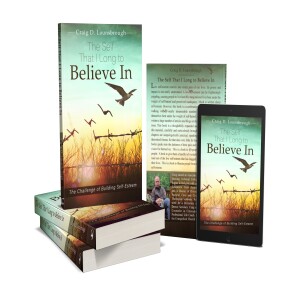
Thursday Jul 24, 2025
The Five Big Lies - Effectively Building Your Self-Esteem
Thursday Jul 24, 2025
Think About It
You are what you choose to be. Life is not a dictated script. It’s far from being something to which you have to surrender. Yes, there are things that we did not ask for that we have to deal with. Regardless, whatever our flaws there is always room to do something about them. Always. Some option always exists. There are always possibilities. Life affords us choices and chances. The human spirit is tenacious, and powerful, and wonderfully creative. Don’t underestimate your capabilities and your resources. Realize that the resources that you possess outclass and outweigh any flaw, perceived or real. Choose to view yourself differently and more accurately. Choose to choose you for despite your low self-esteem, you won’t be disappointed.
“The Self That I Long to Believe In” is a bold, timely, and inspirational book that will help you to effectively build your self-esteem. Get your copy at Amazon, Barnes and Noble, or wherever books are sold.

Thanks for joining us on LifeTalk today. I hope that you take the time to enjoy all of the many programs on our podcast. You’ll find us on most podcast platforms as well as YouTube. See you next time.

Tuesday Jul 22, 2025
”An Intimate Collision - Encounters With Life and Jesus” - Part Three
Tuesday Jul 22, 2025
Dean was deaf. It was that simple, but it was inordinately complex at the same time. Life can have its sinkholes. Sometimes there’s a bunch of them, enough of them to cause a broad and crippling implosion where things just cave in all around us. Life then becomes a litany of foggy responses to trauma where we move zombie-like through whatever the day or the moment holds. There is no forward movement in times like these. When our worlds collapse it all becomes about survival because often that’s all it can be about. Soon survival becomes the norm where we strive to survive for the sake of survival itself. Life becomes abjectly meaningless other than getting through the day to fight the meaningless that will face us again tomorrow.
Dean was deaf. But he was mentally retarded as well. Tenderly kind, compassionate and invitingly soft underneath it all, he was the by-product of the sink-holes that had scattered themselves all around his life. In the end, it all imploded and he retreated into his deafness and his mental retardation, finding there some seclusion away from it all. He sat along the roadside of life watching some of it go by and ignoring the rest of it. He surrendered to isolation and held the world at bay, barricading himself many fathoms deep within himself. He effectively placed himself out of reach of anything. He was a treasure lost in the stratified subterranean layers of his fear.
He had never mastered his deafness. Some lean into their disability and shape it to serve them. He never leaned into it. Some work to compensate for their handicaps by strengthening the things that are not handicaps. He never compensated. Rather, he decompensated down into a silent oblivion where he sat hunched and utterly alone.
Sign language and the reading of lips never broke him out of the prison that deafness had thrust him into; that place so many fathoms deep that no one could get down there. He was somehow held inside with the world held outside. Each could see the other from their variant vantage points, but neither could bridge the gap nor plumb the depths. Whatever separated him from the rest of us seemed intractably immovable.
A Conviction of Greatness
Life sometimes persuades us to believe that there is so much more to something or some person even though we can’t see it. We engage that thing or that person with a certainty that there lies within them something profound despite the fact that it’s completely hidden. It seems that we walk circles around them, looking and probing for some crack or tear that will grant us a peek inside. We look for some chink to wriggle through or a knob that we can wrestle with long enough until some hidden door opens and grants us entrance to the riches within. There emerges a dogged persistence about it all because we dare not bypass what lies within even though it’s held away from us.
That was Dean. He was a kid that I could not let go of even though there was nothing to hold onto. His mild mental retardation put him even further away; a young man of riches unearthed that always provoked me back to him. He was frustrating and abrasive at times, being unable to break through his own deafness and reach up and out to everything outside of himself. His coarse and sometimes rash behaviors seemed to be an expression of his deeply engrained trepidation of the world, combined with his own frustration of choosing to seclude himself. Because he couldn’t break out, he reinforced his isolation from the inside out, pushing everything away so that he would have a sense that it was he who was locking it all out. Somehow he found solace in thinking he controlled it because it gave him a sense he could get out of it. He couldn’t.
I didn’t choose to be relentless with this kid. I had no choice but be relentless. Sometimes what you see in another is far too convincing and too terribly compelling to let it go of it even when you meet with nothing more than outright rejection and ever-thickening walls. And walls there were; thick, fortified and towering. I found myself relentless in pursuit and then disappointed into withdrawal, only to do it all over again because this kid was somehow just too precious to let go of. He needed to hear, maybe not with his ears, but at least with his heart. I prayed that God would pull Dean aside and open up something that would open him up.
Deaf to Life
Rejection and scorn was his lot due to the assumption of sin that others had about him. The world was loudly silent for him. Something was missing that he could not identify because he had never known it. Life is indeed an orchestra full and complete, absolutely masterful. But for the deaf man it was absolutely silent. The musical pieces and masterful renditions for which life was created were soundless for him. Notes and scores that were casually written across the faces of friends, that were penned in the raucous flamboyance across bustling open air markets, that found subtle notation in droning bees gently drifting from blossom to awaiting blossom all gave the faintest hints of the melodies they illustrated, but the sounds were never there. The sheet music ran in front of him in endless reams, but they didn’t spawn a sound.
The haunting call of myriad geese aloft, the pounding surf throwing itself against a forever beach, or the fingers of the wind rustling through listless treetops were silent for him. The roll of a distant summer thunderstorm on a humid horizon, or the raucous laughter of life rising from the soul of humanity itself was nothing more and nothing less than the sound of silence. Entombed in a vacuum of deafening silence, the orchestra had always played soundlessly for this deaf man; vigorously indeed, but vigorously silent. He was deaf and he was starkly alone.
He attempted to interact and engage with the music and the melodies. But to try to participate in a world you can’t hear leaves you ever outside of that world despite how hard you try. His lips were slow and drawn with words that were ill-formed. He arduously attempted to wrap words around voice and syntax and intonation that he had never heard. He spent himself in perpetually frustrating efforts to do what he couldn’t conceive and could much less imagine, to put sounds to words he’d never heard.
His words were slurred, distorted, verbally twisted and linguistically bent, readily inviting and successfully garnering ridicule, mockery and confusion from those that lived in the world of sound. His was a life forced out onto the fringes of life, exiled there in a lonely land where silence is a hated, but forever companion. There was no breech in the wall to slip back through in order to touch humanity so as to belong to something other than the silence.
Rejection by others was based on the errant assumption that some sin had caused his deafness. This conclusion was elevated as full-fledged fact, rendering him an outcast on the falsest of premises. Rejection and silence are both isolating, the difference is that one is a choice, the other is chance. What they have in common is that the person upon whom they both fell chose neither. It was something like a full emasculation of everything it is to be human. This is what it was to be deaf and mute. And so his life went.
There was a rumor that circulated. A distant murmuring unheard by deaf ears, but caught by others said that Jesus was in the Decapolis. This prophet and miracle worker had come. The verdict as to who this Jesus was remained a point of discussion and debate. Some of that was quite heated and some of it was really rather innocuous. Yet, He was coming and the captivating risk that He was something more than a mortal man was compelling.
Had those around this deaf man tired of his dependency, these friends of his, or did they care for him? Was he little more than an object that could be used to entice a miracle of this prophet? Was their intent little more than a ploy for a cheap thrill? The text is unclear. The motive is foggy and indistinct. But they take the deaf mute to Jesus. It didn’t appear to be an action of the deaf man’ own accord as there is no hint of self-determination or self-initiation. There doesn’t appear to be any sort of remote inkling that the possibility of being ushered into the world of sound is a distinct possibility. How can you possibly know what you’re missing if you’ve never had it? How can you desire something if desire has no place to be cultivated because we’ve no idea that there’s anything to be desired?
Sometimes we see in and through others what we could not otherwise see because it’s not within us to see. Sometimes we experience the passionate and vigorous pulse of desire vicariously through the heartbeat of others and we sense the pulse in them. Sometimes our vision of the possible is only possible because we see that vision reflected in the eyes of another and we watch it listlessly dance about in their smile. Sometimes we actually end up dancing because others have caused us to believe in the dance and have ushered us out on the dance floor even when we can’t hear the music ourselves. Such were the deaf mute’s friends.
And so, the rumor draws them to Jesus. Soon the embedded mass was found. Ushered by these friends, the deaf man pressed through the crowd. The small entourage cuts a swath through a fluid array of assorted humanity that swelled and eddied around Jesus. The clamor of a world of never-ending needs simultaneously sought relief. The world clamored around Jesus seeking some shred of hope and some healing that arises from that shred of that very hope. The crowd swirled around this wandering prophet as if in the grip of the undertow of all creation, an irresistible current from which all other currents find their sole source. Passing through a cultural morass of assembled humanity the deaf man is drawn toward the center.
The aged, stooped and shuffling in the grip of long years wandered about in a cloudy curiosity. Children darted in and out. The blind walked about groping, stretching trembling arms outward, substituting touch for sight and sound for vision. Stumbling, they made their way to Jesus. Crutches that were terribly crude and deeply weather-worn were nothing more than primitive prosthetics that sought a miracle for an absent leg. A cripple, his fingers clawing the arid soil drug useless appendages and tattered garments that trailed in the talcum dirt behind him.
Limp in his mother’s arms an infant teetered on the chilling precipice of death, the pallor of death strangely awash across the face of newborn life rendering his skin hues of suffocating purple. His mother stood on panicked tiptoe, stretching her neck to catch a glimpse of something, anxiously groping toward the center of the mass. It was all silence to the deaf mute. It was all wildly alive, vibrant, turbulent and wonderfully riotous, but deathly silent. From his vantage point, the drama was only partly revealed.
Pressing onward and inward, it was more of the same. The scene was packed tight with shifting layers of broken humanity, the curious, the destitute, the rich and poor alike. Finally the last layer of jostling, clamoring humanity parted like the parting of some glorious tapestry. A man of silent stature stood in the crowd, yet infinitely above it. The nucleus of the swirling mass of people and their needs was deafening in silence. Jesus back was to them. Slightly stooped, His hands gently rest on the shoulders of an elderly woman. The look of astonishment was set in her eyes and splashed across her face. A worn cane lay abandoned at her feet. Something unusual had transpired. It was immediately clear that there was thick compassion in His touch, His stance, and His mannerisms. A parting word to the woman and He turns.
His gaze shifted and panned the crowd. Mussing the hair of a playful child, both smile deeply and invade the heart of the other in a superbly divine intersection. Another step and this Jesus was drawn to the outstretched arms of an ecstatic infant. He moved toward her, His face electrically alive with love and aflame with anticipation. To squeals of laughter He took her, held her high, pulled her to His chest, ran His hand across a misshapen leg and it was straight. The convergence of two souls, He drew her deeply to His face. And then He handed her back to an elated set of parents who now held a daughter who was wholly whole. All of it was too much for words; it was too inexplicable to embrace in the confining catacombs of human understanding. The only question that one can formulate is “Who is this?”
Before the answer can be formulated Jesus is drawn to the pleas of those who have brought the deaf mute, pleas the deaf man cannot hear. The man, this Jesus stepped toward them, fastening His attention on those who had brought the man. He seemed discerning and listening with some sort of intuition and understanding that superseded anything they could comprehend.
He then turned intense eyes and fastened His gaze on the mute. His eyes were more than human, although they appeared to be something that was fully human at the same time. They were infinitely deep, profoundly thoughtful and intensely focused. A soft but chiseled spirit enamored the crowd and drew the deaf man to Jesus. It was all a terrible yet inviting contradiction of commanding power and gentle softness. Jesus’ eyes had the breath of infinity behind them. The deaf mute found himself becoming entirely lost in them until Jesus took his arm, gestured and began to move out of the crowd. God was afoot; the Creator of the universe in intentional motion toward an intentional destination. It was all terrifying but exhilarating at the same time.
This fluid mass of humanity parted a second time, but from the inward out. Shifting layers of broken humanity sliced a swath to the edge of the mass. Jesus breeched the fringes of the crowd, walking with a man whose life had been lived on the fringes of life. Jesus was in the process of isolating a man who lived isolated in deafness. In a moment, the crowd was far behind them, their voices falling into a distant murmur. Those that advocated his healing were absent. Suddenly, inexplicably, this deaf mute was alone with God.
Ears and tongue; the world is drawn in through one with the self being released through the other. They both engage in a partnership of exchange, drawing in and letting out. They draw in the world to process it and then release it back into the world with part of the person attached; adding to life, flavoring it, affixing yet another unique note to the chorus of the ages. There, in the world of the deaf, this dance was never initiated. The deaf man was isolated from the world and to the world.
Drawing the man along, Jesus sought isolation. It was within isolation that isolation would be broken. One on one, God and man in relationship echoing back to a lost garden. The Creator and the created rectifying lost creation in an act of recreation. In this joint journey they walked past the rancor and raucous of an open air market filled with bartering and bantering, scales and sweeping gestures. They skirted around scurrying children and walked past stray dogs milling close to tables spread with red meats. A pair of centurions laden with weaponry strode past in the service of oppression, granting Jesus and the deaf mute no notice. Passing priests in ceremonial robes stepped in pompous cadence on errands of perceived righteousness.
And then, an unexpected turn into a vacant alley made up of basalt stones that cut a manmade canyon. The sun found scant room to watch the making of a miracle. It casts angled rays, canting itself to catch the pending phenomenon. The din of the open air market and the jostling of the vendors was put at a sufficient distance, becoming gradually muted and fading soft and indistinct into the background.
Then, a miracle was wrought with gestures that were so familiar to the mute. Gestures were the very means of understanding and the way in which the deaf mute had navigated his world. Jesus was not a God interacting in mystery, but in intimacy. There were no methods cloaked with indiscernible actions or unfamiliar rituals. All was simple, direct and familiar; fingers in ears and a touch of the tongue. Saliva was a symbol of the fullest sharing of self as a participant in the miracle right along with the deaf mute. Jesus engaged the man not as a distant entity cloaked beyond recognition in some sort of misty immutability. Salvia was believed to have had a curative quality; a belief entirely fictional in nature. However, the symbolism of the act provided a needed vehicle that outweighed the myth of the act itself. So Jesus ingeniously chose to use myth as a vehicle for a miracle; a miracle done in the simple language of the deaf mute’s isolated world to obliterate his isolation.
And then there was something for Jesus Himself. Something the deaf man could not hear or participate in. Jesus looked up to heaven. There is a weighted sigh of a God whose love eliminates His ability not to feel. It was a reflection of both His heart and the heart of His Father. It seemed to be the private pain of a God grieving over His own creation, escaping the lethal weight of it all only by virtue of His divinity. Jesus’s sighing was likely the plaintive moan of God once again embracing the awful reality of fallen mankind as manifest in this single, mute life. It was likely the expression of a great angst that arose from an infinite understanding of how far this man’s life was from God’s original intent for him.
There, in that alley God would meet the need of one man. In a few days, He would meet the need of thousands with a scant seven barley loaves and a few small fish. A few months beyond that and He would meet the need of all mankind on a barren hill. It would be a hill that would not be sandwiched between the walls of some abandoned alley, but between two crosses and two worlds. However, there was the need of the moment.
“Be opened!” (Mark 8:34, NIV) said this Jesus. Not just his ears, but his life as no miracle is excluded or in any way restrained solely to the obvious. “Be opened!” Be free to live fully, to hear in perfect pitch the richness of the notes and measures, the scores of life and living. Be opened to engage everything else in life that was open. Be opened so that being closed simply cannot be.
Jesus took a step back and watched life unfold as the miracle reverberated far beyond the miracle; something like when a stone is dropped in a mirrored pool, sending ripples far beyond the point of impact. An alien experience transpired for which the man had no point of correlation. Sounds began to filter through. The orchestra gradually swelled and expanded. The void of silence filled to capacity.
Suddenly, he heard the crunch of gravel beneath his feet, shifting his weight again and again to reproduce the sound his stunned and hungry mind had never imagined. The barking of a dog floated in from afar, the source of the sound and everything that defined it was entirely unknown. Birds darted overhead in tangles of wild flight, cheeps and chirps synchronizing the feathered masses journey. He was caught in the rapture of hearing his own breath. And then words, the first he had ever heard, annunciated clearly, perfectly and concisely. His own voice now came back to him perfect! The cycle was now marvelously complete.
Jesus stood silently, giving the man room and time to embrace the wonder of the moment. Miracles become freeing and claustrophobic at the same time; opening up entirely new venues that are often bigger than our ability to embrace. Time was needed to allow this astonished man sufficient time to reorient to the miracle of a life restored. Maybe Jesus saw in this man, this deaf mute the liberation that the cross would extend to billions.
It may be that the individual miracles, like this one, allowed Jesus to foresee in this solitary face what the cross would do in an endless sea of faces across endless spans of time. Not the kinds of miracles that would eventually fall to the deterioration of frail bodies and the eventuality of death, but miracles that would be eternally fresh because they open up all of eternity to all who seize it. I wonder if maybe it might have been these moments that allowed Him to endure the long moments on a lonely cross.
And then, the first words of another human being that he ever heard. “Don’t tell anyone,” Jesus said. The first words seem irrational and inexplicable. The world of sounds brings with it responsibility to the world it unveils. Miracles bring with them accountability to both the Restorer and what has been restored. A relationship with God brings obedience, the responsibility to act on faith even when that action appears irrational, contrary, odd or plainly wrong. “Don’t tell anyone”. But containment failed. The measure of the miracle was larger than the measure of the man to contain it. But that is what happens when an infinite God interacts within our finite frames. What He does is always bigger than us and bigger than our ability to contain it. Our faith may be big enough to elicit a miracle, but our faith is seldom large enough to embrace it once it happens. Jesus took his arm, gestured and began to move out of the alley and into life.
Aside in an Alley
And so, Jesus pulls me aside at times and isolates me in my isolation. He places creation aside and draws me to a secluded place, away from the crowds that surround me and the world that has so often thrust me to its fringes. Often I am afraid to be there because I am confused and frightened to be one on one with God. I would much prefer to have Him heal me at a safe distance, or intersect my life in the companionship of others, or touch me as part of something larger within which I can meld. But one on one in some alley in my life; secluded with God? Sequestered with the Creator? It is both terrible and wonderful.
And then, to have Him connect with me intimately in that place of isolation? The God of the cosmos coming to me in my isolation? Not just in proximity or in earshot, but in my language and in the raw essence of my being. God steps into my isolation and speaks to me there. Not standing outside of my isolation and beckoning me out of it from out there. But coming in, gently taking my arm and gesturing me out of it. Partnering with me and in the partnering coming squarely into my isolation to commandeer me and rescue me. Cutting through the mass of issues, pain, self-absorption, and self-hatred that surrounds me and drawing me along with Him.
And there, in those isolated alleys of my life He frees me. He relishes watching me come to life and then fumble with a life that’s so new that I have little idea how to hold it. He is as amazed at watching me come to life as He was when He first formed Adam from the dust and “breathed into his nostrils the breath of life” (Genesis 2:7, NIV). It is just as poignant for Him, never being diminished for a God whose love for His creation rages undiminished. God is always revealing that creation can only exist if it is constantly creating. “He has done everything well . . .” (Mark 7:37, NIV). Harkening to yet another statement . . . “and God saw that it was good” (Genesis 1:10, NIV). In that alley God was creating all over again as He always does, doing everything well and good.
Dean’s Alley
It was all experimental, but the doctors said that the surgery might restore Dean’s hearing. He was not enthused at all. Dean walked through the process more like a laboratory rat that had no idea of what was happening or what the possible outcome might mean. He was lethargic through it all, demure and distant.
But the day came quite by accident. I turned and there he stood. My first response was to say “hello” out of some prescribed tedium and routine, knowing that he wasn’t reading my lips. Sometimes rote and ritual turns life lifeless. It robs us of expectation and hope. I felt that way with Dean. But I said “hello” anyway.
He simply looked, canting his head a bit and registering something in those crystal blue eyes that I had never seen. Sometimes we imagine something so much for so long that when it’s ours it’s both wonderful and terribly different than we had ever imagined it being. I think that was the case for Dean. He had heard my voice. The surgery had worked. For the first time, he had taken in the tone and flavor of the single word that I had uttered and had found himself awed by the utterance. He smiled and seemed to wait for more. I paused. “Can you hear me?” I said tentatively, desperately hoping that he was no longer locked in and I locked out.
Instantly he grabbed my arm, turned and in the rush of wonder pulled me down the hall and into his room. He stopped in the middle of that quaint room and pointed at the various objects around us in frantic gestures. It was all so new for me that I had no idea of what he meant. He continued to point in a manner insistent and adamant, walking around the room in a rigid gait and incessantly pointing.
Finally, I realize what he wanted; he wanted me to pronounce what the objects were, to speak their name, to say them so that he could hear them for the first time. Picture, telephone, window, bed, floor, light, wall, rug, Craig; it was a young man surging alive with an urgency that flooded the room with a terrific and wonderful energy. He was hearing it all, for the first time.
Sometimes you sense that you’ve been put in a place of privilege that you are completely and wholly undeserving of. That’s where I was on that day. God came aside this young man through the hands of a caring doctor and an experimental surgery. Now I was privileged to stand beside him as well, inundated in a tsunami of wonderment and life.
It all went on for days and days. I couldn’t wait to see Dean. In indescribable awe, I watched a young man come alive in a way that makes coming alive worth all the pain and disappointment and deafness that we have to endure to get there. A miracle came to me through Dean. Deafness was abated in infinitely more ways that simply physical hearing. Dean reminds me of deafness and what it can do to a person and a life. Dean also reminds me of deafness abated when God comes along side of a single life and renders deafness deaf.
Repeated Deafness
Unlike the deaf mute and unlike Dean, my deafness and my inability to speak to my world come often. Frequently I need Jesus to put His fingers in my ears and touch my tongue. Sin, selfishness and the lure of the world renders me deaf and ill-suited to speak as I should. My condition is pitifully recurrent. God’s presence is likewise persistently recurrent. Daily I am in this alley with Him. While I tire of it and find myself sweltering in embarrassment, He never tires. He likes, it seems, these alley encounters. He relishes taking me aside. And I know that one day He will take me aside for that final time, that time when I will ascend to a place where deafness and speech deficits will simply not exist. Their memory will be vanquished. And there, in that place, I will stand eternally before God in perfection with new worlds perpetually opening up to me. In that place the layers will constantly part to reveal something new. His smile, the relish in His face will never be old, but always new.
Pondering Point
The loud voices in life, those that clamor for our attention are most often not the vital voices. The fact that they have to clamor suggests as much. It is the smaller voices that are weak, thin and easily drown out that are rich. It is these that tend to be the priceless voices. Their worth easily lost in the pompous and presumptuous voices that say much but hold little. It is easy to become deaf. And when we are, we miss the precious voices whose worth is immutable.
Additional Resources
Discover an array of additional resources on our website at www.craiglpc.com. Find all of Craig's thoughtful, timely, and inspirational books at Amazon. com, Barnes and Noble, or wherever books are sold. Also, take a moment to explore Craig's Public Speaking Resources for information regarding the resources available to your business, ministry, or organization.

Thursday Jul 17, 2025
”In the Footsteps of the Few - The Power of a Principled Life” - Part Four
Thursday Jul 17, 2025
"In the Footsteps of the Few - The Power of a Principled Life"
I Was Thinking - To Think Outside the Box(s)
I was thinking. And the more I thought, the more I realized that there is a whole lot to think about. But in my thinking, I thought that most of our thinking (despite how much there is to think about) is really pretty standardized and chafingly rote. We think in predetermined patterns and pre-existent templates that require no thinking, other than the commitment not to think. We think in the way that others have chosen to think because they’ve already done the thinking, which relieves us of the need to do so. We think we think, but the more I think about that, the less I think we think (if you know what I mean). So, while there’s a whole lot to think about in this big, wide world of ours …we don’t.
It seems that our thinking is constrained in a manner that there’s really not that much thinking going on at all. Rather, more often than not our thinking is a tired process of monotonously gathering up a predictable handful of stale but safe thoughts. And if we play with them long enough, we figure that maybe they’ll freshen up and something innovatively fragrant might actually emerge out of the rot. If something actually does, we’re usually scared of whatever it is. If it doesn’t (which is typically what happens) we become increasingly convinced beyond hope that life is actually as stale as we thought it was.
Why?
Most of this appears to happen because we think within boxes that we randomly (and sometimes not so randomly) borrow. We think within predetermined boxes because anything outside of those requires some innovation wherein we let the leash out a bit, let our thoughts find their legs, and let them run. But we’ve discovered that sometimes that simply takes too much thought, far too much energy, and far, far too much courage, for it is much easier and much, much safer to just sit. Or worse yet, we fear that once our thoughts have caught even the slightest whiff of a life running at full stride, they will forever refuse the short leash.
What if our thinking were to open up fresh venues and pull back some hitherto hidden veil that suddenly revealed vast horizons that leaves ignorance no place to hide? And what if the magnitude of such revelations is such that it handily crushes the complacency within which we’ve found so much comfort? What if? And out of the fear that such things might actually befall us, we peruse the stank back alleys of complacency, hastily borrowing boxes that we find deep in the darkened hovels of mediocrity. And life becomes a journey lived within suffocating boxes rather than an adventure crafted of breathless horizons.
Our Box Collection:
The Box of Societal Norms
We think within the box of societal norms. We grant these norms legitimacy because most of the people around us adhere to them in one form or another. Because all these people adhere to them, we naturally grant these norms a morality, assuming that others would not dare embrace them if they weren’t sufficiently ethical or moral. Therefore, (despite the terribly narrow nature of both the boxes and our logic), they are deemed acceptable. To our relief, we quickly discover that if we think within these boxes we are far less likely to be met with rejection, or ridicule, or disdainful judgement, or some other rather distasteful response. We desperately want to be in the good graces of those around us as that’s far more comfortable and far less dangerous than being in some other more adverse state of relationship with these people. Therefore, the rules of the box rule out the role of thinking.
The Box of the Mundane
We think within the well-worn boxes of the mundane as that path is quite well charted, rigorously predictable, and therefore void of anything dangerous because other people have figured out where all the dangerous stuff is and either removed it, or they’ve created paths around it. We know that venturing off the path in life is ref with all sorts of calamity that’s just waiting to happen, and so in the box of the mundane there’s nothing to venture off on because there’s one and only one path. It might be mundane, it might go nowhere, but it’s safe (if you happen to define ‘safe’ as refusing to live in order to effectively avoid being hurt). In an increasingly busy world that’s careening in every conceivable direction, the box of the mundane allows us to perfectly function on autopilot since there’s only one path that we can walk. Better yet, if we so choose we can simply sit along the side of this singular path, as this box generously allows us to somehow think (because we’re not) that sitting is a journey. Therefore, the rules of the box rule out the role of thinking.
The Box of Our Fears
We think within the box of our fears, as anything on the outside of those walls is filled with horrific danger (often of the most fabricated sort). We’ve probably ventured out there a time or two, and when we did, we got hurt. And so, when we were hurt, we put our pain on emotional steroids which exponentially magnified our fear. We then took that fear and fashioned a monster that doesn’t exist, and we hunkered down in our box horrified by the fiction of it all. And while the space out there is a whole lot bigger than the infinitesimally tiny space in here, at least it’s safe. And safety (in our minds) is a decent trade-off, so much so that we amply decorate the box and make it homey with the scant furnishings of justification, rationalization, denial and other carefully appointed excuses. We settle into the scantily upholstered armchair of mediocrity and wile away our days pretending that we’re not pretending. Therefore, the rules of the box rule out the role of thinking.
The Box of Our Families
We think within the box created by our families as we engaged them growing up. In many unhealthy families, their boxes were shaped by their own demons and assorted hobgoblins that they handed the reins of power over to. Over time, they dutifully passed those onto us lock, stock and barrel. Sometimes these families demand that family members stay within those boxes because, somehow, we will vanish into the dank darkness of another life, or be whisked off to parts unknown by friends, or fall headlong into a career if we dare step outside of them. Other times, family members may prompt us to move outside of the box because they have come to recognize the life-sucking quality of the box. Yet, while they prompt us to step out, they did not know how to do so themselves. Therefore, we must do the most daring thing imaginable and think through exactly how in the world we’re going to do that. Therefore, the rules of the box rule out the role of thinking.
The Box of Self-Esteem
We think within the box crafted by our low self-esteems. These are often the smallest of all boxes because we dare not create any room whatsoever for anyone else to come in lest they see how pathetically awful we really are. Sitting in our confining hovel, we know full well that there’s great adventure and untapped possibilities outside of our boxes. There’s a good chance that we studied it, or read about it, or on those better days taken a slight peek outside before slamming the door shut again. In fact, knowing all of that is often the most difficult thing of all. We know outside this box of ours there’s more life than we can wrap our solitary minds around. We constantly hear the invitations to come out. We can imagine adventure because we’ve imagined it so many times that we can almost touch it in our minds, which makes us think that somehow we’re touching the adventure out there (which in fact, we are not). But we doubt our ability to function in it, or find a place in it, or seize it in the cultivation of our dreams, or much less survive it. Therefore, the rules of the box rule out the role of thinking.
I Was Thinking
I was thinking that there are a whole lot of boxes. Lots and lots of them. But I was also thinking that they are just boxes and nothing more. A box is not a fortified prison with towering walls and tangled barbwire, even though we have come to see it as such. It’s just a box and nothing more. And as a box, it doesn’t hold us. Rather, we hold it. I don’t ‘think’ that we have the power to move beyond our boxes. Rather, I ‘know’ that we do. And when we realize that power and move beyond our boxes, the parameters of our lives will explode exponentially in a manner that we will be free to think about all the many things that this big, wide world of ours has to think about. When we do, the role of thinking will finally destroy the rules of the box. And when that happens, we will be genuinely free. And when we’re free we won’t be imprisoned by the dark specter of endings. Rather, we can embrace the majesty of our purpose, and we can run with the power of our calling.
And so, I think I really, really want to think outside the boxes. So, I think I’ll start getting rid of them. It might take some time. I’m going to have to be honest about them and grieve what they’ve already stolen from me. It might be scary (in fact, I know it will be). I may wonder what in the world I’m doing at times. People may wonder what I’m doing as they peer out from the cracks in their own boxes. But to not get rid of the boxes is to rot away in a box. And I know that that is not the life for me. And might I say, I don’t think that’s the life for you either. So, let’s begin the process of letting the role of thinking destroy the rules of the box. And let’s be free.

Tuesday Jul 15, 2025
”An Intimate Collision - Encounters with Life and Jesus” - Part Two
Tuesday Jul 15, 2025
Darren and a cheap plastic fish; it was a dollar store bin filler indelibly stamped with “made in China” that bordered on being junk. There were numerous needs in Darren’s life, so numerous that he himself was lost in them. They were pathetic and endless, so it seemed anyway. A plastic fish was little more than a cheap toy that momentarily anesthetized a child-like mind trapped in the deterioration of a thirty-five year old body. It was a mere trinket, a point of focus upon which to forget the realities that had bent him and ultimately broken him. It served as a pathetic distraction from all that had cut thick furrows across his head and heart far too early and far too prematurely. It was a cheap, plastic fish.
The years had stooped his gait and lined his hair with ever lighter shades of premature gray, cutting deep fissures across his brow and thickening young skin. His gait had been reduced to a shallow shuffle, dragging thick shoes across coarse pavement. He wore the soles thin on the outsides edges, further canting his gait. His soul was much the same, deeply worn along the outside edges as well; throwing into a precarious imbalance the cadence of an already distorted life. Darren found himself limping through a world that placed ultimate premiums on that which is new, believing that any value is inherent only in the degree of newness any object possesses. The world viewed his worn edges as old, used up and spent. He was unfairly evaluated as discarded humanity and rendered invisible to the eye of a world too busy.
Baggy pants were thread thin at the knees and frayed at the pockets with stitching pulled and strained at variant seams. An oversized shirt bespoke of his desperate efforts to fit in life. Like his shirt, it never happened. Stained and limp, a faded handkerchief hung from a weary pocket. A mouthful of decay filled each smile and poured out in each conversation. Chapped lips were edged thick by coarse stubble sprouting from a grimy bed of mottled skin. The expanse of his squared jaw and sunken cheeks were covered with a bumper crop of inattention. His words were primitive and slurred; rolling off his tongue in seamless bursts that made comprehension nearly impossible. Shoulders were drawn down by the weight life had exerted on him, pulling him forward in a Neanderthal sort of cadence that was long and slothful. And he wanted to show me his plastic fish.
“Kind of like the disciples, huh? They caught fish. They were fishermen!” he said. A broad smile of decay anticipated a hearty response from me. Darren was thirty-five, yet he was enamored with a dollar store plastic fish. “Like the disciples, huh?” His persistence accelerated my desire to talk to a real adult. Church was over and there were many candidates milling about. My momentary objective was to determine how to terminate this infantile conversation and find someone with some shred of intelligence that I could talk to. I moved to close the conversation with Darren and did so quite deftly I thought. He would have no idea that I had just ditched him. As I stepped away from him, he held the plastic fish in his weathered hands as if it were a precious treasure and muttered softly to himself, “I was a sinner, now I’m a fisher of men too.”
God Strikes
There are unexpected moments in life when God sends simplicity as a blinding light that is far more pure and infinitely more superior than all the intellectual musings I could devise. Darren’s words . . . “sinner” and now “fisher of men”, though soft, backlit my soul in blinding light and thundered through the very core of my ego-centric spirit. They rocked me, simultaneously illuminating my flagrant sense of superiority as paper thin and backlighting my egotistical self against something far greater and far grander. A light both brilliant and revealing was thrown onto something I had unknowingly lost in the dark pool of piousness and shallow Christianity that I had cultivated. “Sinner” and “fisher of men” represented two opposite ends of life. One was represented by sin sheathed in death on one end, and that of salvation and the humanly unexplainable privilege of salvation on the other. He had seized something spiritually authentic that was indefinably powerful because of its innocent simplicity.
His words drew me down with my soul melting into repentant puddles on the pavement and pooling around Darren’s feet. And in my heart a stark thought shot through my brain. It seized my heart and surged through my soul as the light exposed the grotesqueness of my immaturity . . . “go away from me, Lord, for I am a sinful man!” (Luke 5:9, NIV). I had rarely felt so abjectly ugly and so starkly far from God. I was sickened by myself with nowhere to run in order to get away from myself. Darren had brilliantly backlit my life with a hand full of simple words, a plastic fish and an innocent life. I was repulsed by what I saw in the blinding light.
Fish and Light
The cool of the night aimlessly drifted by. Time drifted listlessly with it. Waves gently lapped the weathered wooden hull as if the night was completely pacified with simply existing. Sails flapped passively, rolling in a dance with an occasional listless breeze that floated out from somewhere deep in the night. The timbered creaking of shifting weight was soft against the darkness. Oars dipped deep and silently, spinning tiny whirlpools of water that softly gurgled in the thin veil of satin moonlight. The damp scent of water gathered in a thin, veneer layer of mist that tentatively skirted the water’s surface. The night was intermittently rendered musty with the odors of nets wet with nothing but water. A distant heron hauntingly called into the night from a far shore. Muffled voices and the lights of other boats drifted listlessly across the water.
Nets were cast in a perfectly spinning arch, pirouetting to the rhythm of the night as they were launched by thick arms sure with experience. Slapping the water, they were given a moment to sink into the night of the lake. Descending, the keel of the boat became smaller in the submerged descent. The chalky white moonlight was shattered into a million moving shards of milky light on the underside of the waves, fading as the depths were listlessly plumbed. The water cooled, darkened, and was stirred by soft currents. All was listless in a dreamlike descent.
And then there was a massive tug initiated by the same sure arms of experience. The net reeled and folded in upon itself, instantly enfolding everything within it. A series of firm tugs follow in a different kind of rhythm that was much less peaceful and much more intentional. Lunging toward the surface the net broke the liquid plane and was hauled into the coarse belly of the boat.
Again it was the same. There was nothing in the nets embrace but weeds, water and disappointment. A gruff remark, and then a curse edged rough with the abrasion of frustration cut the night and oozed the pus of anger into the boat’s belly. Frustration was manifest and coarsely expelled into the night by exasperated fishermen whose finest skills could not coerce the deep waters to offer up their bounty. The waters stubbornly chose to withhold their living treasures. The net was hurriedly prepared by frustrated hands and launched again, and again, and again. Frustration layered upon frustration until nothing other than frustration defined the whole of the night.
The moon slowly descended to sleep behind the horizon. The multitude of stars drifted across the expanse of the velvet blackness, moving in unison with the turn of the universe and the winds of heaven nudging them to the same horizon. Night would soon drift into day. The nets remained empty. Soon the sun stirred with the first tentative band of pastel thin light on a yawning horizon, softly illuminating empty boats. So went the night.
This was Simon Peter’s world, that of his father and his grandfather. His was a lineage of weary boats, hemp nets, flapping fish glinting in flashes of silver, sails and storms. He was isolated within the world of trolling by night as the fish rose to cooler waters and sleeping by day. Lost in this world of his, he was so engrossed in its demands that he was defined by that world, having standardizing everything else by its shape and form. This world of nighttime fishing and the life that goes with it dictated the shape, tenor and tone of his life. It was so familiar and natural that becoming it, for Simon Peter, was being nothing less than who he was and where he needed to be.
There was little thought of anything else for he knew nothing else. No other world other than the methodical frustration of sparse nets, contrary winds, too few fish to market leaving purses thin with coinage, long nights followed by exhausted days with the only promise being more of the same . . . nothing other had backlit his life enough to see anything any different.
In His World
There was an unexpected intrusion in Simon Peter’s tiny world. A carpenter turned prophet found His way to this place of nets, nights and weary men. Word had spread carrying rumors of miracles that had long drifted across the lake, having reached the shoreline and lapped against the wooden hulls of the docked boats. It was likely that many of the fishermen had gotten wind of Jesus as their sails might have caught a slight breeze.
But it was of little import. Rather, it was an inconvenience. Like too many nights, the night had been long and fruitless. The nets had yielded nothing more than water, weeds and weariness. There were no fish to market that day. The lake and the night had joined forces to deny these hunters of the deep any trophy. The coming night would be pressed with the need to make up for a night lost. It was time for sleep, troubled sleep at best, but sleep nonetheless. Yet, despite the need for sleep there was an intrusion . . . of all days.
The crowd grew, giving some degree of credibility or celebrity to whoever this was. These frustrated fishermen picked up a few words here and there, discerning pieces that remained only pieces within the fatigue that enshrouded their minds. Religion won’t catch fish and nice words won’t mend nets. Sweeping platitudes won’t feed hungry families, and brazen prophecies won’t raise wily fish from elusive depths.
But Simon Peter had seen what the winds of rumor had only blown. A mother-in-law had been healed by this itinerant Jesus person. The crippled walked pensively but surely on unfamiliar legs with crutches joyously abandoned at their feet as a necessity that was instantly rendered unnecessary. The blind stumbled in the attempt to align faces with voices for the first time, turning to drink in deep blue skies and finding themselves hopelessly enamored by mounds of brilliant wildflowers. The pallor of death was swept from the faces of catatonic infants with tiny arms and thin legs instantly washed alive with vitality that had no explanation, except . . . He had seen it.
Simon Peter had attempted to correlate all of that with his world of boats, frayed nets, canvas sails and fish. The experience and the exposure had not changed him yet. It was only an anomaly because his world had not been directly intersected. What he had observed was wonderment, but wonderment that had taken place some distance outside the parameters of his tiny and predictable world of wooden boats and hemp nets. It had yet to manifest itself dead center in that world and to render everything entirely less than predictable.
However it happened, Jesus was suddenly in Simon Peter’s boat; dead center in Simon’s world . . . ground zero. Suddenly his boat was turned into a podium and a fisherman was turned into a chauffeur. From the bow of this tired fishing vessel the words of Jesus droned on. It’s not that they weren’t compelling. It’s just that they fell upon a mind dulled with fatigue and deluged with both empty nets and empty pockets. Sometimes the greatest messages are missed because the human mind is occupied with a miniscule net of fish drawn from some tiny puddle when the Fisher of Men is standing right in their boats casting a net into the whole ocean of men.
Scripture does not indicate what Jesus said that struck Simon, it’s what He did. And then, the command came. The nets had already been mended, cleaned and stowed. Weary sails had been drawn tight and tied. Arms were weak and heads were fuzzy. The fish had undoubtedly descended to cooler waters, far beyond the reach of their nets and all of their accumulated skills. And yet this Jesus wanted to go fishing. The logical argument was of no use. A lifetime of experience was discarded and discounted by this Teacher. He was confidently insistent. And so, wearily Peter mumbles, “But because you say so, I will let down the nets” (Luke 5:5, NIV). And he does.
Oars are lowered by weary fishermen who exchanged glances washed in confusion, anger and a slight flush of stupidity for agreeing to this idiotic venture. Plunged into cool waters, awakened oars create spiraling eddies in their wake. The morning sun was now full, having long lifted itself off the horizon of a new day, spilling a cascade of gold that broke into sparkling flecks of yellow glitter on gentle waves. Oars were drawn in with glistening droplets falling from their weathered edges, ever so quickly catching a slight fleck of sunlight before becoming lost in the waters below. Arms of experience grasped the nets, spread them and deftly launch them in perfect flight. Again, they slapped the surface of the water as they had a hundred times the night before. A thousand times maybe. This time however, it was different.
Backlighting
Instantly there was a slight tug. Then, the nets were seized and sent wildly convulsing. The pull was overwhelming, catching the strength and experience of even the most seasoned fisherman entirely off guard. Strained arms were etched with protruding veins. Faces were flushed red. The boat listed under the weight as nets were hoisted to the surface. Drawing against the collective resistance, the surface was broken in an explosive torrent of foaming water and flailing fish. The morning sun caught and threw the first silver glint of hundreds of thrashing fish reflected riotously in the churning waters. The water was agitated, surging white and frothy with the multitude of the catch.
Simon Peter was astounded, his mind gaping with the inability to correlate what he saw with what he knew. A sudden panicked call went out to other boats. They scurried and cast off in pell-mell and chaotic fashion; experienced fisherman completely inexperienced with netting the impossible. Oars plunged deep and hard, frantically pulling against morning’s water. A small army of boats surged forward, creating panicked wakes. The catch spilt as a silver torrent into other hulls. Boats creaked, listed and then dropped to the water line, rolling fat with the bulky weight of the catch.
Simon Peter was caught in the breech of trying to draw in nets that were fraying and snapping while correlating the event in his own mind. For him, it was irreconcilable. It did not match his world or his experience. He was thrust beyond his limited sphere by an event that had occurred in his world, in the very center of it, right in the middle of who he was and what he did.
It was entirely other worldly, smacking of something supernatural even. Every sense and sensation of the miracle was inserted into the very center of his life to blow him beyond that center. His life was now held in sharp and poignant relief against something incomprehensibly greater and immeasurably grander than he. He was no longer compared solely to his world; a comparison which once gave him permission to mindlessly inhabit that world without thought. Now, instantly, he was held up against something infinitely beyond his world. And there, in the stark and contradictory contrast of a miracle happening in his boat, on his lake, with his net and his hands, he saw himself. Here, he was backlit.
Starkly backlit by God, his life was thrust into keen and crippling perspective. The blinding light revealed the thin veneers of his life so much so that he was exposed beyond his ability to comprehend the exposure, much less deal with it. The din of the activity faded as Simon was drawn down, face to face with his revealed self. The sea, the boats, the commotion of fellow fishermen . . . they all disappeared as he devolved deep into himself. Simon Peter was fraught with himself, finding himself grappling with the reality of his person as he had never seen it before, or been willing to see it.
He turned, stepped, and lunged to the front of the boat. Here Jesus had watched the miracle unfold; God incarnate enjoying the provision of the fish, the message in the provision, and lives about to be changed by the provision. Simon Peter dropped before Jesus, a proclamation of utter transparency leaping from his lips in stammering honesty. Starkly set against the activity around him he shouted, “Go away from me, Lord, for I am a sinful man!” (Luke 5:9, NIV).
God had invaded the core of Peter’s being and he had been illuminated against it. Here he saw the real self. He acknowledged what has been exposed as far too much to comprehend, and far too big to allow him to recalibrate it all into something that made sense to him. He could not embrace it, so vast was the exposure. So, he had to get away from the light and get it away from him. Yet, he would ultimately find that entirely impossible. Soon the disciples would be named and his name would be the first called in a list of many names. It was no wonder as being backlit is often the precursor to being called.
My World Defining Me
And so I am lulled into the ebb and flow of my life, into the circumstances that swirl in variant pools around me; the eddies and rippling waters that reflect back to me more of what they are than who I really am. And I blindly accept those reflections as me, allowing myself to become impoverished in the surrender of acceptance. It is when God steps into the middle of my world that what I took for God I find not to be God or of God. It is when He seats himself dead center, squarely at ground zero that I am inoperably exposed. It is here that something vastly superior is held up against who I have defined myself to be and what I have settled for.
Too often my own light is borrowed, reflected off of variant events around me much like the moon borrowing its light from the sun and reflecting back what does not belong to itself. My life is backlit by weak imitations that reflect things that are not their own, backlighting my life by anemic events that reflect a light so washed out that the landscape of my life is hardly perceptible. This I eventually take for light with the eyes of my soul having become so unaccustomed to real light that its absence is no longer comprehended. I then settle and sell out to vagueness as this kind of light provides little more than that. All the while the profound challenges and wild passions lay a silent captive to the deep shadows that such a light casts; shadows that never surrender their contents to whatever light I bring to them until my life is backlit and the shadows are forced to surrender.
The Hopeful Shock
The shock of being backlit by Jesus rests in the instantaneous awareness that it brings. The sudden illumination of everything makes everything vividly stark and painfully clear. Such is the penetrating nature of this light that the light itself brazenly outlines and defines every sordid aspect of who I am, leaving no room to ponder or stew over them myself. Neither does it give me room to manipulate what has been revealed because the clarity is so pure that it’s cognitively impenetrable and completely indefensible. Otherwise the moment would be robbed, becoming something less than wholly divine in the thievery.
To be backlit by Jesus is to fully see and fully comprehend all at once. All that is left for me to do is to embrace the truth vividly set before me, or squander the moment in futile attempts at denial. More times than I can explain I have rushed to the front of the boat, prostrated myself before Him and begged him leave because I am faced with the horror of myself.
At those times my putrid disgust with myself clearly bars my relationship with Him. Inevitably every time, He looks beyond what I cannot. He sees who I am verses what I have become, delineating the difference in vivid starkness so clear that I cannot stand before myself. He reminds me of His grace which makes my grotesqueness the raw material from which He weaves His glory. And then, bedeviled and helpless by what I see in myself He calls the authentic me to works beyond my comprehension when all I want is for Him to leave. And it is in the angst of desperately wanting to flee and break His hold on me that I am held against myself and am drawn kicking and screaming into phenomenal growth.
Making a Habit of the Light
And so I go fishing with Jesus every day. Fishing for men? Yes. But also that kind of fishing that repeatedly back lights my life against the majesty of God. It is placing myself in His presence while fighting every urge not to do so; readying me for the poignant realization that I am not what I presume to be and being with Jesus will highlight that every time. It is not His disappointments in me for His grace will always tempter that. It is my own disappointment in myself. I want to avoid Him because I want to avoid the pain of personal honesty. But I find an incongruent passion that causes me to leap into the boat because I know the joy of being honest before Jesus and what He does with that. I am constantly, repeatedly and forever changed.
Darren and a Plastic Fish
People continued to mill about me, but they had vanished in the midst of deep thought and emotional turmoil beset within me. I turned to Darren who was meandering off to some unknown destination; much like his life. I reached out and touched his shoulder. He stopped and staggered a bit as he turned to look at me, his body long worn beyond grace and dexterity of movement. Sparking eyes set deep in worn sockets met mine, shocking me into the realization that I did not have that sparkle. I paused tentatively. “Can I see your fish?” I stammered. Although a rare treasure, he instantly placed it in my hands without hesitation or forethought. He unabashedly shared the wealth of his life in a simple gesture, freely giving to a soul that needed what he had found; handing to me what he had grasped. I needed the authenticity of his faith and the deep conviction in whose light my own pathetic belief system shrank and ran sour.
Such treasures often come in simple packages, like Darren. Their simplicity is in their security, as few would look there. Few look there because few lend their eyes to simplicity because simplicity suggests vacancy and emptiness. Those who do look there find the opposite . . . they find treasure. They are not out to rob or pillage the treasure, but rather seek it as a precious gift that no one can hoard or hold individually. It is bigger than one individual and made to pass to and through all individuals, so it passes much more simply through simple people like Darren. It is to be savored, drawn fully into oneself and then left to enrich the next passerby. Hidden away in the Darren’s of the world God has deposited His light, set to explode into any life that is so daring and so desperate as to engage the light in simple places.
I held his plastic fish, turning it this way and that, drawing down into its plastic and paint as had Darren, trying to draw out of it what he had. “I’m going to hang it in my house,” he blurted. “I don’t have anything on one wall. It’s all white. Just white, that’s all. And I’m going to hang it right in the middle,” he said. A barren wall; like his life. His faith was hung right in the middle of it. And I thought, how totally appropriate and how absolutely wonderful.
I handed the plastic fish back to him. “I’m going to go home right now and hang it up!” he said with electric excitement. As he turned to shuffle away, I called after him and said, “Thanks Darren.” There was no response. He hadn’t heard me. He was engulfed in the symbol of his faith, a captive to his mad love affair with his God and his fish. Other people still mingled about me, but I no longer desired what they offered. As Darren stepped into the passenger seat of a waiting car I realized that I wanted what he had. I wanted a plastic fish. I wanted a vibrant faith. I wanted to be consumed with God as was this disheveled man; to have all of that hanging in the center of my life. And he had backlit my life in such a way to show me the terrible deficits that I had.
I can still see that fish in my mind. It is clear and vivid reminder of my faith, of following Jesus; of that to which he calls me. Being reminded of that by an event that backlit my life so that I could see my life. And so, Darren, if some day you are to read this, I simply want to say what you didn’t hear that day . . . “thank you!”
Additional Resources
Discover an array of additional resources on our website at www.craiglpc.com. Find all of Craig's thoughtful, timely, and inspirational books at Amazon. com, Barnes and Noble, or wherever books are sold. Also, take a moment to explore Craig's Public Speaking Resources for information regarding the resources available to your business, ministry, or organization.
Thursday Jul 10, 2025
”An Intimate Collision - Encounters With Life and Jesus” - Part One
Thursday Jul 10, 2025
Filth described her very well. While it was an apt depiction, it failed to embrace the fullest description of what she was. Some lives seem to be nothing more than a brutal manifestation of the accumulated slag and scum that is leftover in the wake of some departed tragedy. These people become the thing that life has done to them, being so irreparably identified with their own tragedies that they themselves are a living manifestation of all those assorted tragedies. Sometimes we become what life has done to us. Hers was a life that was already an abysmal collection of untold catastrophes that resulted in filth nearly indescribable. She was only fourteen.
Susan was of little note as she stepped off the bus that first day of summer camp. She was one of over one hundred campers swirling in an arriving mass of anticipation. Gathering tattered bags and a tattered spirit, her eyes were set hollow with the effects of a life lived in hatred. Filth and a pervading stench drew her apart from the rest almost instantly. Her soul seemed to reek with a putrid odor that handily eclipsed the smell emanating from her skin and clothing. There was about her an inner ugliness that permeated everything else about her, that had consumed her and had digested whatever shred of good there might have been. It all seemed to have effectively left the fragrance of any human goodness now consumed in the sludge of whatever it was that seemed to define her.
Her defense mechanism was so refined that she immediately repelled all who drew near, thrusting others so far away that she guaranteed her own isolation. Her own woundedness was so utterly complete that the poison of the pain she felt spewed in venomous rages at anyone who drew near. Her self-hatred was effectively projected outward onto anyone who dared draw near physically or emotionally. She seemed as something less than human, something abominable; something terribly horrifying within which any shred of humanity was consumed and utterly lost.
The following week of camp was to be marred by ugly confrontations. She devolved into assorted rages that were wild, brutish, entirely unprovoked and profuse. She refused to shower. Ferocious outbursts were filled with anger distilled into lethal poison that devastated other hearts, young and old. Physical assaults and violent rages had an insane wildness and a touch of insanity about them. There emerged at times something animalistic about her, something very primal that raged unrestrained by either reason or rationale. At times the line between that of a visceral animal and a human being was blurred and terribly ill-defined.
In the end, Susan was isolated in a lone cabin. Her parents refused to come and get her. Her pastor was unwilling and unable to deal with her rages as her life did not fit neatly into some clean theological rubric that he could manage. The camp staff gathering to pray for her, but found their prayers as ineffective. Some sort of spiritual possession was questioned, and rightly so. She was a monster; a raging pathetic monster that we waited to relieve ourselves of at the close of camp. Such was our judgment of her.
Judging From Fear
Judging is, I think, a manifestation of our own fears. We judge so that we might have some sense of control and some feeling of superiority. If we judge that which is before us, we assume we will not become whatever it is that we are rendering judgment upon. We set ourselves apart as distinct from that thing or that person with that distinction somehow convincing us that we are different. Judging places us above that which we judge, meaning that we will not succumb to it from our supposedly elevated position.
We judge because we fear, and because we fear we are not prone to look deeply into the person that we’re judging. For if we look deeply, we might see ourselves. We might be forced to surrender to the reality that that which we are rendering judgment upon is as much a part of that person as it is a part of us. Superficial judgment allows us to bypass our own humanity and live in the lie of superiority. The person whom we judge is then sacrificed to our thin self-serving judgments and whatever is it that God wanted to do in our lives through that person is tragically lost.
Judgment Revealed
It was to be that final night of camp. The next morning a mass of buses and cars would invade the gravel parking lot, snatching up sun burnt campers filled with the wild tales of a week’s adventures. But that would be tomorrow. For now, night had fallen, drawing up a warm blanket of thick summer air across the camp and out beyond the wooded expanse, tucking the world in at each horizon. Crickets sang in a chorus of the night from the deep woods, lulling the day to slumber with their mesmerizing notes. Frogs bellowed thick from a stream that meandered through a wooded ravine down a slight ridge. Their chorus hauntingly rolled up the rise and across the slight meadow. Lightening bugs cast dancing pinpoint pigments of yellow across the shadowy landscape and deep into the tall stands of sleepy timber. The moon had only shaken a sliver of itself awake, mingling with the starry minions. It was the perfect night; soft and subtle. God’s creation was melding into perfection.
With the campers bedded down for that final night, I strolled down to the chapel now bathed in the soft shadows of night. A few moments with God at the end of a long week seemed so right. Drawn, I descended the winding dirt and gravel path with the soft crunch of each step muffled by night’s thick softness. Slight shadows cut from the thin pastel light of a sleepy moon seemed to whisper something about reverence and what it is to be alone with God.
Another person had thought the same. The outdoor chapel was framed by a wall of river rock that extended muscular granite arms around an expansive gravel floor. Across the gravel expanse there stood a rock and timber altar with a muscular, rough-hewn cross as a shadowy sentry. Thick timbers supported a vaulted wooden roof spread with broad knotty pine boards. The woods beyond were alive with the night. And Susan was there.
A shadowy figure knelt at the altar. Her aloneness was poignant, an isolated life kneeling before an altar in a desperate hope of somehow breaking that isolation. The crying was soft and indistinct, being defy muted by her fear of vulnerability. The moment was a manifestation of a broken heart and deeply wounded spirit which had somehow collided with God enough to strike a spark of hope. She was kneeling there, her fingers embedded in the rock altar, hoping that this hope would not fail her as had everything else.
We had all seen her as ugly, despicable, the slimy scum of humanity that teetered on the savagery of a wild animal. We wanted nothing more than to see the sun break on the final day of camp and watch her leave both the camp and our lives. We could not wait to be rid of her, to relegate this vermin back to the hole from which she had crawled. To say we hated Susan was likely excessive. To say we despised her was likely true. And yet, here she was, broken. The wounded humanity she so vehemently lashed out from was pouring out across that rock and timber altar. Her core was exposed and for the first time I saw a slight glimpse of her humanity. I had errantly judged it not to be there for fear that I would recognize it in myself. Now I saw her brokenness and in it, I recognized my own.
I feared her, not knowing in that moment what to do; not wanting to do anything out of the fear of behaviors I’d observed and the hatred I’d seen spew from her. But I found myself walking toward her anyway. Having made no conscious decision to do anything, I stepped, my footsteps dictated by something wholly other than me. Suddenly I was beside her in the thick dark, in the thick of night; in the thick of her night. Without a word spoken, she reached up and took my hand and drew me down to her side with a force that buckled my knees. Putting a trembling arm around me as if the whole of her spirit was leaning its weight on me, I felt for that brief instance the intolerable hell of her life. And in that moment I understood why she was what she was.
Her words were to silence the night that surrounded us. Nature drew down into the moment, stood on tiptoe so it seemed as God reached out from the expanse of that starry night and changed a life.
Her next words set me back, instantly slicing through all the things that had caused me to judge her so harshly and revealing who this really was. She said, “would you pray with me?” Without a word from me her heart ruptured open in prayer. I never uttered a word. I didn’t have to as such an action would have been only an intrusion in that transforming moment. Massive floodgates surged opened and a enormous reservoir of pain that had accumulated over the incalculable expanse of years and events deluged the darkened chapel. I knelt . . . stunned. I had arrogantly diminished her in my judgments, and I experienced my own cleansing in hers. It was a marvelous and privileged moment.
In the end, we spent over an hour kneeling in the gravel, cloaked in a deep summer’s night. Her prayers, a lifetime tidal wave of events and circumstances kept coming; of abuse and neglect and drugs. The assorted maladies such as hunger, too few clothes, empty birthdays, numerous evictions and the rejection of society that abject poverty brings to a young life. There was a devastating abortion and a fathomless litany of other terrifying choices that shredded her soul. A father’s alcoholism, a brother’s suicide, and a mother’s incessant marital unfaithfulness layered in it all. Things that I could have never have comprehended. Hers was a devastated life beyond description; a human holocaust.
And it all poured into the night, across the rock and timber altar, down the gravel floor, out into the deep woods and into the expanses of heaven itself. When it was done, she was free and her core was cleansed. Likewise, I was free. In that chapel God gave me far more than I had ever expected as I had trod the dirt and gravel path earlier that night. I saw bits of me in her, and they were likewise swept away in her own release.
The next sunrise may have actually been her very first sunrise, the day dawning over a new life. With the sun barely warming the eastern horizon, she went to the shower. Her clothes were deposited in the washer. She combed her hair into long translucent waves, brushed her teeth bright and put on fresh clean clothes. A touch of borrowed make-up and a slight sprits of perfume rounded out the transformation. Arranging herself in the mirror, she gently primped herself to perfection.
Susan walked into the cafeteria for that final breakfast wholly new. Silence fell over one hundred campers. Its power was deafening. All of our superficial judgments had defined her for all of us. So complete were they that we all sat there trying to somehow make them fit this new person for, sadly, we knew no other way to define her. The old judgments of a monster melted away in the light of their gross insufficiency and a fresh understanding of this remarkable young woman seized the room. A litany of miracles walked in with her.
At that final breakfast she went from table to table to table. Asking for forgiveness from those she’d hurt. Weeping with those lives she’d scarred. Holding the faces of so many in her hands, looking intently into their eyes and telling them how sorry she was. Hugging and holding and crying with an endless array of campers and counselors. No one ate breakfast that morning because sometimes life becomes bigger than food and larger than any agenda. Sometimes life intersects us so powerfully that the only thing we can give attention to is that which intersects us. And Susan intersected us all.
A revival broke in that cafeteria. Clusters of young lives gave themselves to God over eggs, bacon and a radically changed life. Busses and arriving cars were asked to wait until the surge of one life changed had fully raced and run through the hundreds of other hurting lives that morning. The vast gulf between what we were and what we could be was searingly highlighted in Susan. And in the end, God ravaged the work of Satan and the deep pain of innumerable adolescents through the life of a single young lady who chose to see her core and live differently because of it. It was the most remarkable thing I have ever seen. A wretched and putrid life detested by those around her changing the very lives that had hated her, thereby leaving a legacy of life with those very lives.
An Errant Judgment
The rocks had dropped; one by one. Each thud stirred a slight wisp of talcum-like dust that quickly settled. With it, a slight wisp of hope and of life spun gentle eddies in her heart. Garbled whispering rose from the gathered cluster of angered religious leaders. Cutting glances rendered razor sharp with hatred were slung across the courtyard toward her. Righteous indignation wrapped itself like a robe around pious bodies. And then, a slow dispersing of those gathered in their robes and finery with the old leaving first. The sound of feet on departing gravel built and then gradually lessened as the courtyard was emptied.
Soon silence drifted in, leaving the scene littered still with lifeless rocks that attest to hatred halted and judgment deferred. All that was left was a prostitute and the Son of God. What remained was a broken woman human groveling in the acidic guilt of promiscuity . . . and Jesus. Wholeness and hollowness stood one on one.
Half naked, the hours had been truncated with deception, discovery, detainment and deliberation. Deep in an illicit sexual embrace, eyes were watching it all happen, peering past slightly parted curtains. A door stood ajar. Shooing away curious passer-byers, they collected visual evidence as to the unfolding offense under the guise of a righteous action while hiding the feeding of their own sensate passion by vicariously engaging in the heat of passion themselves. The trap was sprung. She was seized, a few loose garments were thrown around her naked body, heckles of debauchery were hurled at her and she was dragged away. Her partner somehow vanished as his purpose was fulfilled.
The religious leaders had now departed. Jesus slowly stood. His eyes, contemplative and soft, shifted from the marks scrawled in the dirt and were drawn across the empty courtyard. It is painful that people condemn in others that which they cannot accept in themselves. That somehow the act of condemning it in others supposedly frees them from that very same thing in themselves. They had in some way proven themselves invincible to whatever they were confronting because they had identified it and confronted in it another. In doing so, they somehow viewed themselves as insulated from that same thing.
In the oddity of facing our own filth, judging is most often not a necessary action, but an action initiated out of the fear that those judging might themselves engage in such horrific actions. Judging is too often a self-centered act designed to free the one judging from the belief that they will ever be consumed or controlled by that which they are judging. The sense of love that one might possess for another human being had succumbed to the fear of what oneself might actually do and the narcissism of self-preservation that arises out of that fear. It had all resulted in their judgment of this woman. The rocks that littered the court yard yelled it loudly long after those who had dropped them had exited.
Jesus drew a slight breath, paused and then turned. Before Him there now knelt a scathingly hollow human being. Few turn to the profession of prostitution unless there is wounding emptiness. There are few people in life who are so relentlessly hollow and hold such an unyielding self-hatred as those who ply her trade. She had likely arrived at this moment in time hollow and empty; in desperate need of a touch, of some slight affirmation. Receiving even a morsel of someone’s heart and life might have been just enough to pull her up and out of the life that she lived. Empathy instead of judgment; compassion instead of condemnation; love instead of legalism; someone who might look just a bit farther beyond the putrid exterior to see the wounded and bleeding person inside.
Men had used her, violating her for a few scant coins. They saw her only as an object upon which to release their sexual tensions and live out their distorted fantasies. They had been unwilling to see the person who died a little more after each illicit rendezvous. They didn’t care to see. They had judged her too, but they judged her differently. They had judged how she might be used by them and how the assets she possessed could be abducted in the vandalism of another human being.
Then there was the disgust of other men that was thrown out in taunts and heckling as she made her way through tight streets. Vendors refused to sell her goods. Still other men wanted to stone her, to kill her; to rid the world of her without understanding why she was who she was. All of them rendered their sordid judgments, each colored by their place of proximity and point of orientation to her life. It was the very same thing I had done to Susan.
Yet, here was a very different kind of man, the kind of man I would like to be. His example prompts and prods me to grapple with my inadequacies rather than judging those in the lives of others. His example convinces me that something human resides in even the most destitute of persons and that I must be diligent in seeking it out even when I can’t see it. I must do these things so that I might do the same as He did.
Jesus had no need to judge. He did not need to judge her to feel insulated against her atrocities. He had no need to elevate Himself over her to feel safe from that which had destroyed her. He was not concerned with advancing Himself or His interests at her expense. He simply saw her humanity, He protected it, and then He allowed it to be released rather than condemned by the rendering some sort of self-serving judgment.
He stood in the breech and turned the condemnation away. ”’Woman, where are they? Has no one condemned you?’” (John 8:10), he said to her. A life of condemnation was suddenly still and hauntingly absent; she was entirely free of the condemnation that had satiated her life and shackled her heart. It was an odd and alien experience for her. She was no longer suppressed by the judgments of others that were designed to elevate them. She was not sacrificed out of the need of someone else to feel superior. She was not used so that someone else was satisfied in the using. She was freed to be different and to do different.
Often God intervenes in ways that are outside of our realm of experience. Often the very thing we need, we cannot conceptualize. But it is these very things Jesus brings to us. And in the perfect freedom of the moment that Jesus brings we find ourselves frozen. She was frozen and unable to look up. Her silence makes it clear. This man had turned away the wrath that had followed her all her life. The stones of judgment lay still in the dust. Their voices had been muted and she had no idea what to do in a relationship where she would not be judged.
Caught in the void, she attempted to somehow acclimate to what had happened. She floundered in the freedom because freedom is the place where judgment is absent. She was free to be who it is she truly was without the proclaimed judgments of others forcing her to remain who she was. She stammered with the words forming in the midst of mental groping and said, “‘No one, sir’” (John 8:11, NIV). It was just the two of them. Face to face with this man; alone in the courtyard of her life.
Our Courtyards
“‘Then neither do I condemn you. Go now and leave your life of sin’” (John 8:11, NIV). It is not about judgment or punishment. There was no recitation of sins. No lengthy exposé on the spiritual and psychological implications of sexual sin. There was no need. All that stuff was clear. It was known. Her choices were not the point of discourse for they were only the manifestation of pain, not the pain itself. The lacerated core of this woman that had been heartlessly bludgeoned by so many others is what defined her. Not the outward appearances as they are only a product of those wounds. Not the manifestation of behaviors that are a part of all of that as well. Not her acts of sexual promiscuity. But the terrified and bloodied inner self that intentionally repulses all others at all costs so that wounded self will not incur further damage.
It’s about refusing to judge as judgment only sentences others to that which we’re judging them for. Rather, we need to take a wholly different tact and attempt to see past the behavior to the person behind the behavior so that we can release them from the wounds that so bind them.
Likewise, I have stood in many of my life’s own courtyards. There, in those places, inherent in me is the fundamental knowledge regarding my own nature and the manifest actions of that nature. I often pretend that to not be the case, rummaging forward through the accumulated filth of my life pretending not to know the reason for its accumulation. Playing dumb. Feigning ignorance. Judging others ruthlessly so that I think myself superior and insulated from being what they are, thereby escaping accountability and the possibility of their fate. But I know. I know full well.
But, those that condemn me have departed. The rightful punishment that I deserve is suspended. Justice as I perceive it has been placated and postponed. All that should be happening to me is not. And in the absence of judgment is freedom. God renders all judgment void because the cross consumes it all and renders it all as all gone. The distractions, demands and declarations of the world as it rails against my sin is rendered silent. Any judgments are unable to shackle me to my sin because all judgment has been suspended. Everything that would give me pause to defend defenseless actions is absent for there is no judgment against which I must defend myself. Every voice that would legitimately and rightly describe the repercussions of my behaviors have fallen silent. Justice is suspended in silence. And it is only God; my sin and God and the freedom to be different.
A Choice Freed from Judgment
What was her choice after Jesus turned and left? She stood there, aghast and in paralysis. The sunrise would likewise dawn an entirely new day for her. In the months and years ahead she would wash Jesus’ feet with her tears. She would attend to Him; push through the crowds that hailed Him and then condemned Him; follow Him through the pressing mobs and winding streets of Jerusalem to Golgotha. She would endure the eternity that seemed those three and a half hours on the cross. She would watch Him die, wait through that Saturday with angst indescribable, and be the first in all of time to see Him risen. Her life would be radically new in ways incomprehensible to her, being wrenched out of the bed of prostitution and propelled to partnership with the Messiah. All because Someone refused to bind her with His judgments and instead, sought her freedom.
The End Product
The bus had rumbled up the long gravel road of the camp, dust and diesel leaving a path attesting to its journey. The dust and diesel was now dissipating and thinning in a slight summer breeze. Clusters of birds raised a cacophony of song in the dense foliage of the surrounding woods. Golden sunshine rained from a generous sky of blue. Hundreds of sunburnt campers with suitcases, duffle bags and rich memories gathered in clusters around a myriad of cars, busses and vans that inundated the parking lot. In the departing mayhem there was a tug on my shoulder. A transformed face greeted me. This was not the girl that came off this same bus six days ago. Instantly I was in the grip of hug dripping with the love of a grateful heart. Long and rich, the hug was one of life and living. In the midst of the embrace, she whispered, “thanks so much. I’ll never be the same again.”
Her bus rolled off down that driveway, leaving a trail of dust and diesel as it had when it had arrived. On board was a miracle. God had gotten to the core of her courtyard and suspended judgment. There she seized the second chance. And it changed her forever.
Pondering Point
We judge based on externals. It’s easy that way. There is no expenditure of energy attempting to ascertain that which we cannot see. Seizing and evaluating the obvious is easy, convenient and simple. It allows us to render rapid judgment and avoid encountering a life at the core of that life. It’s cheap living that is superficial and thin. We do the same with ourselves. We are distant from our own cores. That however, is where Jesus meets us. Here, at the core of our courtyards we are afforded two things. Genuine repentance centered in the acknowledgment of our core, and then the chance to do something radically different; a wild departure into the fullness of life and the fullness of God.
Additional Resources
Discover an array of additional resources on our website at www.craiglpc.com. Find all of Craig's thoughtful, timely, and inspirational books at Amazon. com, Barnes and Noble, or wherever books are sold. Also, take a moment to explore Craig's Public Speaking Resources for information regarding the resources available to your business, ministry, or organization.